Spatial Computing, Explained: Life After Headset Hype
Mixed-reality headsets didn't replace your laptop. Here's what spatial computing is actually good for in 2026 — and which devices are genuinely worth it.
Reader-supported: we may earn a commission from links on this page, at no extra cost to you. It never affects our picks. Learn more.
Three years after "spatial computing" became a marketing term rather than a research one, the honest scoreboard looks like this: the headsets got very good, the use cases got very narrow, and the thing people actually wear every day turned out to be a pair of sunglasses with a camera in it.
That's not a failure story. It's a correction. The industry spent 2023–2024 promising that a face computer would replace your monitor, your TV and eventually your phone. What shipped instead is a set of genuinely excellent single-purpose tools — and a much more interesting second act happening at eye level, in frames that weigh less than a paperback.
What's actually happening now
The clearest signal is in the shipment numbers, not the keynotes. Industry trackers put global AR/VR headset shipments at roughly 9.6 million units in 2024, growing under 10% year over year. For a category that was supposed to be the successor to the smartphone, that's a rounding error — smartphones ship well over a billion units annually. Meanwhile, Ray-Ban Meta smart glasses have been repeatedly described by Meta and EssilorLuxottica as outpacing production expectations, and the glasses category is the part of the market analysts keep revising upward.
The second signal is the economics, which commentators have started calling out bluntly: a premium headset asks you to wear something heavy, tethered to a battery pack, for a session measured in a couple of hours, to do tasks your laptop already does better. Apple Vision Pro launched at $3,499 with an external battery rated by Apple for up to 2 hours of general use (up to 2.5 hours of video playback). That's not a defect — it's a physics constraint that no amount of software polish erases.
 Closest you can buy today · Meta Quest 3S — Check price on Amazon →
 Best mixed reality for the money · Meta Quest 3 — Check price on Amazon →
So the category has quietly re-sorted itself into three honest jobs:
- Immersive media and games. Still the only category where a headset is unambiguously better than a screen. Nothing on a TV replicates being inside a space.
- Spatial capture and playback. Spatial video — recorded on iPhone 15 Pro and later, on Vision Pro itself, and on Quest — is the first genuinely new consumer media format in years. It was a recurring theme in CES 2026 coverage, with entire show tours shot in VR180.
- Training, simulation and field work. Enterprise is where headsets pay for themselves: surgical rehearsal, aviation and industrial training, design review. This is dull, unglamorous, and profitable.
Everything else — "spatial productivity," the infinite virtual monitor, the metaverse office — remains a demo that impresses for twenty minutes and then loses to a laptop.
The real players and what's actually shipping
Meta owns the volume. The Quest 3 and the cheaper Quest 3S are the default mixed-reality platform because they're standalone, have color passthrough, and sit on top of the deepest content library in XR by a wide margin. On paper the Quest 3 has the sharper optics and better passthrough cameras; the 3S reuses older Fresnel-style lens hardware to hit a lower price. Based on reviews, the gap matters most for passthrough clarity and text legibility — not for gaming.
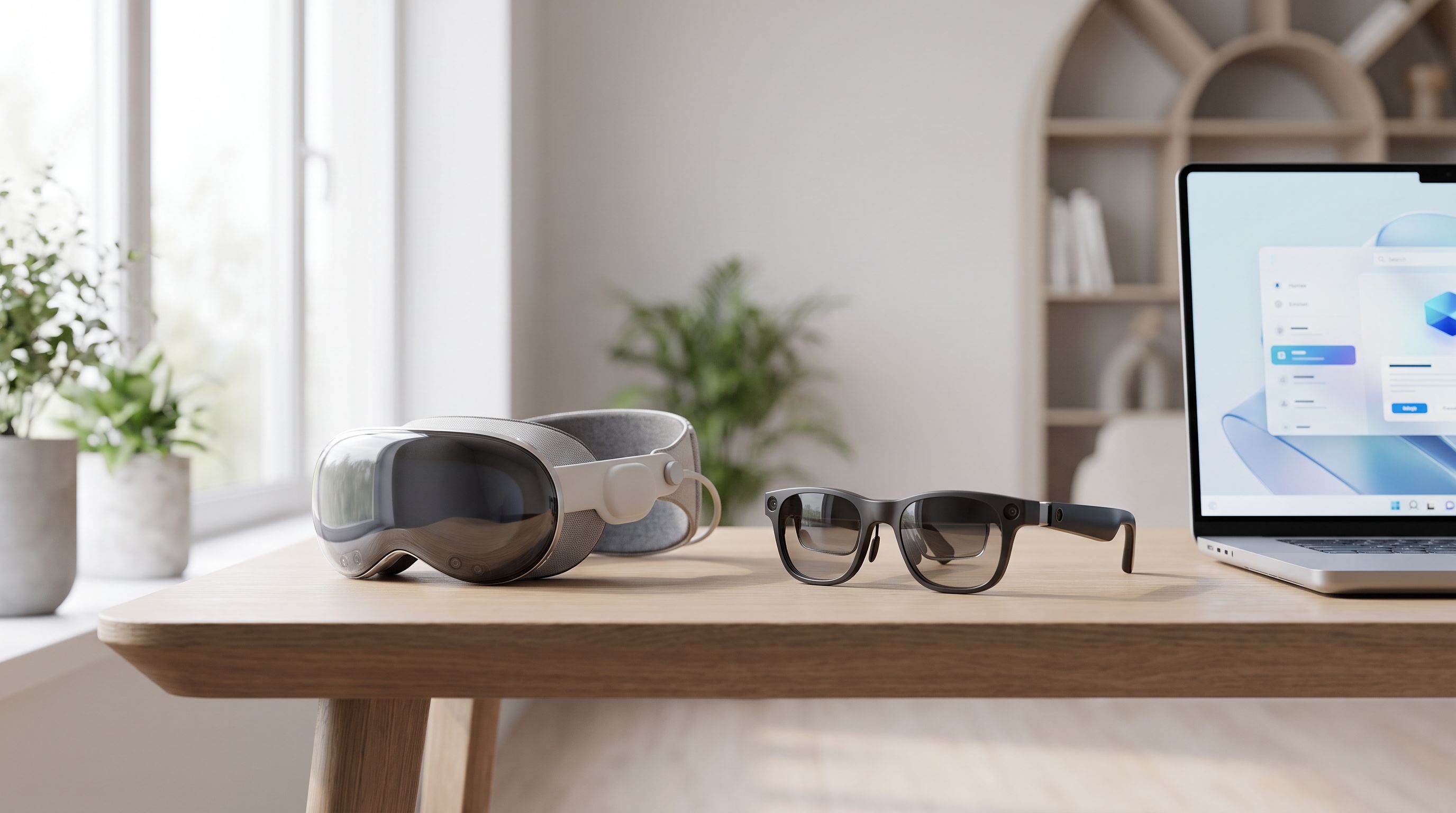
Apple set the fidelity ceiling. Vision Pro is, by near-universal reviewer consensus, the best passthrough and the best spatial video playback available, and its eye-and-pinch input is the most natural control scheme anyone has shipped. It is also heavy, expensive, and short on battery. Apple's own framing has drifted from "spatial computer" toward media and specialist workflows, and the addition of the M5 chip in the updated model was an iteration, not a reinvention.
Sony's PlayStation VR2 remains the tethered console option — great display hardware, thin first-party support since launch. Valve continues to operate in the enthusiast PC-VR lane. And a growing set of Android XR devices, built on Google's platform with Samsung's Galaxy XR as the flagship example, are pushing the "Vision Pro form factor, Android ecosystem" thesis.
Then there's the format that's winning on wrists and faces: Ray-Ban Meta smart glasses. No display in the standard model, which is exactly why they work. Camera, open-ear speakers, microphones, and an always-available AI assistant in a frame that passes as normal eyewear. Meta's Ray-Ban Display model adds a small monocular screen and a wristband controller — an explicit bet that the next step isn't more immersion, but less.
| Device class | Example shipping products | What it's genuinely good at | The honest limitation |
|---|---|---|---|
| Standalone MR headset | Meta Quest 3, Quest 3S | Games, fitness, immersive video, MR apps | Bulk; sessions measured in hours, not workdays |
| Premium spatial computer | Apple Vision Pro, Samsung Galaxy XR | Best-in-class passthrough, spatial photo/video | High price, weight, external battery |
| Tethered console VR | PlayStation VR2 | High-end VR gaming on a PS5 | Limited first-party release cadence |
| Display-free smart glasses | Ray-Ban Meta | All-day wear, capture, audio, voice AI | No visual overlay in the base model |
| Display glasses | Meta Ray-Ban Display, Xreal-style viewers | Glanceable info, virtual big screen | Narrow field of view; early software |
What it means if you're shopping today
The practical rule: buy for the job the hardware already does well, not the job it's promised to do in three years.
If you want mixed reality and you want it cheap, the Quest 3S is the entry point with no meaningful compromise on content access. If passthrough clarity matters — MR apps, using it in a lit room, reading anything — the Quest 3 is the version reviewers consistently prefer. Neither will replace your monitor for a workday, and you should buy them assuming they won't.
If your real goal is "I want technology to help me through the day without holding a phone," a headset is the wrong shape entirely. Ray-Ban Meta glasses are the closest thing to the ambient-computing promise that you can wear to lunch. They do less; you'll use them more.
And Vision Pro remains what it always was: the benchmark. If you already live in Apple's ecosystem, capture spatial video on an iPhone, and want the best personal-cinema and spatial-media experience that exists, it's defensible. As a laptop replacement, it isn't — and Apple's own messaging has stopped implying otherwise.
What to watch next
Three things worth tracking through 2026:
- Weight and optics, not resolution. The real unlock is sub-200g devices with usable displays. Watch what happens as pancake optics, micro-OLED and silicon-carbide waveguides get cheaper.
- On-device AI as the input method. The most interesting spatial products aren't the ones with the best graphics — they're the ones where the assistant sees what you see. That's the thread connecting Ray-Ban Meta, Android XR, and the "physical AI" framing analysts used heading into 2026.
- Spatial video going mainstream. CES 2026 coverage leaned heavily on VR180 and spatial capture. A format needs cameras, players and a reason to exist; two of the three are now in consumers' pockets.
The headset hype cycle ended. Spatial computing didn't — it just stopped pretending it was a laptop.
FAQ
Is a mixed-reality headset worth buying in 2026? For games, fitness and immersive video, yes — the Quest 3 and 3S are mature, well-supported products. As a general-purpose computer replacement, reviews and battery specs both say no.
What's the difference between Quest 3 and Quest 3S? Primarily optics and passthrough quality. The Quest 3 uses higher-end pancake lenses and better passthrough cameras; the 3S hits a lower price with older lens hardware. Both run the same content library.
Do smart glasses replace a headset? No — they're a different category. Ray-Ban Meta glasses have no immersive display; they're for capture, audio and voice AI. They complement a headset rather than replacing one.
Is spatial video actually useful, or a gimmick? It's real and shipping: iPhone 15 Pro and later can capture it, and Vision Pro and Quest can play it back. Whether it becomes a habit depends on how many people own playback hardware — which is still the bottleneck.
Our picks
Meta Quest 3S 128GB | Virtual Reality — VR Headset — Gorilla Tag Bundle
The cheapest genuine mixed-reality headset with color passthrough and a huge, mature app library.
Meta Quest 3 512GB | Virtual Reality — VR Headset — Gorilla Tag Bundle
Higher-resolution pancake optics and better passthrough than the 3S, still the default MR reference point.

Ray-ban | Meta Smart Glasses Wayfarer, Matte Black/Polarized Gradient Graphite, Regular (Renewed)
No display, but camera, open-ear audio and voice AI in a frame you'll leave on all day.
Meta Quest 3S 128GB | Virtual Reality — VR Headset — Gorilla Tag Bundle
Still the clearest demonstration of what high-fidelity passthrough and spatial video can look like.
Get the best tech deals in your inbox
Join the BytePlaza newsletter for hand-picked gadget deals and new buying guides. No spam, unsubscribe anytime.
Related reads
AI Companion Gadgets, Explained: Where the Market Really Is
AI pins, pendants and desk robots promised a phone-free future. Here's what actually shipped, what reviewers found, and which AI gadgets are worth buying now.
The Robot Vacuum Arms Race, Explained
Mopping, self-emptying docks, stair-climbing legs and literal robot arms: how home-cleaning robots got so capable, and what's actually worth buying now.
Home Robots in 2026: Are They Finally Actually Useful?
CES 2026 was packed with humanoid home robots. Here's what's actually shipping, what's still a concept, and which robots are genuinely worth buying right now.