AI Cameras in 2026: The End of Manual Photography?
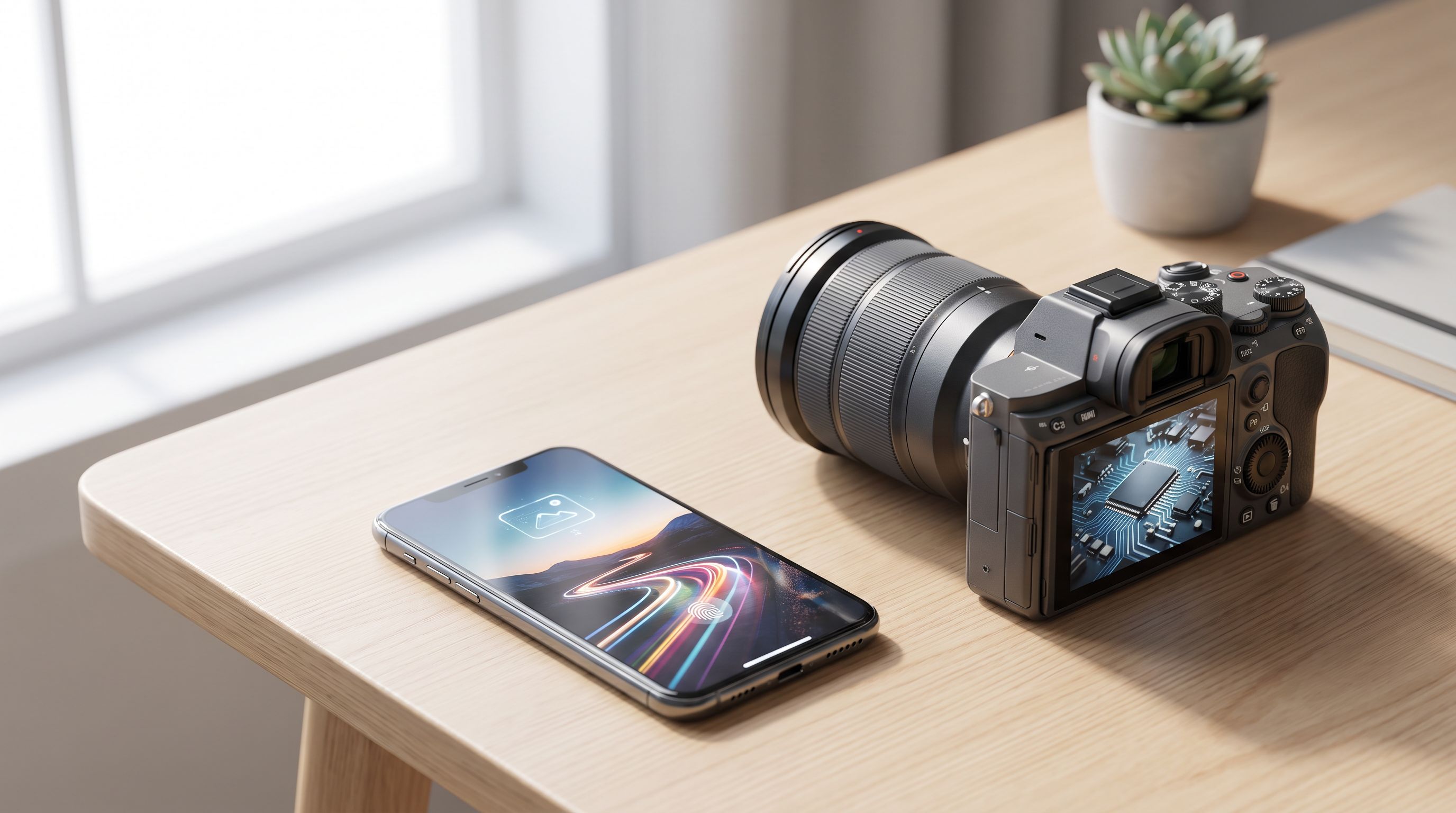
AI cameras are reshaping focus, editing and even the shutter press. Here's what's actually shipping in 2026 — and what it means if you're buying gear now.
Reader-supported: we may earn a commission from links on this page, at no extra cost to you. It never affects our picks. Learn more.
The shutter button is no longer the most important part of a camera
For about 180 years, taking a photograph meant making a sequence of physical decisions: aperture, shutter speed, focus, framing. In 2026, a growing share of those decisions is made by software — some of it before you press the button, much of it after. That shift has a name, computational photography, and it's now entering a second act in which machine learning doesn't just merge exposures but decides what the picture should look like.
The honest version of this story isn't "cameras are dead" or "AI replaces photographers." It's messier and more interesting: camera hardware has largely plateaued, as several industry commentators have argued in 2026 retrospectives, while the software layer around it is moving fast. Meanwhile, dedicated cameras are selling better than they have in years. Both things are true at once, and that tension is exactly what you're buying into if you pick up a camera today.
What's actually happening now
Three separate trends are getting blended together under the "AI camera" label, and separating them clarifies a lot.
First, AI inside the camera. This is the oldest strand and the least revolutionary. As photography commentators have pointed out, Canon shipped an autofocus mode literally branded "AI Focus" on the EOS 10 back in the film era — the acronym then stood for something closer to "artificial intelligence" as 1990s marketing used it. What's genuinely new is that modern subject-detection autofocus is trained on real neural networks running on-sensor silicon. Today's mirrorless bodies identify eyes, faces, birds, dogs, cars and motorcycles and hold focus on them through clutter. That's not a gimmick; on paper and in published reviews it's the single biggest usability jump in a decade.
Second, AI after the camera. This is where the disruption is real. Industry coverage in 2026 describes AI tools automating skin retouching, sky replacement and exposure correction at a quality that used to require a skilled retoucher. One widely cited comparison of manual versus AI editing workflows claims AI holds roughly 98% consistency across large batches, while human consistency reportedly drops 15–20% after about four hours of work. Treat those figures as vendor-adjacent rather than gospel, but the direction is unmistakable: the editing bottleneck in high-volume work — weddings, events, real estate, e-commerce — is being automated first.
Third, AI instead of the camera. Generative imagery means some pictures that once required a shoot now require a prompt. That mostly threatens stock and generic commercial illustration, not documentary, event or personal photography. The bigger side effect, as 2026 commentary keeps noting, is epistemic: it's getting harder to know what's real, which is why provenance standards like C2PA Content Credentials have moved from a niche initiative to something camera makers actively advertise.
Against all this, here's the counterintuitive data point: CIPA's 2026 forecasts project about 2.77 million fixed-lens camera shipments, a 13.6% increase over 2025 — which itself jumped 29.6%. A category everyone wrote off is growing. Dedicated cameras are becoming a deliberate choice rather than a default one.
The real players and what's shipping
The split in the market right now is roughly "AI-first" versus "optics-first," and both camps have credible products you can buy today.
On the AI-first side, smartphones remain the frontier. The Google Pixel 9 Pro is the clearest showcase: Best Take swaps faces between frames so nobody's blinking, Magic Editor moves and regenerates parts of a scene, and Add Me composites the photographer into a group shot. These are not enhancements of a captured moment; they're reconstructions of a moment that never quite existed. Apple's iPhone 16 Pro line pushes a different flavour — Camera Control, Photographic Styles that can be re-tuned after capture, and visual intelligence — while Samsung's Galaxy S25 Ultra leans on its Galaxy AI editing suite.
On the optics-first side, the mirrorless makers are using AI mostly to remove friction rather than to invent content. The Sony Alpha a7 IV's real-time subject recognition and the Canon EOS R6 Mark II's deep-learning Dual Pixel AF II both exist to help you nail the frame you actually intended. Nikon's Z-series expert bodies and OM System's computational modes (Live ND, in-camera focus stacking, handheld high-res) sit in the same bucket: algorithms in service of capture, not substitution for it.
 Closest you can buy today for AI subject tracking · Canon EOS R6 Mark II — Check price on Amazon →
Then there's the deliberate counterweight. The Fujifilm X100VI has been one of the hardest cameras in the world to buy since launch precisely because it offers the opposite proposition — a fixed lens, physical shutter-speed and aperture dials, and film simulations baked in so you can finish a picture without touching a slider.
 Best argument for staying manual · Fujifilm X100VI — Check price on Amazon →
| Approach | Representative gear | AI does… | You still control… |
|---|---|---|---|
| AI-first mobile | Google Pixel 9 Pro, iPhone 16 Pro | Scene reconstruction, generative edits, multi-frame fusion | Framing, timing, subject choice |
| AI-assisted mirrorless | Sony a7 IV, Canon EOS R6 Mark II | Subject detection, tracking, noise handling | Exposure, lens, depth of field, light |
| Deliberately manual | Fujifilm X100VI | Minimal; film sims are presets, not generation | Essentially everything |
What it means if you're shopping today
A few practical takeaways, with no hype attached.
Buy autofocus, not megapixels. The meaningful difference between a 2018 body and a 2026 one is usually subject detection and tracking, not resolution. If you shoot kids, pets, sports or events, that's where your money does real work.
Don't buy a camera to beat your phone at casual snapshots. You won't, in good light, on small screens. Buy one for the things phones structurally can't fake well: genuine shallow depth of field from fast glass, long reach, low-light performance from a big sensor, and the tactile act of shooting. The CIPA shipment growth suggests plenty of buyers have already reached that conclusion.
Assume your editing workflow will be AI-assisted whether you like it or not. Lightroom's Denoise, generative remove and adaptive masking are already standard-issue, and the "manual vs AI" debate in 2026 is less about quality than about where you want to spend your hours.
If authenticity is part of your work, ask about Content Credentials. Provenance metadata support varies by brand and firmware; it's worth checking before you commit to a system.
What to watch next
Watch for on-device generative editing inside cameras themselves — the obvious next step, and one that will force brands to decide whether they're selling evidence or art. Watch whether subject-detection AF becomes trainable by the user for niche subjects. Watch provenance signing spreading from flagship bodies down the range, especially as AI-generated imagery saturates the open web. And watch the fixed-lens compact revival: if those CIPA forecasts hold, the industry's growth is coming from people who want one camera, one lens and fewer decisions — the analogue response to infinite software options.
The end of manual photography? No. The end of manual photography as the default path to a technically good image? That happened a while ago. What's left is a choice about which parts of the process you actually want to do yourself.
FAQ
Is AI making camera skills obsolete? No. AI handles execution — focus, noise, retouching consistency. It doesn't choose the subject, the moment or the light, which is where most of the difference between pictures still lives.
Should I just use my phone? For most everyday photos, yes. Dedicated cameras win on fast lenses, telephoto reach, low light and handling. The Pixel 9 Pro shows how far computational imaging goes; the Sony a7 IV shows what optics still do better.
Are AI edits detectable? Increasingly, yes — via C2PA Content Credentials, which record capture and edit history. Support is uneven across brands and apps, so verify before relying on it.
Is now a bad time to buy a camera? Not especially. Hardware has plateaued, which means today's bodies won't feel obsolete quickly. Most upgrades arriving now are firmware-level AF and processing improvements.
Our picks
Sony Alpha a7 IV Full-Frame Mirrorless Camera
Real-time subject recognition AF for humans, animals and birds, with full manual exposure still front and centre.
Canon EOS R6 Mark II 24.2MP Full-Frame Mirrorless Camera (5666C002) Bundle
Deep-learning Dual Pixel AF II tracks people, animals and vehicles while you keep dials and rings.
Google Pixel 9 Pro
Showcases where AI-first imaging is going: generative edits, Best Take and heavy on-device processing.
Fujifilm X100VI Point & Shoot Camera (Silver) & Case (16821822) Bundle
Fixed 40MP lens, physical dials and film simulations — a deliberate counterweight to automation.
Get the best tech deals in your inbox
Join the BytePlaza newsletter for hand-picked gadget deals and new buying guides. No spam, unsubscribe anytime.
Related reads
Ambient Computing 2026: Why Sensors Beat Screens
Ambient computing in 2026 explained: presence sensors, always-listening hubs, and local AI. What actually works today, what to skip, and the gear to start with.
Smart Glasses in 2026: The Road to All-Day AR
Smart glasses in 2026 split into audio-first AI, HUD, and viewer categories. Here's what today's glasses actually do, who's shipping, and what's next.

Foldables, Rollables, Tri-Folds: Where Phones Go in 2026
Tri-folds are shipping, rollables are rumored, and book-style foldables finally got good. Here's the real state of the phone form-factor race in 2026.