Smart Glasses in 2026: The Road to All-Day AR
Smart glasses in 2026 split into audio-first AI, HUD, and viewer categories. Here's what today's glasses actually do, who's shipping, and what's next.
Reader-supported: we may earn a commission from links on this page, at no extra cost to you. It never affects our picks. Learn more.
For about a decade, "smart glasses" meant a prototype on a conference stage and a promise that real augmented reality was two years out. That script finally changed. In 2026, you can walk into a store, buy glasses that look like glasses, and use them all day — but the thing most people picture when they hear "AR," a persistent digital layer painted over the world, is still not what's in the box.
The interesting part of 2026 isn't the gap between hype and reality. It's how quickly the category has fragmented into three very different products that all happen to sit on your nose. Understanding that split is the difference between buying something you wear every day and buying something that lives in a drawer by March.
What's actually happening now
The headline number is growth, not capability. IDC's tracking, as reported in industry coverage, puts smart glasses shipments up roughly 167% year over year, with a forecast of about 13.6 million units for the full year and roughly 27.3 million projected for the following year. That's a real market now — small next to smartphones, but no longer a rounding error.
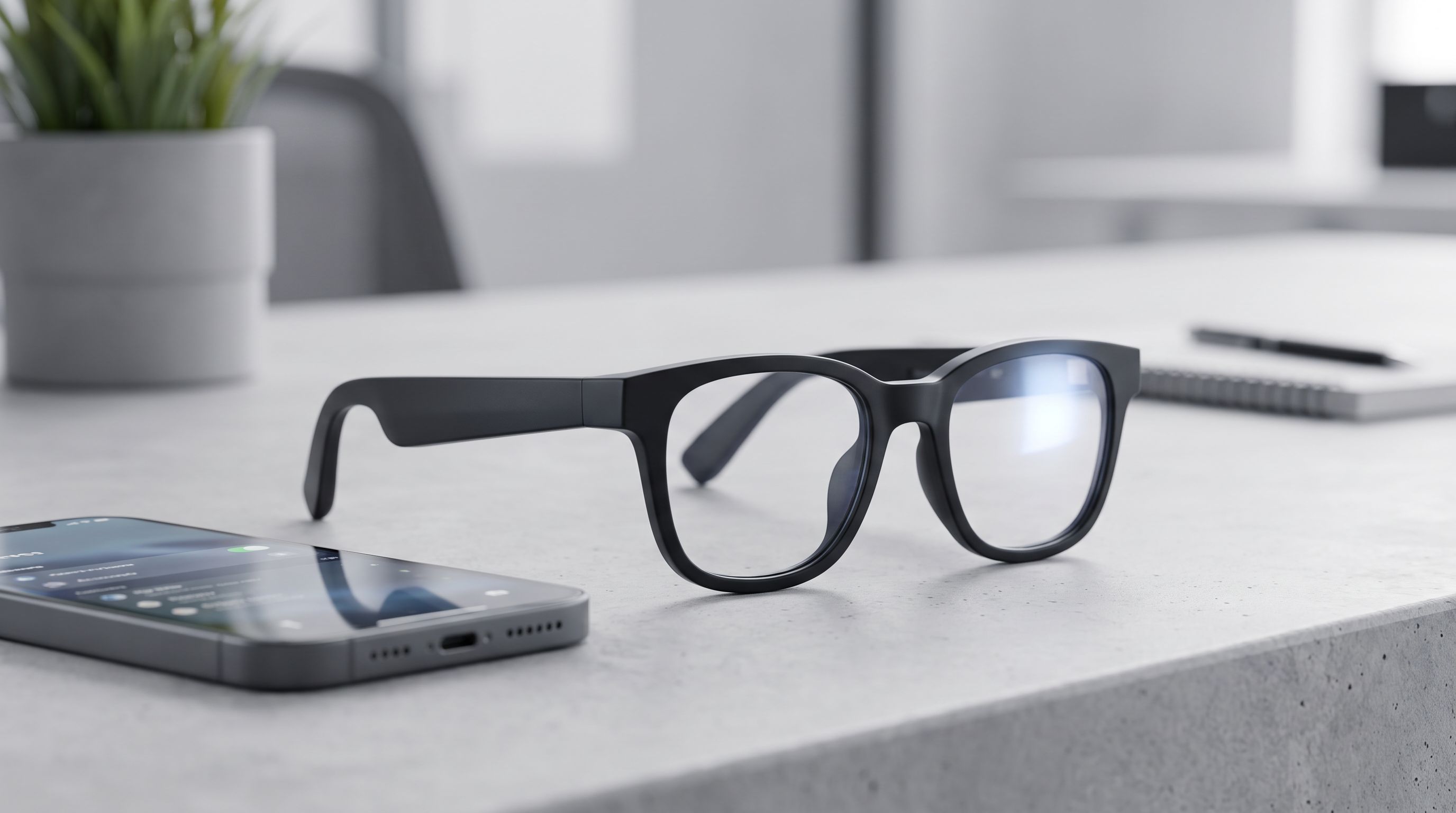
What's driving it isn't AR. It's AI plus cameras plus speakers in a frame light enough to forget. The breakthrough product category of the last two years has been audio-first AI glasses: no display at all, just microphones, open-ear speakers, a camera, and a voice assistant that can describe what you're looking at or translate a conversation. They're cheap to build, they have acceptable battery life, and they don't require anyone to solve the brutal optical physics of waveguides.
Industry roundups now sort the category into three practical buckets, and that framing is the most useful thing to take into 2026:
| Category | What it does | Trade-off | Example |
|---|---|---|---|
| Audio-first AI glasses | Voice assistant, camera capture, open-ear audio; some are camera-free | No visual output at all | Ray-Ban Meta (Gen 2), Amazon Echo Frames (3rd Gen) |
| HUD / display glasses | Small monocular or heads-up display for notifications, directions, captions | Limited screen area, higher price, heavier | Meta Ray-Ban Display |
| Display viewers ("AR glasses") | Large virtual screen from a connected device | Tethered, not world-aware, not for walking around | XREAL One |
 Closest you can buy today · Ray-Ban Meta (Gen 2) Smart Glasses — Check price on Amazon →
Those are three different products with three different reasons to exist. Lumping them together is how buyers end up disappointed.
The real players and what's shipping
Meta remains the gravitational center. The Ray-Ban Meta Gen 2 glasses are widely treated in 2026 roundups as the default recommendation for AI-only use — the thing you buy if you want hands-free capture, music, calls, and a voice assistant in a frame people won't stare at. There's no display, and that's deliberate; the design budget went into weight, looks, and battery instead.
Above that sits the Meta Ray-Ban Display, Meta's HUD-equipped model, which adds a small in-lens display paired with a wrist-worn neural band input device. It's the product that proves the category's next step is real, and also the product that shows what that step costs: more weight, more money, more charging anxiety. Reviews and roundups consistently position it as the AR-display option rather than the all-day default.
Then there's the viewer lane, where XREAL has been the most consistent shipper. The XREAL One line puts on-board processing in the glasses themselves so a virtual screen stays anchored in place rather than swimming with your head — great for watching something on a plane or extending a laptop, not a tool for navigating a city. CES 2026 coverage highlighted this lane getting louder, with a ROG-branded XREAL R1 gaming variant among the show's standouts, alongside entries from TCL and Even Realities, plus niche plays like Povec Optics sports sunglasses.
Beyond that, the pipeline is thick with announcements that have not shipped. Community trackers and release calendars list things like the EIO AR-1 Pro, floated for late 2026, as among the most-discussed combined AI-and-AR designs. Treat those timelines as intentions, not dates. The history of this category is one of slipped quarters.
What it means if you're shopping today
The practical advice is unglamorous: buy for the category, not the future.
If you want something you'll genuinely wear every day, the audio-first lane is where the hardware is mature. The Ray-Ban Meta Gen 2 is the reference point — normal-looking frames, camera, assistant, open-ear audio. If the always-on lens camera is a dealbreaker for you or the people around you, camera-free alternatives exist; the Amazon Echo Frames (3rd Gen) are the simplest, taking the audio-and-assistant part and leaving the camera out entirely.
If what you actually want is a big screen in a small bag, you want a viewer, and XREAL One is the most established answer. On paper and in reviews it's a display accessory for a phone, laptop, or console — spatially stabilized, but it does not understand your room, and nobody should buy one expecting navigation arrows on the sidewalk.
And if you want a display on your face that reacts to the world, you're buying a first-generation product. Meta Ray-Ban Display is the one to look at, with the honest caveat that HUD glasses in 2026 are about glanceable information — messages, directions, live captions — not immersive overlays. Coverage of the current crop emphasizes exactly that: live translation, hands-free AI, and simple mapped cues.
One more buying note that gets overlooked: prescription support and frame fit matter more than feature lists. Glasses you can't see through are useless, no matter what chip is inside.
What to watch next
Three things will decide whether 2026's momentum becomes an actual platform.
Optics and weight. Full-color, wide field-of-view waveguides at glasses weight remain the hard problem. Every shipping HUD today is a compromise on field of view, brightness, or both. Watch for displays that stay readable outdoors without ballooning power draw.
Input. Voice is awkward in public and touch bars are clumsy. Meta's neural wristband is the most serious commercial attempt at solving this, and whether rivals copy the wrist-based approach or find another path will shape the next generation.
Battery and the phone relationship. Audio-first glasses get through a day because they do very little. Add a display and that math changes. Expect more designs that lean on a phone or a puck for compute.
Price compression. The volume forecast implies cheaper hardware. More Chinese entrants and more CES-stage startups means the $200–$400 AI-glasses tier gets crowded fast, which is good for buyers and brutal for margins.
The realistic read: all-day AR — a lightweight pair of glasses that understands your environment and renders convincing graphics into it from breakfast to bedtime — is not a 2026 product. What 2026 delivered instead is a credible, wearable, genuinely useful stepping stone. That's less exciting than the demo reels. It's also, for once, something you can actually buy.
FAQ
Are smart glasses in 2026 true AR? Mostly no. The best-selling models have no display at all. HUD models like Meta Ray-Ban Display show glanceable information rather than world-anchored 3D graphics, and viewer glasses like XREAL One project a screen rather than understanding your surroundings.
Do I need a phone? In nearly all cases, yes. AI glasses pair with a phone for connectivity and processing, and display viewers typically connect to a phone, laptop, or console.
What about privacy? Camera-equipped glasses use indicator lights, but social discomfort is real. Camera-free options such as Amazon Echo Frames exist specifically for people who want the assistant without the lens camera.
Should I wait for the glasses announced for late 2026? Only if you're comfortable waiting indefinitely. Models like the EIO AR-1 Pro have been discussed with late-2026 windows, but announced timelines in this category slip often.
Our picks
Meta Ray-Ban (Gen 2) Wayfarer Smart AI Glasses, Matte Black, Clear Lenses
The default AI-and-camera glasses: no display, but the most polished everyday package.

XREAL One Pro AR Glasses with X1 Chip, 171" 120Hz FHD Display, Native 3 DoF
A tethered display viewer with on-board processing that pins a huge screen in front of you.
Amazon Echo Frames (3rd Gen)
Camera-free open-ear audio glasses for people who want assistant access without a lens camera.
Get the best tech deals in your inbox
Join the BytePlaza newsletter for hand-picked gadget deals and new buying guides. No spam, unsubscribe anytime.
Related reads
Spatial Computing, Explained: Life After Headset Hype
Mixed-reality headsets didn't replace your laptop. Here's what spatial computing is actually good for in 2026 — and which devices are genuinely worth it.
AI Companion Gadgets, Explained: Where the Market Really Is
AI pins, pendants and desk robots promised a phone-free future. Here's what actually shipped, what reviewers found, and which AI gadgets are worth buying now.
Best Smart Glasses 2026: Ray-Ban Meta and Rivals
The best smart glasses in 2026, compared: Ray-Ban Meta, Oakley Meta HSTN, Amazon Echo Frames and Solos AirGo. Audio, cameras, AI, privacy and battery explained.