AI Companion Gadgets, Explained: Where the Market Really Is
AI pins, pendants and desk robots promised a phone-free future. Here's what actually shipped, what reviewers found, and which AI gadgets are worth buying now.
Reader-supported: we may earn a commission from links on this page, at no extra cost to you. It never affects our picks. Learn more.
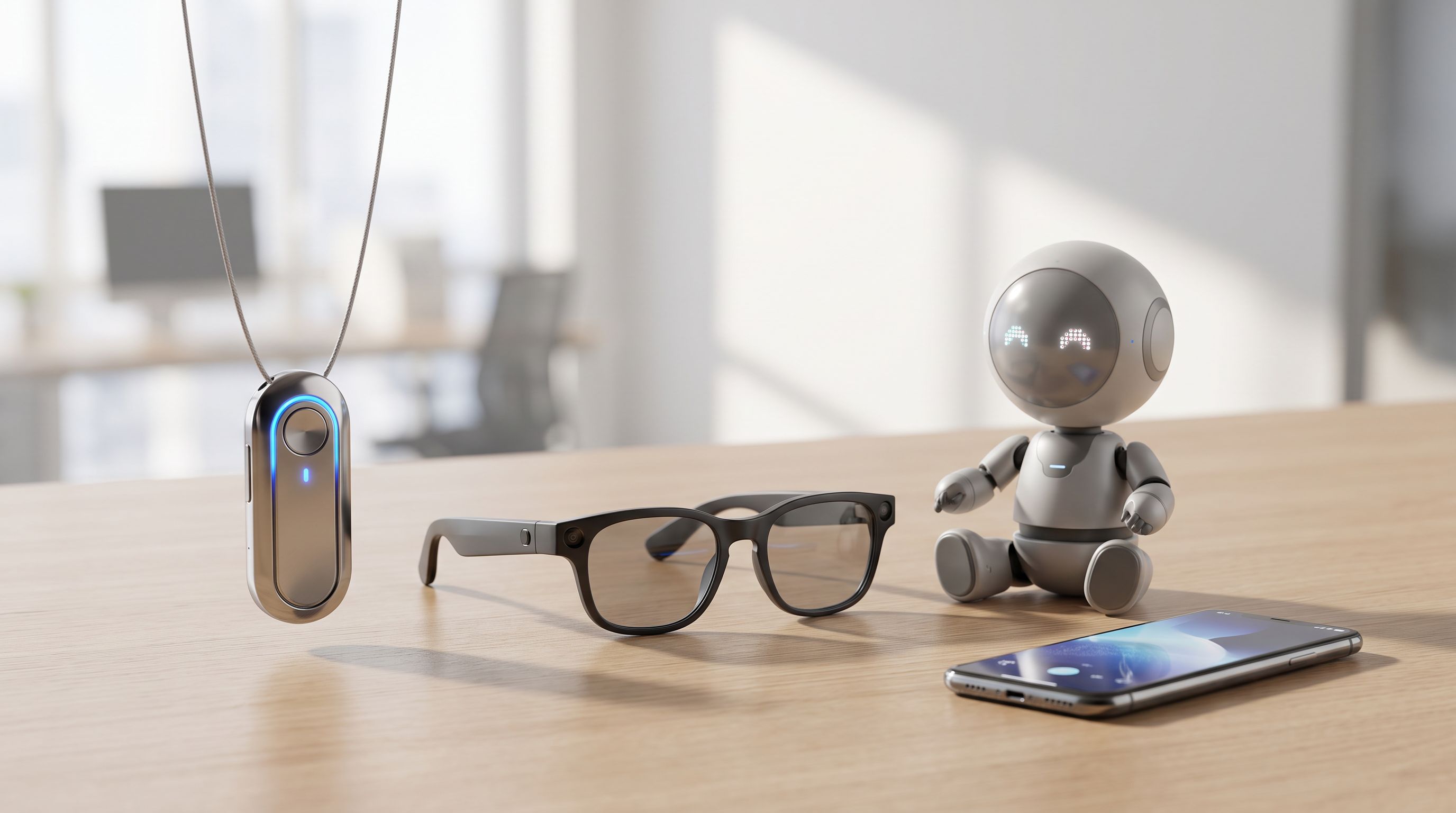
Two years ago, the pitch was irresistible: a small, screenless device you clip to your shirt that listens, sees, remembers, and answers — and slowly makes your phone irrelevant. Investors loved it. Keynotes loved it. Then the reviews landed, and the category ran into a wall it still hasn't climbed.
The interesting part is what happened next. The "AI companion" idea didn't die — it migrated. It moved into glasses, into note-taking pendants, into smart displays and rings and robot vacuums. The dream of a standalone AI friend is still mostly a demo. The useful pieces of it are already on shelves, wearing different clothes.
What's Actually Happening Now
The first wave of dedicated AI hardware set the tone. The Humane AI Pin launched in 2024 to some of the harshest reviews in modern gadget history — critics hammered its latency, heat, and the projected laser display — and Humane was acquired by HP in 2025, with the Pin's cloud services shut down. Rabbit's r1, the other headline device of that wave, shipped early and reviewers widely reported that its flagship "large action model" features weren't there at launch; the company has kept updating it since, but it never became the phone replacement the launch video implied.
The lesson wasn't "AI hardware is bad." It was more specific: a new device has to beat the phone in your pocket at something, and general-purpose assistance isn't that something. Cloud-round-trip latency, battery constraints, and the absence of apps made standalone AI gadgets slower and dumber versions of what people already carried.
So the market rerouted. Instead of replacing the phone, the successful devices in 2025–2026 attach to it. They handle one job — capture, glanceable context, ambient sensing, hands-free vision — and let the phone do the heavy lifting. Forbes Vetted's roundup of AI wearables, for example, evaluates devices like Bee and Plaud not as phone killers but as recall and note-taking tools. That reframing is the entire story of the category right now.
Meanwhile, CES 2026 coverage points to a second front: AI robots and "companions" as physical objects — desk bots, home robots, and pet-like devices. Reporting ahead of the show flagged at least one new AI companion debut alongside a broad push from robotics companies. Those are announcements, not shipping products, and the gap between the two is exactly where this category keeps stumbling.
The Real Players and What's Actually Shipping
Four distinct groups are competing for the same "AI thing that isn't your phone" slot.
Smart glasses are the clear winner so far. Ray-Ban Meta Smart Glasses put a camera, open-ear speakers, and Meta AI into a frame that looks like eyewear rather than tech. Meta has publicly described strong demand and expanded the line with the Oakley Meta HSTN and, in late 2025, the display-equipped Meta Ray-Ban Display with a neural wristband. Glasses solve two problems the pin never did: they sit where your eyes and ears already are, and they're socially legible — people understand glasses.
Capture pendants and recorders are the pragmatic survivors. Plaud's NotePin and Plaud Note are built around recording, transcribing and summarizing meetings and conversations, and they've found a real professional audience. Bee, an inexpensive always-listening wearable, was acquired by Amazon in 2025 — a signal that big platforms see value in continuous personal context, even if they haven't productized it broadly yet. Limitless (formerly Rewind) sells a similar pendant. None of these promise to replace your phone; they promise you'll remember what was said.
Desk and home robots are the most hyped and least proven. Samsung's Ballie has been demoed repeatedly since 2020 and shown with Google Gemini integration, but a consumer launch has slipped more than once. LG has shown its AI home hub concept. Amazon's Astro remains limited-availability and was discontinued for business use. Meanwhile, actual robots people buy are boring and excellent: robot vacuums from Roborock, Dreame and Ecovacs now ship with obstacle-recognition AI and, in some 2025 flagships, small robotic arms for picking up socks. That's the real state of home robotics — it cleans floors.
Ambient sensors quietly do the most work. The Oura Ring 4 and Whoop-style bands don't talk to you; they build a model of your body and surface it as readable insight. There's no assistant persona, no wake word, and correspondingly few disappointed reviews.
 Best ambient AI wearable · Oura Ring 4 — Check price on Amazon →
| Category | Shipping examples | What it's genuinely good at | The catch |
|---|---|---|---|
| Smart glasses | Ray-Ban Meta, Oakley Meta HSTN | Hands-free capture, audio, visual AI queries | Battery life, privacy optics, prescription cost |
| Capture wearables | Plaud NotePin, Limitless Pendant | Meeting recall, transcripts, summaries | Subscriptions; consent and recording laws |
| Smart displays | Echo Show, Google Nest Hub | Voice control, timers, cameras, home hub | Not mobile; assistant quality varies |
| Desk/home robots | Mostly demos; robot vacuums are real | Floor cleaning, mapping | "Companion" robots largely unreleased |
| Ambient sensors | Oura Ring 4, fitness wearables | Sleep, recovery, long-term trends | Insight, not interaction |
 Best available now for capture · Plaud NotePin — Check price on Amazon →
What It Means If You're Shopping Today
The practical translation is simple: buy the function, not the future.
If you want the closest working version of the AI-companion fantasy, it's glasses. The Ray-Ban Meta Smart Glasses deliver voice queries, "look and ask" visual questions, calls and music from a device you'll actually wear outside — which is more than any pin managed. Reviews consistently praise the wearability and audio while noting battery life as the ceiling.
If the appeal was really memory — never losing what was said in a meeting or a doctor's appointment — a dedicated recorder like the Plaud NotePin is the honest version of that product. It does one job and reviewers generally judge it on transcription quality rather than sci-fi promises. Check your local recording-consent rules before you clip it on.
If you pictured a chirpy little robot on your desk, the unglamorous truth is that an Amazon Echo Show 8 already covers most of what a desk bot would do: voice assistant, video calls, smart-home dashboard, camera. It just doesn't have wheels or a face. And if you want AI that improves your life without demanding conversation, an Oura Ring 4 is the category's quiet overachiever.
 The desk bot that already exists · Amazon Echo Show 8 — Check price on Amazon →
What to avoid: paying today for a subscription tied to a startup's cloud. The Humane shutdown is the cautionary tale — when the servers go, the hardware goes with it. Prefer devices from companies with a plausible ten-year existence, or ones that retain some function offline.
What to Watch Next
Three things will decide whether this category graduates.
On-device models. Qualcomm's Snapdragon platforms and Apple's on-device Apple Intelligence stack are pushing inference off the cloud. Latency was the number-one complaint about the first AI gadgets; local models fix it structurally.
Display glasses. Meta's Ray-Ban Display and Xreal/Rokid-style AR glasses are testing whether people want information in their field of view. If a lightweight display plus a reliable input method (wristband, voice, gesture) clicks, the pendant category becomes redundant.
Robots that do a physical task. Watch whether Samsung's Ballie actually ships, and whether robot vacuum arms evolve into genuine tidying. A robot that talks is a novelty; a robot that picks things up is a product.
The honest summary: AI companion hardware is real, growing, and useful — just not in the shape the 2024 keynotes promised. Buy what solves a problem you have this week, and let someone else fund the demo videos.
FAQ
Can I still buy a Humane AI Pin? No. Humane's assets were acquired by HP in 2025 and the AI Pin's cloud services were discontinued, which disabled most of the device's functionality.
Are smart glasses better than a pendant? For most people, based on reviews and sales signals, yes — glasses sit near your eyes and ears, offer a camera, and look normal. Pendants win only if your specific need is discreet, all-day audio capture.
Do these devices need a subscription? Often. Recording and transcription wearables commonly gate advanced summaries behind paid tiers, and health wearables like Oura use a membership model. Check the recurring cost before the sticker price.
Is there a real "desk robot" I can buy? Not a mainstream one. Companion robots remain largely at the demo and CES-announcement stage; the robots consumers actually buy today are vacuums and mops.
Is it legal to record conversations with an AI pendant? It depends where you live. Some jurisdictions require all-party consent. Treat continuous recording as something to disclose, not assume.
Our picks

Meta Ray-Ban (Gen 2) Wayfarer Smart AI Glasses, Matte Black, Clear Lenses
Camera, open-ear audio and a voice assistant in a frame people actually wear every day.
Plaud NotePin S Wearable AI Voice Recorder, Transcribe & Summarize, Black | AI Note Taker for Meetings Interviews, Professionals, Teams, 112 Languages, App Control, Find My, 4 Accessories
A wearable recorder with AI transcription and summaries — the pendant idea, minus the moonshot.
Amazon Echo Show 8 (newest model), Vibrant HD 8.7" display with spatial audio, Designed for Alexa+, Graphite
Always-on screen, Alexa voice control and smart home hub duties for a fraction of a robot's price.
OURA Ring 4 Smart Ring - Silver - Size 9 | Sleep, Activity, Women’s Health, AI Advisor, Up to 8 Days of Battery Life, Size Before You Buy, Android & iOS Compatible
Sensor-driven health insights you actually read, with no screen and no talking assistant.
Get the best tech deals in your inbox
Join the BytePlaza newsletter for hand-picked gadget deals and new buying guides. No spam, unsubscribe anytime.
Related reads

On-Device AI in 2026: Why the Cloud Is Losing Ground
On-device AI is reshaping phones, PCs and wearables in 2026. Here's what actually runs locally, which shipping gadgets do it, and what it means for buyers now.
Smart Glasses in 2026: The Road to All-Day AR
Smart glasses in 2026 split into audio-first AI, HUD, and viewer categories. Here's what today's glasses actually do, who's shipping, and what's next.
Spatial Computing, Explained: Life After Headset Hype
Mixed-reality headsets didn't replace your laptop. Here's what spatial computing is actually good for in 2026 — and which devices are genuinely worth it.