On-Device AI in 2026: Why the Cloud Is Losing Ground
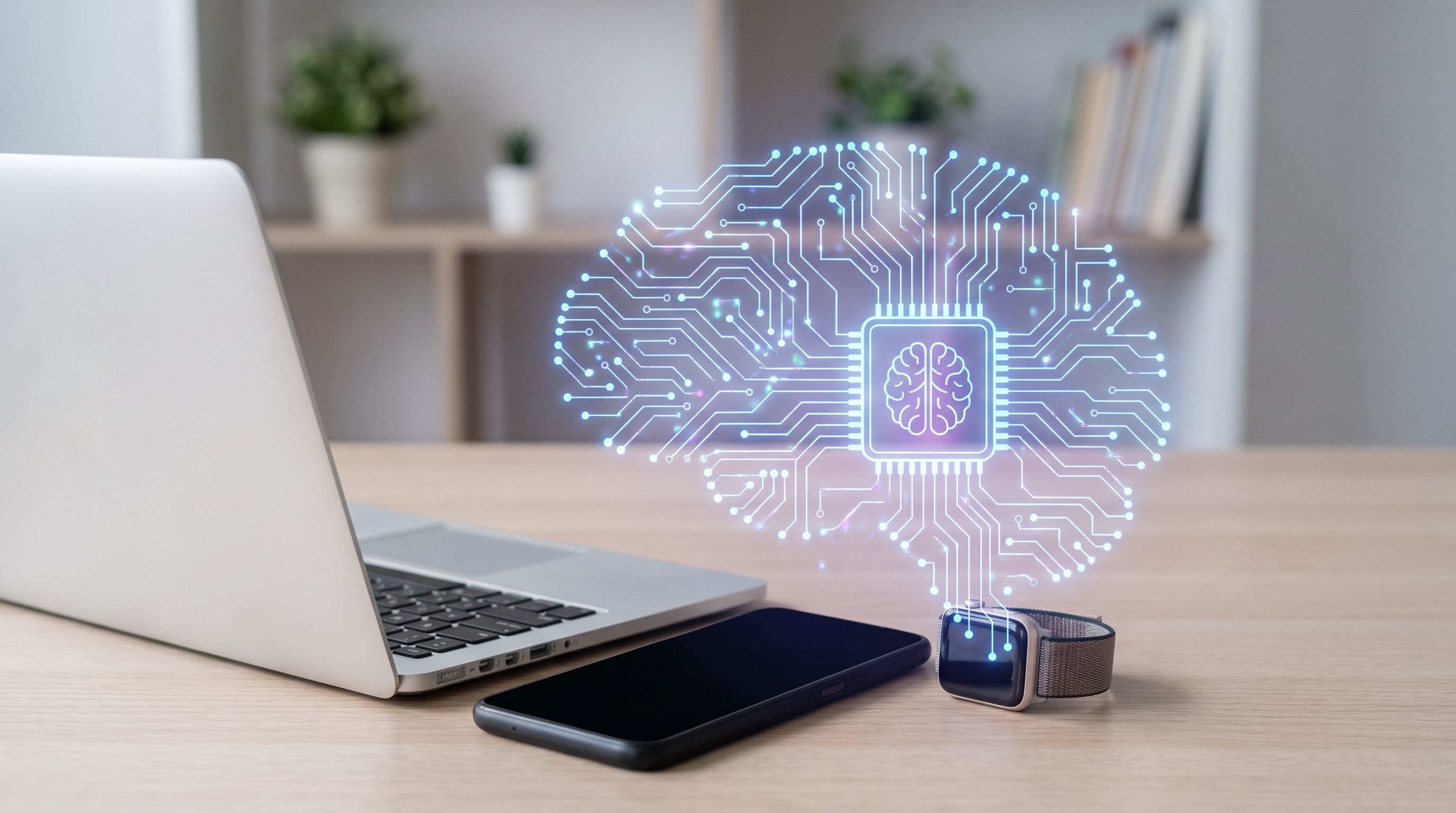
On-device AI is reshaping phones, PCs and wearables in 2026. Here's what actually runs locally, which shipping gadgets do it, and what it means for buyers now.
Reader-supported: we may earn a commission from links on this page, at no extra cost to you. It never affects our picks. Learn more.
For about three years, "AI gadget" effectively meant "a microphone with a subscription." You spoke, your words went to a data center, a model answered, and the answer came back. The hardware was almost incidental. That model is now under real pressure — not because the cloud stopped working, but because the economics, the latency and the privacy math all point the same direction.
The shift has a name in the industry: on-device AI, or edge AI. And unlike most future-tech narratives, this one is unusually easy to verify, because the silicon is already in products you can buy. The question for anyone shopping in 2026 isn't whether local AI is coming. It's how much of it any given device actually does — and how honest the manufacturer is about where your data goes.
What's Actually Happening Now
Three forces converged.
The first is cost. Running a large model in the cloud means somebody pays for GPU time on every single query. On-device inference shifts that compute to hardware the customer already bought. As one recent analysis put it bluntly, there's no need to pay a big data center operator — which is why even companies with enormous cloud businesses are pushing work to the edge where they can.
The second is latency and reliability. A local model answers without a round trip, and it keeps working on a plane, in a basement parking garage, or when your ISP has a bad morning. For anything interactive — live transcription, translation, camera effects — a few hundred milliseconds of network delay is the difference between "magic" and "annoying."
The third is privacy and regulation. Keeping audio, photos and health data on the device sidesteps a large category of compliance and PR problems at once. That's the main reason on-device processing has become a selling point in healthcare-adjacent and enterprise contexts, not just a consumer talking point.
The practical result is hybrid: small models run locally, big models get called remotely when the task genuinely needs them. Nobody serious is claiming a phone will run a frontier-scale model offline. The interesting engineering is in the routing — deciding what stays home.
The Real Players and What's Actually Shipping
The clearest implementations today live in phones and PCs, not in standalone AI pendants.
Apple's approach is the most explicitly architectural. Apple Intelligence, introduced with the iPhone 16 generation, runs a meaningful chunk of its features on the device's Neural Engine, and routes heavier requests to what Apple calls Private Cloud Compute — Apple silicon servers it says don't retain user data. Whatever you think of the marketing, it's a public commitment to a split-brain design, and the Apple iPhone 16 Pro is where that design shipped first in volume.
 Closest you can buy today · Apple iPhone 16 Pro — Check price on Amazon →
Google's version is Gemini Nano, the compact model that runs on Tensor-series silicon. On the Google Pixel 9 Pro, Nano powers things like on-device summarization and call-handling features, with larger Gemini models in the cloud for anything more demanding. Google has also been pushing Nano into Android more broadly through AICore, which is the part that matters long-term: it makes local inference a platform service rather than a flagship exclusive.
 Best on-device AI showcase · Google Pixel 9 Pro — Check price on Amazon →
Samsung took the most consumer-legible route. Galaxy AI on devices like the Samsung Galaxy S25 Ultra includes a setting that restricts supported features to on-device processing only. It's a toggle, not a philosophy, and some features simply stop working when you flip it — but it's one of the few places where a buyer can directly observe the local/cloud boundary instead of trusting a diagram.
 Hybrid AI done openly · Samsung Galaxy S25 Ultra — Check price on Amazon →
On the PC side, Microsoft drew a hard line with Copilot+ PCs: a neural processing unit rated at 40+ TOPS is the entry requirement, which is why the category launched on Snapdragon X Elite machines like the Microsoft Surface Laptop before Intel and AMD parts caught up. Features such as Live Captions with translation and the much-debated Recall were built around local inference. Recall's rocky rollout is itself the cautionary tale here: "it's on your device" is necessary for trust, not sufficient.
Then there's the standalone AI gadget category — pendants, pins, recorders, companion devices. Coverage through 2025 and into this holiday cycle describes a wave of these racing to shelves, and the wearable segment has broadened from simple voice recorders into devices that summarize and organize what they hear. But the honest assessment from reviewers has been consistent: most of these are thin clients. The microphone is local; the intelligence is rented. Some do run wake-word detection or basic audio processing on-board, which is real but modest.
| Category | Representative shipping device | What runs locally (per vendor claims) | What still needs the cloud |
|---|---|---|---|
| Flagship phone | Apple iPhone 16 Pro | Many Apple Intelligence tasks on the Neural Engine | Complex requests via Private Cloud Compute |
| Android flagship | Google Pixel 9 Pro | Gemini Nano summarization, call features | Full Gemini models for heavy reasoning |
| Android, user-controlled | Samsung Galaxy S25 Ultra | Supported Galaxy AI features with on-device toggle | Features disabled when toggle is on |
| Windows laptop | Copilot+ PC (Snapdragon X Elite) | NPU features: live translation, image tools | Web-grounded Copilot answers |
| Standalone AI wearable | Various pendants/recorders | Typically wake-word and audio capture | Transcription, summarization, Q&A |
What It Means If You're Shopping Today
A few grounded takeaways.
Buy the platform, not the gadget. The devices doing the most real local AI are things you were likely buying anyway — a phone, a laptop. A $200 pendant that needs a subscription and a signal is a harder case to make when the phone in your pocket already has a neural engine and a model running on it.
Treat the NPU spec as a floor, not a feature. Microsoft's 40 TOPS requirement is useful precisely because it's a published threshold. On paper, machines below it simply won't get the Copilot+ feature set. That's the rare case where a number on a spec sheet maps to a concrete capability difference.
Assume hybrid unless told otherwise. If a product markets itself as "AI-powered" without specifying what runs where, the safe assumption is that it's cloud-dependent. Ask the two practical questions: does it work in airplane mode, and is there a subscription? Those answers reveal the architecture faster than any white paper.
Be skeptical of the subscription math. Reviewers tracking this category have been pointed about how much money gets spent on hyped AI hardware that duplicates phone features. Local AI is partly a cost story for manufacturers; it should eventually be a cost story for you too, in the form of fewer monthly fees. Where the fee persists, something is still running on someone else's server.
What to Watch Next
Watch memory, not just TOPS. The real constraint on local models is RAM and memory bandwidth, which is why base-model RAM has been creeping up across phones and laptops. Expect that to keep climbing.
Watch for on-device toggles becoming standard. Samsung's switch is the template. If regulators or competitive pressure make that disclosure normal, buyers get a genuine way to compare claims.
Watch the smart home. Local voice processing in hubs and cameras removes the most uncomfortable part of always-listening hardware. The direction of travel in that category — toward local wake-word and local video analysis — is one of the more consequential applications, and it's less glamorous than pendants.
And watch what fails. The standalone AI gadget wave is in its expensive learning phase. Some of it will consolidate into phone features; some will find narrow, genuinely useful niches. The silicon trend underneath it, though, isn't speculative — it's already shipping.
FAQ
Does on-device AI mean my data never leaves the device? Not automatically. Most mainstream implementations are hybrid: small tasks local, complex ones routed to servers. Apple discloses this via Private Cloud Compute; Samsung exposes it as a toggle. Read the specifics per feature.
Is local AI less capable than cloud AI? For now, generally yes on raw capability. Compact models like Gemini Nano are tuned for summarization, rewriting and classification rather than deep reasoning. The trade is speed, offline function and privacy.
Do I need a Copilot+ PC? Only if you want the NPU-gated Windows features. The 40+ TOPS requirement is a real gate, but plenty of AI work still happens in the browser and the cloud on ordinary laptops.
Are standalone AI wearables worth it yet? Based on reviews across 2025 and this cycle, most still depend heavily on the cloud and on subscriptions. They're interesting, but they're not yet the clearest expression of the on-device shift — phones and PCs are.
Our picks
Apple iPhone 16 Pro, 128GB, Black Titanium - Unlocked (Renewed)
Apple Intelligence runs a large share of its models on-device thanks to the A18 Pro Neural Engine.
Google Pixel 9 Pro, 128GB, Obsidian - Unlocked (Renewed)
Tensor G4 runs Gemini Nano locally for summaries, call features and photo tools.
Samsung Galaxy S25 Ultra, 256GB, Titanium Black - Unlocked (Renewed) | Unlocked
Galaxy AI lets you toggle 'process data only on device' for supported features.

Microsoft Surface Laptop (2026), 13.8-inch Premium Performance Laptop, Snapdragon X2 Elite Processor, Touchscreen Display, 16GB RAM, 512GB SSD Storage, Windows 11 Copilot+ PC Built for AI, Platinum
Copilot+ PCs require a 40+ TOPS NPU for features like Live Captions translation and Recall.
Get the best tech deals in your inbox
Join the BytePlaza newsletter for hand-picked gadget deals and new buying guides. No spam, unsubscribe anytime.
Related reads
AI Companion Gadgets, Explained: Where the Market Really Is
AI pins, pendants and desk robots promised a phone-free future. Here's what actually shipped, what reviewers found, and which AI gadgets are worth buying now.
Baby Monitors in 2026: Wi-Fi or Closed-Circuit?
Wi-Fi vs closed-circuit baby monitors compared on privacy, range and battery life — plus the best baby monitor 2026 picks for every kind of parent.

Wearable AI Recorders in 2026: 4 Picks That Actually Stick
Looking for the best AI voice recorder wearable in 2026? We compare Plaud, Anker Soundcore Work and Limitless on accuracy, battery, subscriptions and consent.