Retro Handhelds Over $200 in 2026: PS2-Class Picks
Outgrown your $60 retro handheld? Here are the best retro handheld consoles over $200 in 2026 — GameCube and PS2-capable chips, better screens, real ergonomics.
Reader-supported: we may earn a commission from links on this page, at no extra cost to you. It never affects our picks. Learn more.
If you started with an R36S or a Miyoo Mini Plus, you already know where the wall is. Those devices are brilliant at what they do — Game Boy, SNES, Genesis, arcade, most PS1 — and then they fall off a cliff. Dreamcast is a coin flip. GameCube is a slideshow. PS2 is a fantasy. And the 3.5-inch screen that felt charming for Link's Awakening becomes a squint-fest the moment you try anything with small text.
Spending over $200 buys you three things that budget handhelds structurally cannot offer: a modern ARM SoC with real GPU headroom, a display worth looking at for hours, and a chassis with shoulder buttons and sticks that don't feel like an afterthought. Here's how to choose, based on our comparison of current-generation specs, independent reviews, and long-run owner feedback from the emulation community.
What changes when you cross $200
The chip is the whole story
Below roughly $150, you're mostly buying Allwinner or older Rockchip silicon — fine for 2D, hopeless for sixth-gen 3D. Above $200, you're buying Qualcomm Snapdragon (or a decent Unisoc), and that's what unlocks the tier people actually want: GameCube, Wii, PS2, PSP at upscaled resolutions, Dreamcast without compromise, and in the higher brackets, meaningful Switch emulation.
A rough hierarchy as it stands in 2026:
- Snapdragon 865 class — GameCube and PS2 run well across most of the library, PSP at 3x native, Wii is mixed. This is the value floor for "serious" emulation.
- Snapdragon 8 Gen 2 class — PS2 and GameCube become near-universal, Wii is comfortable, and Switch emulation moves from "demo" to "playable in many titles."
- Unisoc T820 class — capable of PS2 and GameCube, but with more per-game tuning and fewer driver options than Snapdragon.
Important caveat: emulation performance is per-game, not per-console. "Runs PS2" always means runs most PS2, and the last 20% of any library is where handhelds separate.
Screens stop being an afterthought
This is the upgrade people underestimate. Budget handhelds ship 3.5-inch 640×480 IPS panels. At this price you're choosing between large 1080p IPS and AMOLED — and for retro content, AMOLED's black levels make a genuine difference on titles built for CRTs. The trade-off is that AMOLED can show slight smearing on fast scrolling, which purists notice in shmups.
Aspect ratio matters too. A 16:9 panel is ideal for PSP, PS2 and Dreamcast but wastes space on 4:3 systems. A 4:3 or 3:2 panel flips that equation. Decide which era you actually play most before you spend.
Android vs. Linux
Almost everything over $200 runs Android, and that's a feature, not a compromise. Android gives you RetroArch, standalone emulators (Dolphin, AetherSX2 forks, Yuzu-descendants), streaming apps, and the Play Store. It also means more setup: mapping controls, installing frontends, choosing drivers. If you want to power on and play with zero configuration, a Linux-based budget device is genuinely a better experience — you're paying for capability, and capability costs fiddling.
The picks
Retroid Pocket 6 — best overall
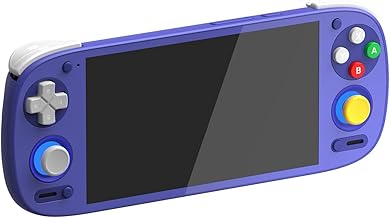 Best overall · Retroid Pocket 6 — Check price on Amazon →
The Retroid Pocket 6 is the device most of the community converged on through 2026, and for good reason: it pairs a big, bright 1080p display with a Snapdragon chip that handles PS2 and GameCube without the per-game anxiety of cheaper hardware. Retroid's own launcher has matured considerably, and the ergonomics — full-size grips, Hall effect sticks, proper triggers — are a different species from the flat slabs at the bottom of the market. If you're upgrading once and want that upgrade to last, this is the default answer.
Retroid Pocket 5 — best value upgrade
 Best value upgrade · Retroid Pocket 5 — Check price on Amazon →
The Pocket 5 hasn't been made obsolete; it's been made cheaper. Snapdragon 865 with a 5.5-inch 1080p AMOLED is still an excellent combination, and the 865 remains one of the best-supported chips in the emulation scene, meaning mature Adreno driver options and abundant per-game settings guides. If your ceiling is "PS2, GameCube, PSP and everything below, on a gorgeous screen," you don't need to spend more.
AYN Odin 2 Portal — premium pick
 Premium pick · AYN Odin 2 Portal — Check price on Amazon →
The Odin 2 Portal is the enthusiast endpoint short of a Windows handheld. A Snapdragon 8 Gen 2 behind a 7-inch 1080p AMOLED gives you headroom nothing else in this class matches, and the larger body is genuinely more comfortable for long sessions if you have adult-sized hands. It's also the most credible option for Switch emulation and for Wii titles that stumble elsewhere. The downsides are size — this does not go in a jacket pocket — and price.
Anbernic RG556 — best AMOLED alternative
 Best AMOLED alternative · Anbernic RG556 — Check price on Amazon →
Anbernic's ecosystem is the friendlier one. The RG556's 5.48-inch AMOLED is lovely, the Unisoc T820 handles PS2 and GameCube with some tuning, and Anbernic's build quality and out-of-box setup tend to be gentler on newcomers than Retroid's more DIY posture. Choose it if you like Anbernic's software and don't need the last slice of performance.
AYN Thor — best for DS and 3DS
 Best dual-screen for DS/3DS · AYN Thor — Check price on Amazon →
If your backlog is Pokémon, Phoenix Wright, The World Ends With You and half of the 3DS library, a single-screen handheld will always be a compromise. The Thor's hinged dual-screen design renders those systems the way they were designed, with no stacked-screen squinting. It's a specialist purchase — but if DS/3DS is 60% of your play time, it's the right one.
Comparison
| Model | Screen | Silicon class | Best for | Trade-off |
|---|---|---|---|---|
| Retroid Pocket 6 | Large 1080p, 16:9 | Snapdragon, current gen | All-round PS2/GCN/PSP | Stock availability is inconsistent |
| Retroid Pocket 5 | 5.5" 1080p AMOLED | Snapdragon 865 | Best performance per dollar | Not a Switch machine |
| AYN Odin 2 Portal | 7" 1080p AMOLED | Snapdragon 8 Gen 2 | Wii, Switch, max headroom | Large; highest price |
| Anbernic RG556 | 5.48" AMOLED | Unisoc T820 | Friendly setup, great panel | Less community driver support |
| AYN Thor | Dual screens | Snapdragon | DS and 3DS natively | Niche outside those systems |
How to choose in 60 seconds
- You mostly play 2D and PS1, but want a better screen: don't spend $250. Stay in the budget tier.
- You want PS2 and GameCube to just work: Retroid Pocket 5 or Pocket 6.
- You want Switch emulation and Wii: AYN Odin 2 Portal.
- You want DS/3DS done properly: AYN Thor.
- You want the least setup friction: Anbernic RG556.
One last practical note: budget for a fast, high-capacity microSD card and a decent USB-C charger. Sixth-gen game libraries are large, and cheap cards are the single most common cause of stutter that owners mistakenly blame on the hardware.
FAQ
Is a $250 Android handheld better than a Steam Deck for retro games? For pure emulation portability, often yes — it's lighter, boots instantly, and sips battery on older systems. A Steam Deck wins on raw power, PC games, and Windows-era emulation, but it's heavier and overkill for SNES.
Can any of these actually play Switch games? Only the highest tier, and inconsistently. Snapdragon 8 Gen 2 devices like the Odin 2 Portal can run a meaningful slice of the library, but treat Switch emulation as a bonus, not a purchase reason.
AMOLED or IPS for retro gaming? AMOLED for contrast, colour and battery on dark games; IPS for absolute motion clarity and lower cost. Most owners prefer AMOLED once they've used it.
Do I need to buy games separately? Yes. These devices ship without a legitimate game library. Legally, you should dump ROMs from cartridges and discs you own — preloaded-card listings are a legal grey zone at best.
Will spending more fix bad emulation of a specific game? Not always. Some titles are limited by emulator accuracy, not hardware. Check per-game compatibility lists for Dolphin and PS2 emulators before buying for one specific game.
Our picks
Retroid Pocket 5 Retro Handheld Game Console, 8+128G, 5.5-inch touchscreen 1080p Portable Android Gaming Handheld with Adreno 650 GPU & WiFi 6/BT5.1, Snapdragon 865 Processor, Android 13 (GC)
A large OLED-class 1080p panel and a Snapdragon-tier chip that finally makes PS2 and GameCube feel routine.
Retroid Pocket 5 Retro Handheld Game Console, 8+128G, 5.5-inch touchscreen 1080p Portable Android Gaming Handheld with Adreno 650 GPU & WiFi 6/BT5.1, Snapdragon 865 Processor, Android 13 (GC)
Snapdragon 865 plus a 5.5-inch 1080p AMOLED — still the sweet spot for Dreamcast through PS2 and light Switch.
AYN Odin 2 Portal Base Retro Handheld Game Console - Snapdragon 8 Gen 2, 8+128GB, 7" 1080P OLED Touch Screen, 120Hz Refresh Rate, 8000mAh, Android 13, Android Gaming Handheld
Snapdragon 8 Gen 2 behind a 7-inch 1080p AMOLED; the most capable non-PC handheld for heavy emulation.
Anbernic RG556 Retro Handheld Game Console , Android 13 System Unisoc T820 Processor 5.48 Touch Inch AMOLED Screen 5500mAh Battery Support WiFi Online DP Output (Transparent Blue)
A 5.48-inch AMOLED and Unisoc T820 in Anbernic's familiar, beginner-friendly software ecosystem.
AYN Thor Max Dual-Screen Clamshell Gaming Handheld | Snapdragon 8 Gen 2 | 6" 120Hz AMOLED Primary Display | 16GB RAM, 1TB Storage | Wi-Fi 7 | Android 13 Retro Console
Two screens, real hinge, proper DS and 3DS layouts without stacking or cropping.
Get the best tech deals in your inbox
Join the BytePlaza newsletter for hand-picked gadget deals and new buying guides. No spam, unsubscribe anytime.
Related reads
Retro Handhelds Under $200 in 2026: 5 That Earn It
The best retro handheld console 2026 picks under $200, ranked by screen quality, emulation ceiling and battery — from the Miyoo Mini Plus to the Retroid Pocket 5.
1440p 180Hz on a Budget: The Best Cheap Gaming Monitors 2026
Looking for the best budget gaming monitor in 2026? We compared fast 1440p IPS panels at 165–200Hz to find the value picks worth buying instead of OLED.
Capture Cards in 2026: 5 Picks That Actually Hold 4K60
The best capture card for streaming in 2026, compared: 4K60 passthrough, HDR handling, USB vs internal PCIe, and which budget cards avoid dropped frames.