Retro Handhelds Under $200 in 2026: 5 That Earn It
The best retro handheld console 2026 picks under $200, ranked by screen quality, emulation ceiling and battery — from the Miyoo Mini Plus to the Retroid Pocket 5.
Reader-supported: we may earn a commission from links on this page, at no extra cost to you. It never affects our picks. Learn more.
If a Steam Deck or ROG Ally is out of reach — or just more machine than you need — the retro handheld scene has quietly become the best value in portable gaming. Under $200 you can get an OLED screen, hall-effect sticks, and enough horsepower to run GameCube and PS2 libraries that were unthinkable on portable hardware five years ago.
But the category is chaotic. Dozens of near-identical Chinese handhelds launch every quarter, spec sheets are inconsistent, and half the "reviews" online are unboxings. BytePlaza researched this category using manufacturer specifications, independent expert reviews, and verified owner feedback from communities like r/SBCGaming to rank what's actually worth buying in 2026.
How we ranked these
Three factors matter far more than raw benchmark numbers:
Screen quality. This is the single biggest upgrade over a decade-old handheld. Look for IPS or OLED panels, and pay attention to aspect ratio: a 4:3 screen fills the frame with Game Boy Advance, SNES, DS and PS1 content, while a 16:9 panel leaves black bars on almost everything retro but suits PSP and modern Android games.
Emulation ceiling. Every device here handles NES through PS1 flawlessly. The differences appear at Nintendo DS, Dreamcast, PSP, then GameCube, Wii, PS2, and finally Switch. Be skeptical of any claim that a sub-$200 device "runs Switch" — a handful of titles run, most don't run well.
Battery and ergonomics. A device that dies in two hours or cramps your hands in twenty minutes doesn't get used. Linux handhelds with modest chips routinely outlast Android ones by hours.
Android vs. Linux: pick your side first
This is the decision that determines everything else.
Linux handhelds (Miyoo, most Anbernic "XX" models) boot straight into a game launcher in a few seconds. They're cheap, sip battery, and are genuinely delightful to use. The trade-off: a hard ceiling around PS1/Dreamcast, no app store, no streaming, and setup usually means editing folders on a microSD card.
Android handhelds (Retroid, Anbernic's "V" line, AYN) run standalone emulators, Xbox Cloud Gaming, Moonlight streaming, Netflix, and native Android games. They're vastly more capable and vastly more fiddly — expect an evening of installing emulators, configuring per-system controls, and hunting for the right BIOS files.
If "I want to play Link's Awakening on the couch tonight" describes you, go Linux. If "I want one device that does everything through PS2" describes you, go Android.
The picks
Retroid Pocket 5 — best overall
 Best overall · Retroid Pocket 5 — Check price on Amazon →
The Retroid Pocket 5 is the device most people should buy in this bracket. Its 5.5-inch 1080p AMOLED panel is genuinely striking — deep blacks make CRT shader filters look far better than they do on an IPS screen — and the Snapdragon 865 remains the sweet spot for emulation performance per dollar. In practice that means confident GameCube and Dreamcast, most of the PS2 library with per-game tweaking, and Wii for anything that doesn't demand motion controls.
It's a 16:9 device, so retro content sits in a letterboxed window, and the horizontal form factor won't slip into a jeans pocket. But hall-effect sticks and triggers, a comfortable grip, and a mature community with step-by-step setup guides make it the easiest recommendation for someone who wants one handheld to cover everything.
Miyoo Mini Plus — best budget pick
 Best budget pick · Miyoo Mini Plus — Check price on Amazon →
At roughly the price of a couple of new indie games, the Miyoo Mini Plus is still the entry point everyone recommends, and for good reason. It's a Game Boy-shaped Linux device with a sharp 3.5-inch IPS screen, an excellent d-pad, and a build that feels far above its cost. Everything from Atari through PS1 runs cleanly, and the community OnionOS firmware turns it into a slick, box-art-driven launcher.
It has no analog sticks, so N64 and PS1 analog titles are compromised, and it will never touch DS or PSP. That's fine — it's the best pure 2D retro machine you can buy, and it actually fits in a pocket.
Anbernic RG35XX SP — best clamshell
 Best clamshell · Anbernic RG35XX SP — Check price on Amazon →
If your handheld lives in a bag, the folding design of the RG35XX SP solves the problem that plagues every other device here: a scratched screen. It's a Game Boy Advance SP tribute with a 3.5-inch 4:3 IPS display, Linux firmware, and battery life measured in many hours rather than a few.
Performance is broadly in the same class as the Miyoo — 8- and 16-bit systems, GBA, and PS1 with light compromise. You're paying a small premium for the hinge and the nostalgia, and it's worth it if you value protection and portability over raw power.
Anbernic RG406V — best vertical Android pick
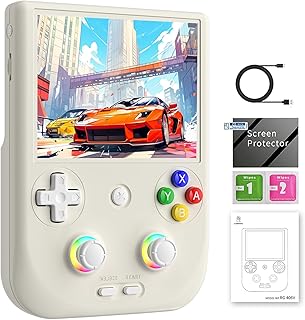 Best vertical Android pick · Anbernic RG406V — Check price on Amazon →
The RG406V is the answer for anyone who wants Android capability without a wide, 16:9 body. Its 4-inch 4:3 touchscreen is the correct shape for DS (both screens stacked, no wasted space), GBA, SNES and PS1, and the MediaTek Helio G99 handles PSP, Dreamcast and a good slice of GameCube.
The touchscreen matters more than it sounds: DS and 3DS emulation is dramatically better when you can actually tap the lower screen. Hall-effect sticks are included. It won't match the Retroid Pocket 5 on PS2, but for the classic-era libraries most people actually play, it's arguably the better shape.
Retroid Pocket Mini V2 — premium compact pick
The Mini V2 packs a 3.92-inch OLED into a body barely larger than a Miyoo, with silicon significantly stronger than the RG406V's. It's for the buyer who wants the smallest possible device that still runs GameCube and dips into PS2. The screen is the nicest in this guide, full stop.
The compromises are physical: a small panel makes text-heavy RPGs and PSP menus a squint, and larger hands will notice the cramped grip during long sessions.
Comparison table
| Model | OS | Screen | Realistic ceiling | Best for |
|---|---|---|---|---|
| Retroid Pocket 5 | Android | 5.5" 1080p AMOLED, 16:9 | GameCube / Wii / much of PS2 | One device that does everything |
| Retroid Pocket Mini V2 | Android | 3.92" OLED, ~1:1 | GameCube, some PS2 | Maximum power in a tiny shell |
| Anbernic RG406V | Android | 4" 4:3 touchscreen | PSP, Dreamcast, some GameCube | DS and classic-era libraries |
| Anbernic RG35XX SP | Linux | 3.5" 4:3 IPS, clamshell | GBA, PS1 (light) | Bag-friendly protection |
| Miyoo Mini Plus | Linux | 3.5" 4:3 IPS | PS1 | Cheapest great experience |
Things buyers regret
Preloaded microSD cards. Many listings advertise "20,000+ games." These cards are legally dubious, frequently full of broken ROMs, and often use slow, unreliable flash. Budget for a reputable A2-rated card from SanDisk or Samsung and build your own library from games you own.
Assuming Switch emulation. Following the shutdown of major Switch emulators, expectations here should be near zero on sub-$200 hardware. Don't buy based on a marketing bullet point.
Ignoring the software curve. Android handhelds arrive as blank slates. Set aside an evening for emulator installation and controller mapping, or buy Linux instead.
Skipping the accessories. A case and a screen protector cost little and prevent the most common failure — a cracked or scratched panel from a device rattling around in a bag.
FAQ
Do I need to buy games separately?
Yes. These devices ship without game files. Dumping cartridges and discs you own is the legally sound route; homebrew and public-domain libraries are also excellent and completely free.
Is a 4:3 screen really better?
For pre-2005 consoles, yes — those games were made for 4:3 displays, so the image fills the panel. If you plan to play PSP, stream games, or use Android apps, 16:9 is the better fit.
How long do these batteries last?
Linux handhelds like the Miyoo Mini Plus commonly deliver most of a day of light play; Android devices running demanding emulators typically land in the three-to-five-hour range depending on brightness and workload. Manufacturer figures assume best-case conditions.
Are hall-effect sticks worth caring about?
Yes. They use magnetic sensors instead of contact potentiometers, which effectively eliminates stick drift — the most common long-term failure on cheap handhelds.
Should I just save up for a Steam Deck?
Only if you want a PC games library. For emulation specifically, a $150 Android handheld covers the same retro ground in a package a fraction of the size and weight.
Our picks
Retroid Pocket 5 Retro Handheld Game Console, 8+128G, 5.5-inch touchscreen 1080p Portable Android Gaming Handheld with Adreno 650 GPU & WiFi 6/BT5.1, Snapdragon 865 Processor, Android 13 (Black)
A 5.5" 1080p AMOLED and Snapdragon 865 make it the emulation ceiling king under $200.
Miyoo Mini Plus with Portable Case Retro Emulator Handheld Game Console Latest Version with WiFi & RTC, 3.5’’ 640*480 IPS Screen 3000mAh Battery, Black
Pocketable Game Boy-style Linux handheld that nails everything up to PS1 for around $50.
RG35XXSP Portable Flip Retro Handheld Game Console RG35XX SP Flip Game Console Linux System 3.5 '' IPS Screen 64G Preloaded 5532 Games RG 35XXSP Support HDMI TV Output 5G WiFi Bluetooth 4.2 Grey
Folding GBA SP-style build with a protected screen, ideal for bags and pockets.
RG406V Handheld Game Console RG 406V 4-inch IPS Multi-touch Screen Retro Game Console No Card Android 13 Retro Emulator RG406V 5500mAh Battery 1080p DP WIFI Bluetooth Beige White
4" 4:3 touchscreen and Helio G99 give DS, PSP and GameCube a proper home.
Retroid Pocket 5 Retro Handheld Game Console, 8+128G, 5.5-inch touchscreen 1080p Portable Android Gaming Handheld with Adreno 650 GPU & WiFi 6/BT5.1, Snapdragon 865 Processor, Android 13 (Black)
Small 3.92" OLED body with near-flagship silicon — the nicest screen in this price band.
Get the best tech deals in your inbox
Join the BytePlaza newsletter for hand-picked gadget deals and new buying guides. No spam, unsubscribe anytime.
Related reads
Retro Handhelds Over $200 in 2026: PS2-Class Picks
Outgrown your $60 retro handheld? Here are the best retro handheld consoles over $200 in 2026 — GameCube and PS2-capable chips, better screens, real ergonomics.
Gaming Chairs Under $300 in 2026: 5 That Hold Up
We compared the best gaming chair under 300 options for 2026 on lumbar support, weight rating, armrest adjustability and long-term owner reports. Here's what lasts.
Stream Deck Alternatives 2026: 4 Macro Pads That Deliver
Looking for a Stream Deck alternative macro pad in 2026? We compare LCD control decks, hot-swap macro pads and knob-driven controllers for streamers and editors.