Portable Wi-Fi Hotspots in 2026: 5G Box or Travel Router?
The best portable wifi hotspot depends on whether you need your own 5G data or just better hotel Wi-Fi. We compare 5G hotspots, travel routers and data plans for 2026.
Reader-supported: we may earn a commission from links on this page, at no extra cost to you. It never affects our picks. Learn more.
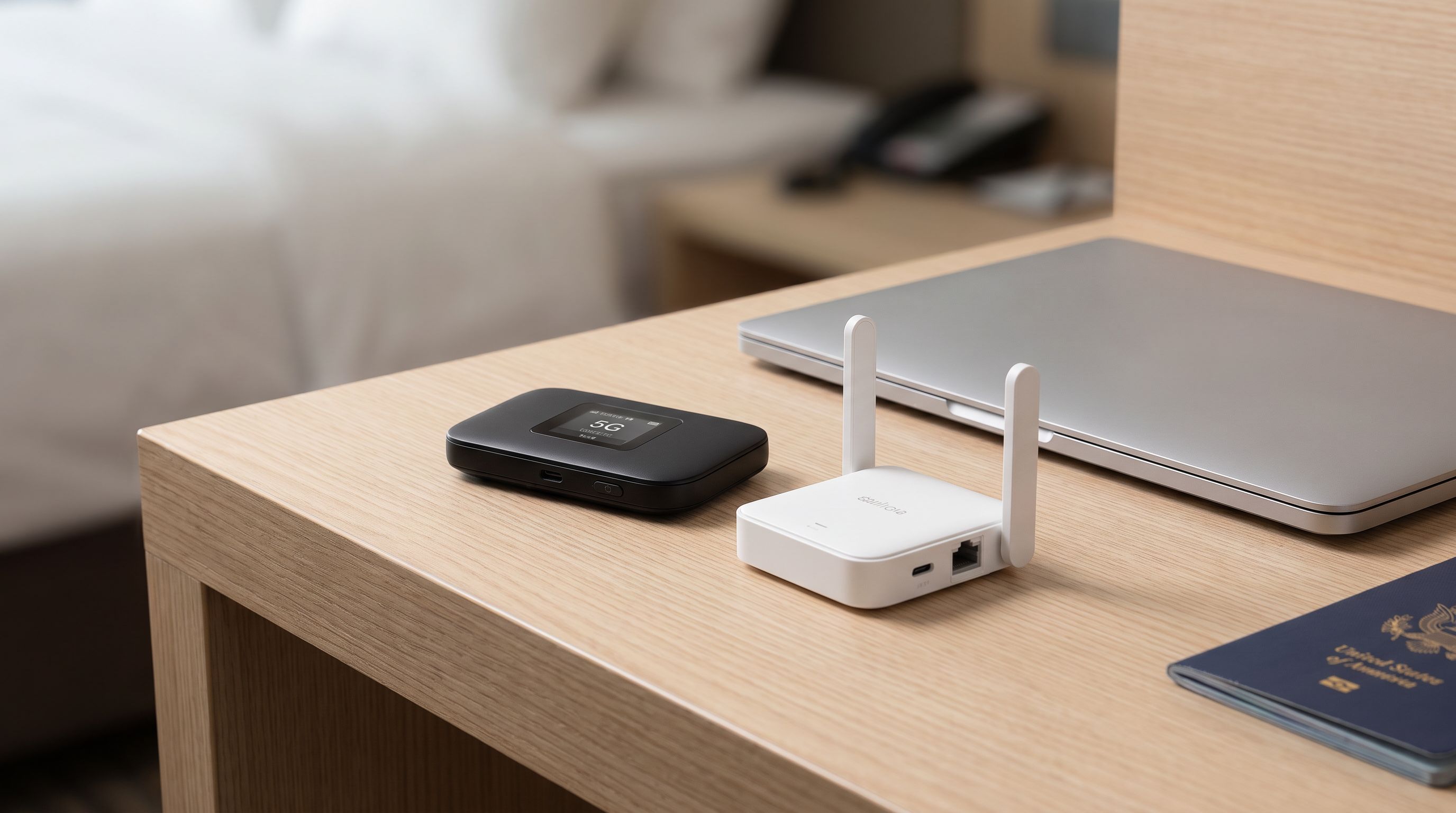
Most people searching for the best portable wifi hotspot are actually asking two different questions. One group wants their own cellular connection — a pocket 5G box with a SIM in it, for road trips, RV life, campsites and client sites with no usable Wi-Fi. The other group already has Wi-Fi at the hotel or Airbnb; it's just slow, captive-portal-infested, and only lets one device log in at a time. That group needs a travel router, not a hotspot.
Buying the wrong one is the single most common mistake here. Below, we break down which category fits your trip, then rank the specific models worth your money in 2026, based on manufacturer specs, independent review testing and verified owner feedback.
Hotspot vs travel router: the 30-second decision
A mobile hotspot (MiFi) has its own modem and SIM. It creates internet where there is none. It needs a data plan, and that plan is where most of your money goes.
A travel router has no modem. It takes an existing connection — hotel Wi-Fi, an Ethernet jack, or your phone's USB tethering — and rebroadcasts it as your own private network. You log into the captive portal once, and your laptop, tablet, Kindle, streaming stick and partner's phone all ride along. It also lets you run a VPN for every device at once, which matters on shared hotel networks.
| 5G mobile hotspot | Travel router | |
|---|---|---|
| Creates internet? | Yes — own SIM + modem | No — reuses existing Wi-Fi/Ethernet |
| Ongoing cost | Data plan required | None |
| Best for | Road trips, RVs, remote work off-grid, backup WAN | Hotels, Airbnbs, cruise cabins, coworking, conferences |
| Typical size | Deck-of-cards, built-in battery | Bar of soap, usually USB-C powered |
| VPN for all devices | Usually limited | Yes, core feature (WireGuard/OpenVPN) |
| Device limits | Bypasses per-device Wi-Fi caps | Bypasses per-device Wi-Fi caps |
| Weak point | Coverage + data cost | Only as good as the Wi-Fi it repeats |
Honestly? A lot of frequent travellers end up carrying both. A travel router weighs almost nothing and costs a fraction of a hotspot.
The 5G hotspots worth buying
NETGEAR Nighthawk M6 Pro (MR6550) — best overall
 Best overall · NETGEAR Nighthawk M6 Pro (MR6550) — Check price on Amazon →
The M6 Pro remains the halo device for unlocked hotspots. It pairs Wi-Fi 6E — meaning a clean 6GHz band that nobody else in the hotel is sitting on — with a 5G modem that supports mmWave as well as sub-6. There's a 2.5 Gbps Ethernet port so it can serve as a home backup WAN, a colour touchscreen for signal and data monitoring, and TS-9 connectors for external antennas if you're parked somewhere with one weak bar.
Two practical things reviewers consistently praise: the removable battery (you can carry a spare instead of babysitting a power bank) and the ability to run it plugged in with the battery removed, which avoids the swelling problem that kills older hotspots left on a dashboard.
The caveat is that mmWave is only useful in dense urban pockets, and the M6 Pro carries a real premium for it. If you never see mmWave coverage, you're paying for a spec you can't use.
NETGEAR Nighthawk M3 (MR3100) — best value
 Best value 5G hotspot · NETGEAR Nighthawk M3 (MR3100) — Check price on Amazon →
The M3 is the sensible pick for most buyers. It keeps the Nighthawk formula — colour touchscreen, removable battery, solid sub-6 5G, Ethernet port — and drops the mmWave hardware and 6GHz band. In everyday use on a normal carrier network, the speed difference between M3 and M6 Pro is far smaller than the price gap suggests, because your bottleneck is almost always the tower, not the device.
If you want one hotspot for a family road trip, a jobsite, or as a home internet failover, this is the one we'd point most people to.
GlocalMe Numen Air 5G — best for international travel
 Best for international trips · GlocalMe Numen Air 5G — Check price on Amazon →
Cross-border travel is where traditional hotspots fall apart: your carrier's roaming is expensive, and buying local SIMs in each country is a chore. GlocalMe's cloud-SIM approach sidesteps it. The Numen Air 5G connects to partner networks in 100+ countries and lets you buy regional day passes or data bundles in-app, with no contract. It also takes a physical SIM if you'd rather use a local plan, and it can double as a power bank for your phone.
Owner feedback is consistent on the tradeoff: convenience is excellent, per-gigabyte cost is not the cheapest, and speeds depend entirely on which partner network it lands on. Treat it as a "land and be online in 60 seconds" device rather than a heavy-streaming solution. The same category includes rental-style options like RoamWiFi, which work on a similar no-SIM model if you'd rather not own hardware.
A note on carrier-locked hotspots
If you're committed to one network, the carrier-exclusive devices are often the better deal. On T-Mobile, the Franklin Wireless JEXtream RG series (the RG2100 and newer RG3100) has become the default recommendation from outlets including PCMag and Wirecutter, thanks to strong 5G performance, long battery life and simple setup. Verizon buyers get the Inseego MiFi series. These are frequently bundled cheaply with a plan — but they're locked, so they're poor choices if you switch carriers or travel abroad.
The travel routers worth buying
GL.iNet Beryl AX (GL-MT3000) — best for hotel Wi-Fi
 Best travel router for hotel Wi-Fi · GL.iNet Beryl AX (GL-MT3000) — Check price on Amazon →
This is the device that fixes the hotel-internet problem. It repeats the property's Wi-Fi, handles the captive portal once, and presents your devices with a network name they already trust — so your laptop, phone and Chromecast just reconnect automatically in every city. It's Wi-Fi 6, palm-sized, USB-C powered, and includes a built-in VPN client so everything behind it is encrypted on an untrusted network.
For nomads who hit a new accommodation every week, it's arguably a bigger quality-of-life upgrade than any hotspot.
GL.iNet Slate AX (GL-AXT1800) — best for VPN-heavy work
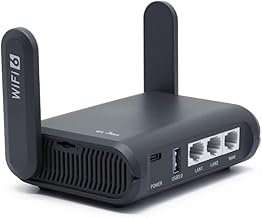 Best for VPN-heavy remote work · GL.iNet Slate AX (GL-AXT1800) — Check price on Amazon →
The Slate AX adds a dedicated Ethernet WAN port (useful in older hotels and some offices), a slightly more rugged form factor, and strong WireGuard throughput for people who must route work traffic through a corporate or personal VPN. Both run OpenWrt underneath, so you get real firewall, DNS and ad-blocking controls if you want them — and a clean app-style interface if you don't.
Data plans: where the real cost hides
The device is a one-time cost. The plan is forever, so read the fine print:
- "Unlimited" almost never is. Hotspot plans typically have a high-speed allotment, after which you're throttled to speeds that make video calls unusable. Check the deprioritisation threshold, not the headline word.
- Phone-plan hotspot data is separate. Your phone's tethering allowance is usually a small monthly bucket carved out of your main plan.
- Prepaid is your friend for seasonal use. If you only need data three months a year, a prepaid hotspot plan you can pause beats a 24-month contract.
- Check band support before buying unlocked. An unlocked hotspot is only as good as its band coverage on your carrier — particularly mid-band 5G, which does the heavy lifting.
- eSIM travel plans from providers like Airalo or Holafly can be cheaper than cloud-SIM hardware if your phone's hotspot function is allowed on the plan. Confirm tethering is permitted; some cheap eSIMs block it.
How we picked
We compared current-generation hotspots and travel routers on modem generation and band support, Wi-Fi standard, battery design, port selection, external antenna options and firmware track record. We weighted independent lab testing from outlets like PCMag and Wirecutter alongside patterns in verified owner reviews — particularly around heat, battery longevity and real-world captive-portal handling. BytePlaza researches and compares products using manufacturer specs and third-party testing; we don't physically test units ourselves.
FAQ
Is a portable hotspot better than using my phone? For short stints, no — tether your phone. A dedicated hotspot wins when you need all-day runtime without draining your phone, better antennas for weak-signal areas, Ethernet output, or a separate data bucket you don't have to ration.
Can a travel router work without any Wi-Fi around? Not on its own. Most GL.iNet models, including the Beryl AX and Slate AX, can accept a USB-tethered phone or USB LTE dongle as their WAN source, which turns one phone's data into a proper network for everyone.
Do hotspots work on cruise ships or planes? No. Cellular hotspots have no signal at sea or in the air. A travel router can still help by sharing a single paid onboard Wi-Fi login across your devices — though some providers actively block this, so check the terms.
How many devices can I connect? Most modern hotspots support 30 or more clients, and travel routers similar. The practical limit is bandwidth, not the device count — ten people streaming on one 5G connection will feel it.
Should I buy locked or unlocked? Locked carrier devices (Franklin JEXtream, Inseego MiFi) are cheaper upfront and tuned to that network. Unlocked Nighthawks cost more but travel internationally and survive a carrier switch. Choose based on how likely you are to change networks in the next two years.
Our picks
NETGEAR Nighthawk | M6 Pro 5G | WiFi 6E | Mobile Hotspot Router | MR6500 | Up to 8Gbps | Only for At&T | Black
Wi-Fi 6E, mmWave-capable 5G and a removable battery — the most capable pocket hotspot you can buy unlocked.
NETGEAR Nighthawk M7 Pro Mobile Hotspot 5G mmWave, WiFi 7, Unlocked, AT&T & Verizon, International, Portable Device for Travel (Renewed)
Most of the M6's real-world speed and a swappable battery, without the mmWave premium.
GL.iNet GL-MT3000 Beryl AX Wi-Fi 6 Travel Router, 2.5G WAN, VPN, OpenWrt
Pocket Wi-Fi 6 router that repeats hotel Wi-Fi, runs a VPN client and hides all your devices behind one login.
GL.iNet GL-AXT1800 Slate AX Pocket-Sized Wi-Fi 6 Travel Router with VPN
OpenWrt-based travel router with strong WireGuard throughput and an Ethernet WAN port for wired hotel jacks.
GlocalMe Numen Air 5G Mobile Hotspot, Portable WiFi Hotspot for Travel in 200+ Countries, Ultra High Speed Pocket Hotspot Device with Speed Up to 2.5Gbps, No SIM Card Required, 16 Connected Devices
Cloud-SIM hotspot that buys data in 100+ countries with no local SIM hunting or roaming contract.
Get the best tech deals in your inbox
Join the BytePlaza newsletter for hand-picked gadget deals and new buying guides. No spam, unsubscribe anytime.
Related reads
Best Portable Monitor 2026: 4K, OLED & USB-C Picks
The best portable monitor picks for 2026, from OLED travel screens to budget USB-C panels — ranked by panel quality, weight and single-cable power.
Best GaN Chargers in 2026: 100W Picks for Laptops
The best 100W GaN chargers in 2026 for laptops, tested criteria explained: port layouts, power splitting, travel size, and which models actually deliver full wattage.
Portable Monitors for MacBook in 2026: 5 One-Cable Picks
The best portable monitor for MacBook in 2026, ranked by brightness, weight and stand design — plus which models truly run off a single USB-C cable.