Window Heat Pump vs Window Air Conditioner in 2026
Window heat pump vs window air conditioner in 2026: how BTU sizing, inverter efficiency, app ecosystems and winter heating stack up for renters.
Reader-supported: we may earn a commission from links on this page, at no extra cost to you. It never affects our picks. Learn more.
Window air conditioners stopped being dumb boxes a few years ago. Today the good ones are inverter-driven, app-connected, and quiet enough to sleep next to. At the same time, a new category has crept onto the same shelf: the window heat pump — a unit that cools in summer and reverses to pull heat indoors in winter, all from the same sash.
If you rent, that second category is tempting. One appliance, one window, heat and cool, no landlord permission for a mini-split. But window heat pumps are not strictly better, and the running-cost claims attached to them deserve a closer look. Here's how we'd decide in 2026, based on manufacturer specs, independent reviews from outlets like Wirecutter and WIRED, and verified owner feedback.
The short version
- Buy a smart window AC if you already have working building heat (steam, baseboard, forced air) and you only need cooling plus maybe a touch of shoulder-season warmth.
- Buy a window heat pump if your heat is electric resistance, expensive, or unevenly distributed — a bedroom that's freezing while the rest of the apartment bakes, for example.
- Buy a saddle-style U-shaped unit if noise and window usability matter more than anything else.
What actually separates the two
A window heat pump is a window AC with a reversing valve. In cooling mode the two are mechanically near-identical. The difference shows up in winter: instead of burning electricity to make heat directly, a heat pump moves heat from outdoor air into your room. Even at 35°F outdoors there's usable heat in the air.
That's where the efficiency claim comes from. A resistance space heater is roughly 100% efficient — one unit of electricity, one unit of heat. A heat pump at mild temperatures can deliver two to three units of heat per unit of electricity. On an electric-heat apartment, that's a real difference on the bill.
The caveats are equally real:
- Capacity falls as it gets colder. Many window heat pumps lose meaningful output below freezing and switch to electric backup heat, at which point your efficiency advantage evaporates. Check the manufacturer's rated low-temperature operating range before you buy — it varies a lot between models.
- Defrost cycles exist. The outdoor coil frosts; the unit periodically reverses to melt it. You'll hear it, and the room cools slightly during the cycle.
- Drainage matters more. Owner reports — including the common complaint of a heat pump unit "leaking because no drainage was put in" — trace back to winter condensate having nowhere to go. Heat pumps produce meltwater outdoors in heating mode. Installation slope and drain provisions are not optional.
- Many units labeled "with heat" aren't heat pumps at all. A lot of cheaper models include a resistance heating element. Useful, but no efficiency benefit. If the listing doesn't say "heat pump" or quote a COP/HSPF figure, assume resistance.
Side-by-side
| Smart window AC (inverter) | Window heat pump | |
|---|---|---|
| Summer cooling | Excellent; inverter models modulate instead of cycling | Essentially identical |
| Winter heating | None, or resistance element on some models | True heat-pump heating, backup element below rated temp |
| Efficiency in heating | ~1:1 if resistance | Typically 2–3x resistance in mild weather, degrades in deep cold |
| Noise | Best-in-class on U-shaped and dual-inverter models | Similar in cooling; added defrost noise in winter |
| Install complexity | Standard bracket + seal | Same, plus stricter drainage/slope requirements |
| Year-round window use | Many renters remove in winter | Stays installed all year — a pro and a con |
| Best for | Apartments with adequate building heat | Electric-heat units, cold bedrooms, converted spaces |
BTU sizing: the part people get wrong
Oversizing is the single most common mistake, and inverter units punish it less than old compressors did — but they still punish it.
A rough starting point is 20 BTU per square foot of cooled space. A 250 sq ft bedroom lands near 5,000–6,000 BTU; a 450 sq ft living room near 9,000–10,000. Then adjust: add roughly 10% for a sunny, west-facing room, subtract 10% for a heavily shaded one, add 600 BTU per additional regular occupant, and add about 4,000 BTU if the unit has to handle a kitchen.
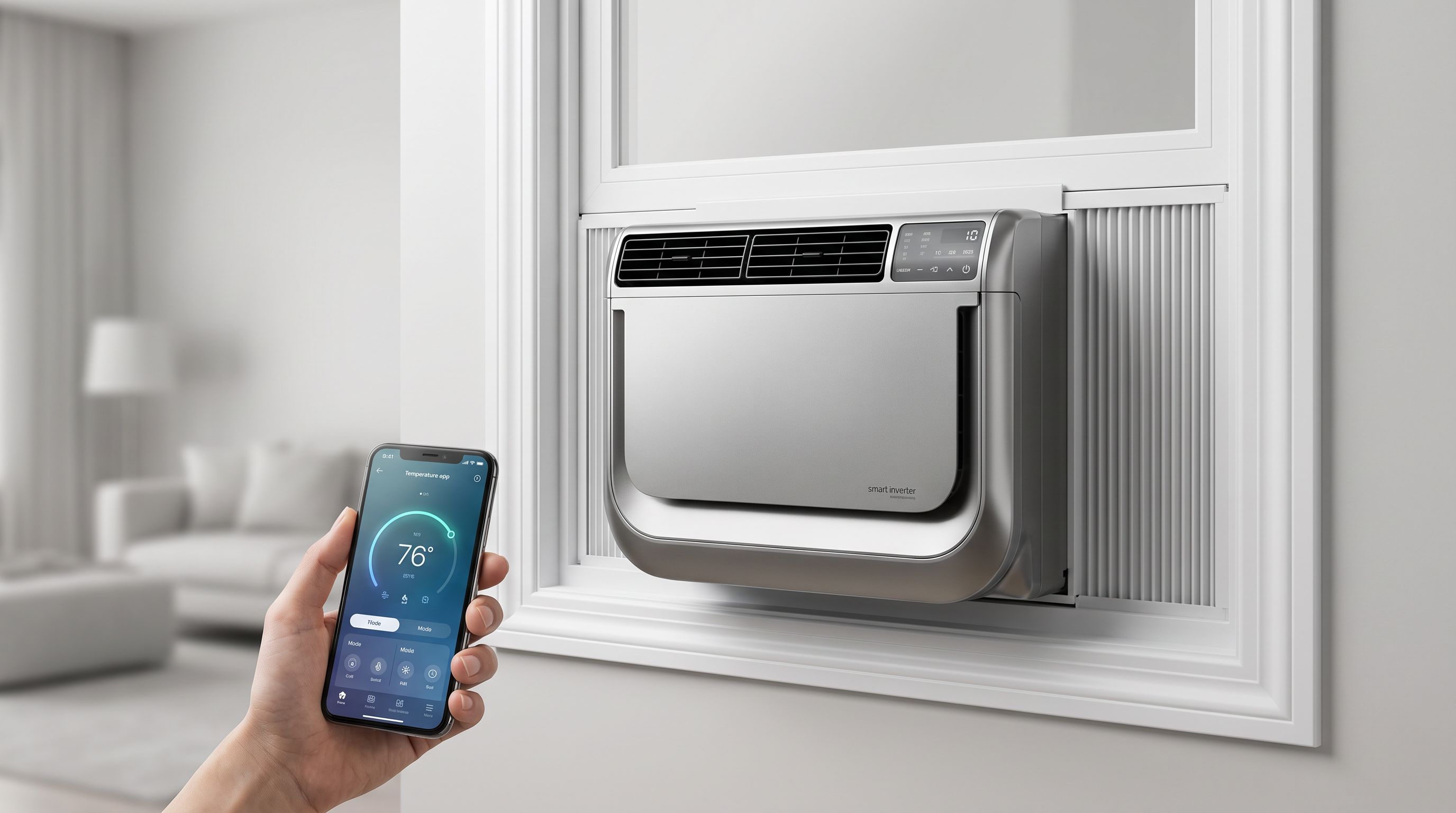
An oversized AC cools the air fast, shuts off, and never runs long enough to pull humidity out. You end up with a cold clammy room. Inverter units like the Midea U-Shaped 8,000 BTU Smart Inverter Window Air Conditioner (MAW08V1QWT) mitigate this by throttling down rather than cycling off, which is a big part of why they dehumidify better than old units at the same rating.
For heat pumps, size for the cooling load first, then verify the heating output at your area's typical winter lows. Heating BTU is almost always lower than cooling BTU at the temperatures you actually need heat.
App ecosystems: what renters should check
Smart features are where marketing gets loudest and reality gets thin. The things worth caring about:
- Scheduling and geofencing. Cooling an empty apartment is the most expensive thing you can do. Both the Midea app and LG ThinQ handle schedules well.
- Matter / HomeKit support. Still inconsistent across window units in 2026. If you're deep in Apple Home, confirm support for the exact model number, not the product family.
- Local control fallback. If Wi-Fi drops, does the unit keep running its schedule? Cheap units often don't.
- Remote shut-off and open-window detection. Genuinely useful for renters who leave for a weekend.
The LG Dual Inverter Smart Window Air Conditioner (LW1517IVSM) is our pick when app quality is the deciding factor — ThinQ is mature, stable, and integrates cleanly with Alexa and Google Home. Midea's app is less polished but perfectly functional and covers the essentials.
Our picks, and who each is for
Midea U-Shaped 8,000 BTU Smart Inverter Window Air Conditioner (MAW08V1QWT) — the best default for a bedroom or small living room. The U-shape lets the window sash close through the middle of the unit, which both cuts noise substantially and lets you still open the window. Reviewers at WIRED and Wirecutter have consistently ranked the U-shaped Midea family at or near the top for efficiency and quiet.
Midea U-Shaped 12,000 BTU Smart Inverter Window Air Conditioner (MAW12V1QWT) — same platform, sized up. Wirecutter has called the 12,000 BTU U-shaped model its top pick for performance. Choose it for open-plan spaces or rooms with heavy afternoon sun, not for a 200 sq ft bedroom.
LG Dual Inverter Smart Window Air Conditioner (LW1517IVSM) — conventional shape, so it fits windows where the U-shape bracket geometry doesn't work. Dual-inverter compressor keeps it quiet, and ThinQ is the better app.
Midea 12,000 BTU Inverter Window Heat Pump Air Conditioner with Heat — the 2-in-1 answer. Inverter cooling in summer, heat-pump heating in the shoulder seasons and mild winters. The right call if your winter heating bill is electric.
Friedrich Chill Premier 12,000 BTU Smart Window Air Conditioner with Heat — the premium, built-to-last option with integrated Wi-Fi and supplemental heat. Friedrich's chassis quality is a step above the mass-market units, which matters if the thing stays in the window year-round.
Installation notes that save deposits
- Confirm your window opening dimensions and the sill depth before ordering. U-shaped units have different bracket requirements than conventional ones.
- Use a support bracket. Many municipalities require one, and most leases implicitly do.
- Slope the unit slightly toward the outside — a quarter-bubble on a level is the usual guidance, but follow the manual; some inverter units are designed to sit level with internal drainage.
- For year-round heat pump installs, seal the side panels properly with foam and weatherstripping. Winter air infiltration around a badly sealed unit will cost you more than the heat pump saves.
FAQ
Is a window heat pump cheaper to run than my building's heat? If your heat is electric resistance, almost certainly yes in mild weather. If you have included steam or gas heat, usually no — you'd be paying for electricity to replace heat you already pay for in rent.
Do window heat pumps work below freezing? Some do, with reduced output; many fall back to a resistance element. Check the model's rated minimum operating temperature. Don't assume cold-climate mini-split performance from a window unit.
Can I leave a window heat pump in all winter? That's the point of buying one. Make sure the install is properly sealed and drained, and consider an exterior cover is not used in heating mode — the unit needs airflow.
Do I need a dedicated circuit? Most units up to roughly 12,000 BTU run on a standard 115V circuit, but heating modes draw more. Check the nameplate amperage and don't share the circuit with a microwave or space heater.
Is an inverter worth the premium? Yes. Quieter, better dehumidification, lower running cost, and less temperature swing. In 2026 it's the single spec worth prioritizing on either type of unit.
Our picks

Replacement Remote Control for Midea MAW12V1QWT MAW08V1QWT MAW10V1QWT 8000BTU 10000BTU 12000BTU U-Shaped Smart Inverter Window Air Conditioner
U-shape design, inverter quiet operation and class-leading efficiency with solid Wi-Fi app control.
Replacement Remote Control for Midea MAW12V1QWT MAW08V1QWT MAW10V1QWT 8000BTU 10000BTU 12000BTU U-Shaped Smart Inverter Window Air Conditioner
Same U-shaped inverter platform, sized for open-plan living rooms and sun-facing spaces.
LG Dual Inverter Smart Window Air Conditioner (LW1517IVSM)
LG ThinQ control, quiet dual-inverter compressor and a conventional shape that fits most windows.

Midea 12,000 BTU U Shaped Window Air Conditioner, Cools up to 550 Sq Ft
Inverter cooling plus true heat-pump heating for shoulder seasons, no second appliance needed.

Friedrich Chill Premier 12,000 BTU Window/Wall AC
Built-in Wi-Fi, heavy-duty build and supplemental heat for year-round use in a single window.
Get the best tech deals in your inbox
Join the BytePlaza newsletter for hand-picked gadget deals and new buying guides. No spam, unsubscribe anytime.
Related reads
Smart Air Conditioners in 2026: 4 Picks Sized by Room
The best smart air conditioner depends on your window and your square footage. We compared Wi-Fi window and portable ACs on BTUs, noise, app control and Matter.
Smart Blinds in 2026: Retrofit Picks That Beat Replacing
Comparing the best smart blinds 2026 options: retrofit motors like SwitchBot Blind Tilt vs made-to-measure shades, on Matter/Thread, solar charging and noise.
Smart Thermostats in 2026: 4 Picks With the Fastest Payback
The best smart thermostat 2026 picks compared on real energy savings, C-wire needs and Matter/Thread support — plus which one pays for itself fastest.