Smart Thermostats in 2026: 4 Picks With the Fastest Payback
The best smart thermostat 2026 picks compared on real energy savings, C-wire needs and Matter/Thread support — plus which one pays for itself fastest.
Reader-supported: we may earn a commission from links on this page, at no extra cost to you. It never affects our picks. Learn more.
Heating and cooling is the single biggest line item in most household energy bills — the U.S. Department of Energy puts it at roughly half of typical home energy use. That's why a thermostat costing less than a decent pair of headphones can, in the right house, pay for itself in a year or two.
But "smart thermostat saves you money" is a claim that deserves scrutiny. The savings depend almost entirely on three things: how bad your current schedule is, whether your home has hot and cold rooms, and whether the thermostat actually gets used properly after week three. We compared the leading 2026 models on those practical terms — plus the two things that most often derail an install, the C-wire and Matter/Thread compatibility.
BytePlaza doesn't physically test units. This guide is built from manufacturer specifications, independent lab and field testing published by outlets like Wirecutter, Reviewed and Forbes Vetted, ENERGY STAR certification data, and a large volume of verified owner feedback — with particular attention to what people complain about six months in.
The savings math, honestly
ENERGY STAR-certified smart thermostats are independently validated to deliver savings, and the certification requires demonstrated field performance rather than a lab claim. Manufacturers commonly cite figures in the range of 8–15% on heating and cooling. Treat those as a ceiling, not a promise.
You'll land near the top of that range if:
- You currently leave a manual or non-programmable thermostat at one temperature all day
- Your house is empty for predictable stretches (work, school)
- You have a heat pump, where smarter staging avoids expensive auxiliary heat
- You have rooms that run hot or cold, so you over-condition the whole house to fix one bedroom
You'll see very little if you already run a tight programmable schedule and everyone's home all day. In that case buy for comfort and convenience, not payback.
Rough payback rule of thumb: divide the total installed cost by your annual heating/cooling spend multiplied by 0.10. If you spend $1,200 a year on HVAC energy, a 10% saving is $120 — so most mid-range thermostats land in the one-to-two-year window, and a budget model can pay back in well under a year.
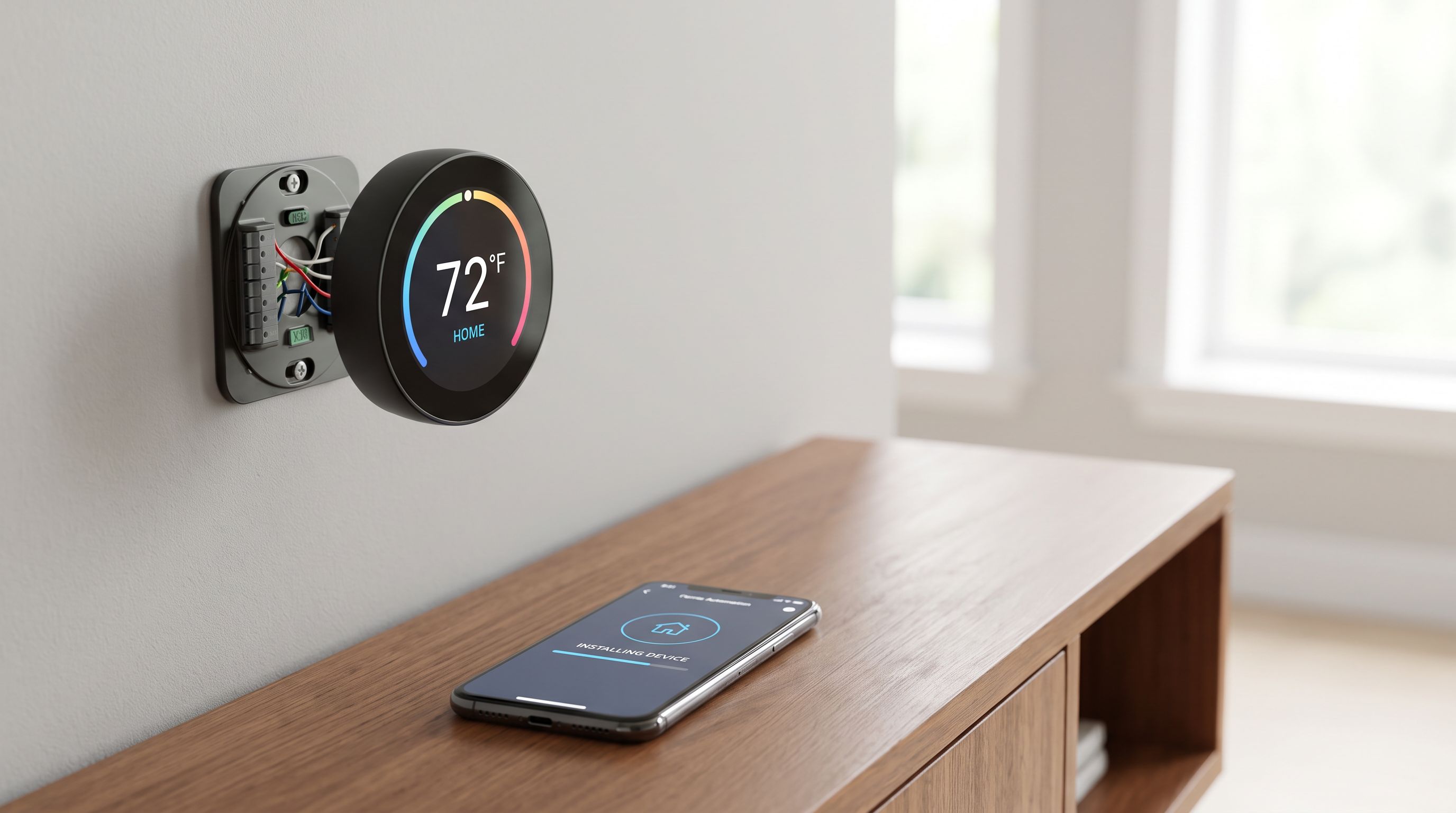
The C-wire question (read this before you buy)
The "common" wire delivers continuous 24V power. Without it, a thermostat has to steal power from the heating or cooling wire, which can cause short-cycling on some systems.
Pull your current thermostat off the wall and look at the terminals:
- A wire in the C terminal — you're fine, any model works.
- No C wire, but a spare unused wire in the wall bundle — often the easiest fix; that spare can usually be connected at the furnace board.
- Only four wires (R, W, Y, G), no spare — the ecobee Smart Thermostat Premium includes a Power Extender Kit that solves this at the furnace. The Google Nest Thermostat (Gen 4) is also designed to run on many 4-wire systems without a C.
- Two wires only (heat-only, some boilers) — options narrow sharply; check compatibility checkers on the manufacturer site before ordering, and budget for an add-a-wire adapter or an electrician.
 Best no-C-wire option · Google Nest Thermostat (Gen 4) — Check price on Amazon →
 Best overall · ecobee Smart Thermostat Premium — Check price on Amazon →
Also check for high-voltage line systems (electric baseboard) and millivolt systems — most mainstream smart thermostats do not support them.
Matter and Thread: what it actually buys you
Matter is the cross-platform smart home standard; Thread is the low-power mesh network many Matter devices use. For a thermostat — a mains-powered device sitting on Wi-Fi — Thread matters less than it does for a battery sensor.
What Matter genuinely gives you is platform freedom: a Matter thermostat can be controlled from Apple Home, Google Home, Alexa and SmartThings simultaneously, and it keeps working if you switch phone ecosystems later. Both the ecobee Smart Thermostat Premium and the Google Nest Learning Thermostat (4th Gen) support Matter, and the Nest Thermostat (Gen 4) adds Siri and Alexa control alongside Google's own app.
 Best automation · Google Nest Learning Thermostat (4th Gen) — Check price on Amazon →
One caveat worth knowing: Matter's thermostat feature set is deliberately basic. Advanced scheduling, occupancy logic and remote sensor behaviour still live in the manufacturer's own app. Matter is a control layer, not a replacement for the native experience.
How the top models compare
| Model | Remote sensors | C-wire required | Matter | Standout strength |
|---|---|---|---|---|
| ecobee Smart Thermostat Premium | Included (occupancy + temp) | PEK included if none | Yes | Air quality sensor, radar occupancy, deepest savings tooling |
| Google Nest Learning Thermostat (4th Gen) | Optional (sold separately) | Not always | Yes | Auto-learning schedule, best-looking display |
| Google Nest Thermostat (Gen 4) | Optional | Often not needed | Yes | Lowest-friction install, Siri + Alexa support |
| Amazon Smart Thermostat | No | Yes | No (Alexa/Wi-Fi) | Cheapest credible ENERGY STAR option |
| Honeywell Home T9 Smart Thermostat | Included, motion-sensing | Yes | No (Wi-Fi) | Room prioritisation in uneven homes |
 Best for uneven multi-room homes · Honeywell Home T9 Smart Thermostat — Check price on Amazon →
 Budget pick · Amazon Smart Thermostat — Check price on Amazon →
Which one should you buy?
For most homes with hot and cold rooms: ecobee Smart Thermostat Premium
The reason ecobee keeps topping independent rankings — Wirecutter and Forbes Vetted both name it their overall winner — is the sensor ecosystem. A thermostat that only measures the hallway it's mounted in will happily freeze your bedroom. Remote sensors let it average across occupied rooms, which is where real-world savings and real-world comfort actually overlap. The Premium adds air quality monitoring and a built-in speaker, and its Power Extender Kit removes the C-wire objection for most 4-wire systems.
Trade-off: it's the fiddliest install of the group, and the on-device interface has a learning curve.
For set-and-forget automation: Google Nest Learning Thermostat (4th Gen)
If nobody in your household is going to build a schedule, buy the thermostat that builds one for you. The 4th-gen Learning Thermostat watches your adjustments and occupancy, then constructs a schedule it keeps refining. Its Matter support means you're not locked into Google Home, and the display is the nicest to live with. Remote sensors are an extra purchase, which is the main cost consideration.
For the fastest payback: Amazon Smart Thermostat
Built by Honeywell Home and ENERGY STAR certified, this is the shortest route from purchase to positive return. You give up remote sensors, a fancy display and Matter — control runs through Alexa and the Alexa app. But if your goal is purely "stop heating an empty house," it does the job for a fraction of the outlay, and Alexa Hunches can adjust automatically based on your routines.
For tricky wiring: Google Nest Thermostat (Gen 4)
Consistently the easiest install in the category, with a trim plate in the box for covering old thermostat marks and broad tolerance for systems lacking a dedicated C-wire. It also gained Matter with Siri and Alexa support, which is unusual at its price. It doesn't learn as aggressively as the Learning Thermostat, but scheduling in the Google Home app is straightforward.
For occupancy-driven zoning: Honeywell Home T9 Smart Thermostat
The T9's sensors detect motion, not just temperature, so the system prioritises rooms that are genuinely occupied. In a multi-storey home with one problem bedroom, that logic is worth more than any app polish.
Installation and setup checklist
- Photograph your existing wiring before disconnecting anything. This is the single most useful five seconds of the whole job.
- Kill power at the breaker, not just the thermostat.
- Run the manufacturer's online compatibility checker with your wire labels — it takes two minutes and prevents a return.
- Set a realistic setback, not a dramatic one. Roughly 7–8°F for eight hours a day is the DOE guidance; heat pumps prefer gentler setbacks.
- Enable geofencing and check it after a week. Aggressive geofencing that fires while you're in the garden is the top reason people disable the feature and lose the savings.
- Check for utility rebates. Many energy providers offer meaningful rebates or demand-response credits on ENERGY STAR thermostats, which can cut payback time dramatically.
FAQ
Does a smart thermostat work with a heat pump? Yes, and heat pumps are where the savings can be largest — but choose a model with explicit heat pump and auxiliary heat support, and configure the aux heat lockout. All the picks here support heat pump systems; verify your specific stage count in the compatibility checker.
Do I need Thread, or is Wi-Fi enough? Wi-Fi is fine for a mains-powered thermostat. Thread is more relevant for battery sensors and locks. Matter support is the feature worth prioritising, because it decides which apps and voice assistants can control the unit.
Will a smart thermostat work if my internet goes down? Yes. All of these keep running their last schedule locally; you just lose remote and voice control until the connection returns.
Are remote sensors worth the extra cost? If any room in your home is noticeably hotter or colder than the thermostat's location, yes — that's typically where the biggest comfort and efficiency gain comes from. If you live in a small, evenly conditioned flat, skip them.
How long until it pays for itself? For a household currently running no schedule at all, a budget model can pay back inside a heating season. A sensor-equipped premium model in a large home typically lands in the one-to-three-year range, faster with a utility rebate.
Our picks
Smart Thermostat Premium - WiFi, Siri & Alexa Built-In, Smart Sensor | Air Quality Monitor. Works with Alexa, Siri and Google Home. Live view from your ecobee Doorbell. Energy Saving thermostsat
Remote sensors, air quality monitoring and Matter support make it the most complete savings package.
Google Nest Thermostat - Smart Thermostat for Home - Programmable Wifi Thermostat - Charcoal
Learns your schedule automatically and supports Matter, with a Borosilicate glass display that reads across the room.
Amazon Smart Thermostat, Save money and energy, Works with Alexa and Ring, C-wire required
Honeywell-built ENERGY STAR thermostat with Alexa Hunches — the cheapest credible route to savings.
Google Nest Thermostat - Smart Thermostat for Home - Programmable Wifi Thermostat - Sand
Ships with a trim kit, works on many 4-wire systems, and adds Matter plus Siri and Alexa support.
Honeywell Home T9 WiFi Smart Thermostat with 1 Smart Room Sensor, Touchscreen Display, White | RCHT9610WFSW2003 Touchscreen Display
Room sensors detect occupancy and motion, prioritising the rooms you're actually using.
Get the best tech deals in your inbox
Join the BytePlaza newsletter for hand-picked gadget deals and new buying guides. No spam, unsubscribe anytime.
Related reads
Smart Blinds in 2026: Retrofit Picks That Beat Replacing
Comparing the best smart blinds 2026 options: retrofit motors like SwitchBot Blind Tilt vs made-to-measure shades, on Matter/Thread, solar charging and noise.
Which Smart Lock Should You Buy in 2026? Keypad vs Matter
Our 2026 smart lock guide compares Yale, August, Schlage, Aqara and Level on Matter/Thread, keypad vs fingerprint entry, battery life and renter-friendly retrofits.

Matter Smart Bulbs in 2026: 4 Picks That Earn Their Sockets
The best smart bulbs 2026 has to offer, compared on color accuracy, brightness, and hub requirements — Matter and Thread picks for renters and whole-home setups.