Which VR Headset Should You Buy in 2026?
The best VR headset 2026 depends on what you already own. We compare Quest 3, Quest 3S, PSVR2 and PC VR options on price, comfort, library and long-term value.
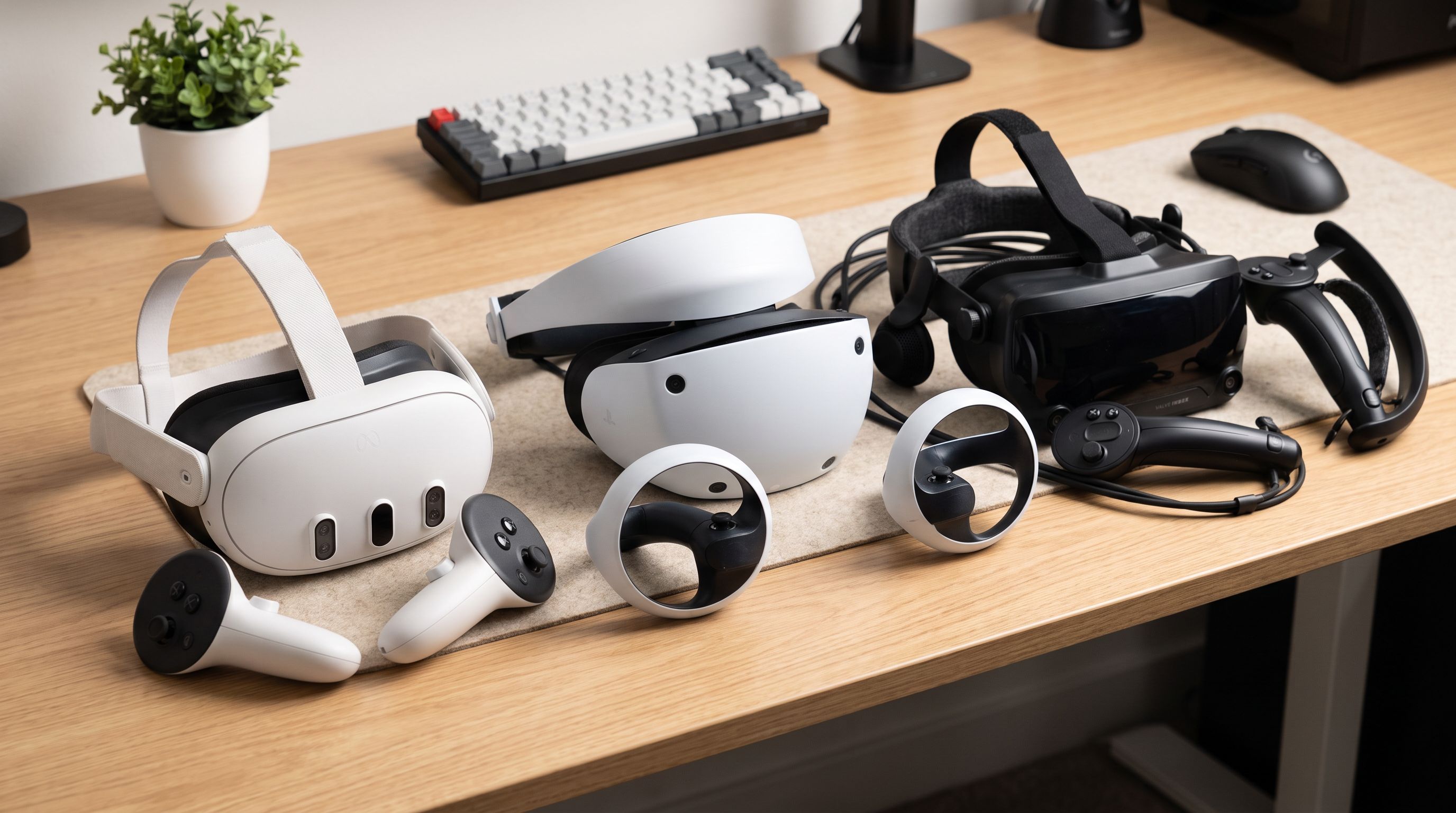
Reader-supported: we may earn a commission from links on this page, at no extra cost to you. It never affects our picks. Learn more.
VR in 2026 is no longer a single market. It's three overlapping ones: cheap standalone headsets you can hand to a guest, a console headset that only makes sense if a PS5 is already under your TV, and PC-tethered gear built for people who care about sim racing, flight, and modded games at maximum fidelity.
The good news is that choosing between them is mostly a question about the hardware you already own — not about which headset has the best spec sheet. We compared current models on optics, comfort, library depth and long-term support, drawing on manufacturer specs, independent reviews and owner feedback, to make that decision quick.
The short answer
- Most people should buy a Meta Quest 3. It's the only headset that works fully standalone and plugs into a gaming PC for SteamVR, and its pancake lenses are noticeably clearer edge-to-edge than the older Fresnel designs.
- On a tight budget, the Meta Quest 3S runs the identical game library on the same processor. You give up lens quality and passthrough sharpness, not compatibility.
- If you own a PS5 and nothing else, the PlayStation VR2 delivers OLED contrast and eye-tracked foveated rendering that standalone chips can't match — with the caveat of a smaller, slower-growing library.
- If you're building around a high-end PC, the Valve Index remains the reference point for tracking precision and controller feel, and a Quest 3 over Link or Virtual Desktop is the flexible alternative.
 Best value · Meta Quest 3S 128GB — Check price on Amazon →
 Best overall · Meta Quest 3 512GB — Check price on Amazon →
How the platforms actually differ
Standalone (Meta Quest)
Standalone headsets run games on a mobile chipset inside the visor. That means no cables, no PC, and a five-minute setup — which is precisely why the Quest ecosystem has by far the largest active user base and the deepest catalogue of native VR games. It's also the only place a big chunk of VR's best-known titles exist without workarounds.
The trade-off is raw horsepower. Native Quest games are rendered by a phone-class SoC, so lighting, geometry and draw distance are scaled back compared to PC VR. The escape hatch is that both Quest models can tether to a PC by cable or Wi-Fi and play full-fat SteamVR titles, which effectively makes a Quest two headsets in one.
Console (PlayStation VR2)
PSVR2 is the simplest premium option in VR. One cable into a PS5, done. Its OLED panels give true blacks and HDR highlights that LCD-based standalone headsets can't reproduce, and eye tracking enables foveated rendering — sharpening only where you're looking, which frees up GPU budget for better visuals overall. The Sense controllers add adaptive triggers and per-controller haptics.
The honest caveat: first-party VR output from Sony has slowed considerably, and the library grows mostly through ports and indie releases. Sony's PC adapter opens up SteamVR, but without eye tracking, HDR or headset haptics carried over — it's a bonus, not a second platform.
PC VR
PC VR is where fidelity lives: high-resolution mods, DCS World, iRacing, Assetto Corsa, Half-Life: Alyx, Skyrim VR with hundreds of mods. The Valve Index uses external base stations for sub-millimetre tracking that doesn't break when your hands leave the headset's camera view — the reason sim and dance-rhythm players still swear by it. Its knuckle controllers strap to your hands and sense individual fingers, which no inside-out competitor has matched for social VR expressiveness.
It's also the most demanding path. You need a capable GPU, wall space, and patience for setup. And with newer high-end PC headsets arriving from the likes of Pimax and Bigscreen at premium prices, PC VR remains an enthusiast lane rather than a starting point.
Comparison table
| Headset | Platform | Optics / display | Tracking | Best for | Main compromise |
|---|---|---|---|---|---|
| Meta Quest 3 | Standalone + PC VR | Pancake lenses, LCD, colour passthrough | Inside-out cameras | Almost everyone; mixed reality | Stock strap is poor; LCD blacks |
| Meta Quest 3S | Standalone + PC VR | Fresnel lenses, LCD | Inside-out cameras | Cheapest entry to the full Quest library | Softer edges, narrower sweet spot |
| PlayStation VR2 | PS5 (PC via adapter) | OLED HDR, eye tracking | Inside-out cameras | PS5 owners wanting the best image | Smaller library; wired to console |
| Valve Index | PC only | Fresnel, high refresh rate | SteamVR base stations | Sim racing, flight, social VR | Expensive, complex setup, ageing design |
 Best for PS5 owners · Sony PlayStation VR2 — Check price on Amazon →
Comfort is the spec nobody lists
The most common reason a headset stops getting used isn't graphics — it's weight on the face. Front-heavy designs put pressure on cheekbones and the bridge of the nose, and sessions end after 30 minutes.
Two fixes matter. First, a rigid halo-style strap that transfers weight to the crown and back of the skull instead of the face. The BOBOVR M3 Pro is the standard recommendation for Quest 3 owners because it does that and moves a battery to the rear, counterbalancing the display module while extending playtime. It's the single best money-per-comfort upgrade in VR.
 Best comfort upgrade · BOBOVR M3 Pro Head Strap for Quest 3 — Check price on Amazon →
Second, facial interface fit. Glasses wearers should check whether their frames clear the lenses, and consider prescription lens inserts — they're widely available for Quest and PSVR2 and eliminate the scratch risk of wearing glasses inside a headset.
Buying advice by situation
You've never tried VR and want to see if you like it. Quest 3S. It plays everything the Quest 3 plays. If you fall in love with VR, the resale market for Quest hardware is healthy.
You want one headset for the next several years. Quest 3. The lens upgrade is the difference you'll notice every single session, the passthrough is good enough for genuine mixed-reality apps, and PC tethering means it grows with your hardware.
You own a PS5 and don't want another ecosystem. PlayStation VR2. Accept the library size; enjoy the best contrast in mainstream VR.
You're a sim racer or flight sim pilot with a strong PC. Valve Index if you want the most reliable tracking and best controllers. A Quest 3 on a wired Link connection is the lighter-commitment alternative and gets you standalone use as a bonus.
Households with kids or frequent guests. Standalone wins by default — no cables to trip on, no PC to occupy, quick guest mode.
What to ignore in 2026
Don't chase headline resolution numbers alone; lens quality and the size of the sweet spot influence perceived sharpness more than pixel counts. Don't buy an ultra-premium mixed-reality device like a flagship Android XR headset or a Vision Pro purely for gaming — their game libraries are thin and their strengths lie in productivity and media. And don't buy a PC VR headset before checking that your GPU can actually feed it; an underpowered PC turns high-end VR into a stuttering, nausea-inducing experience.
FAQ
Is the Quest 3S worth skipping for the Quest 3? If you can stretch, yes. The pancake lenses, wider clear area and better passthrough make the Quest 3 more pleasant for long sessions. But the 3S is not a compromised platform — it's the same chip and the same games.
Can PSVR2 work with a PC? Yes, via Sony's official PC adapter and SteamVR. You lose eye tracking, HDR and headset haptics, so treat it as a useful extra rather than a reason to buy the headset.
Do I need a gaming PC for VR at all? No. Standalone Quest headsets run everything on-device. A PC only becomes necessary if you specifically want SteamVR titles, mods or sim racing at high fidelity.
How much space do I need? Seated and standing experiences need almost none. Roomscale games are comfortable in roughly a 2m x 2m clear area; base-station systems like the Index reward more space but don't require it.
Does motion sickness go away? For most people it improves with short, regular sessions and by starting with teleport-movement games. Look for headsets and titles with comfort settings such as vignetting and snap turning.
Our picks
Quest 3 512GB | VR Without Wires — Gorilla Tag Cardboard Monkenaut Bundle — Amazon Exclusive— Access to 100+ Games with a 3-Month Trial of Meta Horizon+ Included | Includes 512GB headset, 2 controllers, charging cable and power adapter for gaming, fitness and entertainment
Sharpest pancake lenses and full-colour passthrough, plus it runs standalone or tethers to a gaming PC.
Meta Quest 3S 128GB | VR Headset — Thirty-Three Percent More Memory — Virtual Reality Without Wires — Access to 40+ Games with a 3-Month Trial of Meta Horizon+ Included (Renewed Premium)
Same Snapdragon XR2 Gen 2 chip and full Quest library at the lowest entry price in VR.
Sony PlayStation VR2 Headset and Controllers - White (Renewed)
OLED HDR panels, eye tracking and haptic Sense controllers — no PC or phone setup required.

Valve Index VR Full Kit (Renewed)
Base-station tracking and finger-sensing knuckle controllers still set the bar for sim and social VR.
BOBOVR M3 Pro Battery Pack Head Strap Accessories, Compatible with Meta Quest 3/Quest 3S,Reduce Facial Stress,Magnetic Battery Swap Design
Rigid halo strap with battery pack that fixes the Quest 3's biggest complaint for very little money.
Get the best tech deals in your inbox
Join the BytePlaza newsletter for hand-picked gadget deals and new buying guides. No spam, unsubscribe anytime.
Related reads
Gaming Chairs Under $300 in 2026: 5 That Hold Up
We compared the best gaming chair under 300 options for 2026 on lumbar support, weight rating, armrest adjustability and long-term owner reports. Here's what lasts.
Spatial Computing, Explained: Life After Headset Hype
Mixed-reality headsets didn't replace your laptop. Here's what spatial computing is actually good for in 2026 — and which devices are genuinely worth it.
Stream Deck Alternatives 2026: 4 Macro Pads That Deliver
Looking for a Stream Deck alternative macro pad in 2026? We compare LCD control decks, hot-swap macro pads and knob-driven controllers for streamers and editors.