Solid State Battery 2026: What Actually Ships This Year
Solid state battery 2026 hype vs reality: what's shipping now, why silicon-carbon cells got to phones and power banks first, and which gadgets to buy today.
Reader-supported: we may earn a commission from links on this page, at no extra cost to you. It never affects our picks. Learn more.
Every January for the past five years, someone has announced that solid-state batteries are about to change everything. CES 2026 was no different — a five-minute-charge "Donut" cell drew crowds, and carmakers reiterated pilot-line timelines. Meanwhile, the battery in your pocket is still lithium-ion with a liquid electrolyte, same as 2015.
So here's the honest version. In 2026, solid-state batteries are real, they are being manufactured, and almost none of them are in products you can buy on Amazon. The battery improvement you can actually feel this year came from somewhere else: silicon-carbon anodes. This guide separates the two, explains what each one does, and points you to the gadgets worth buying right now.
What a solid-state battery actually changes
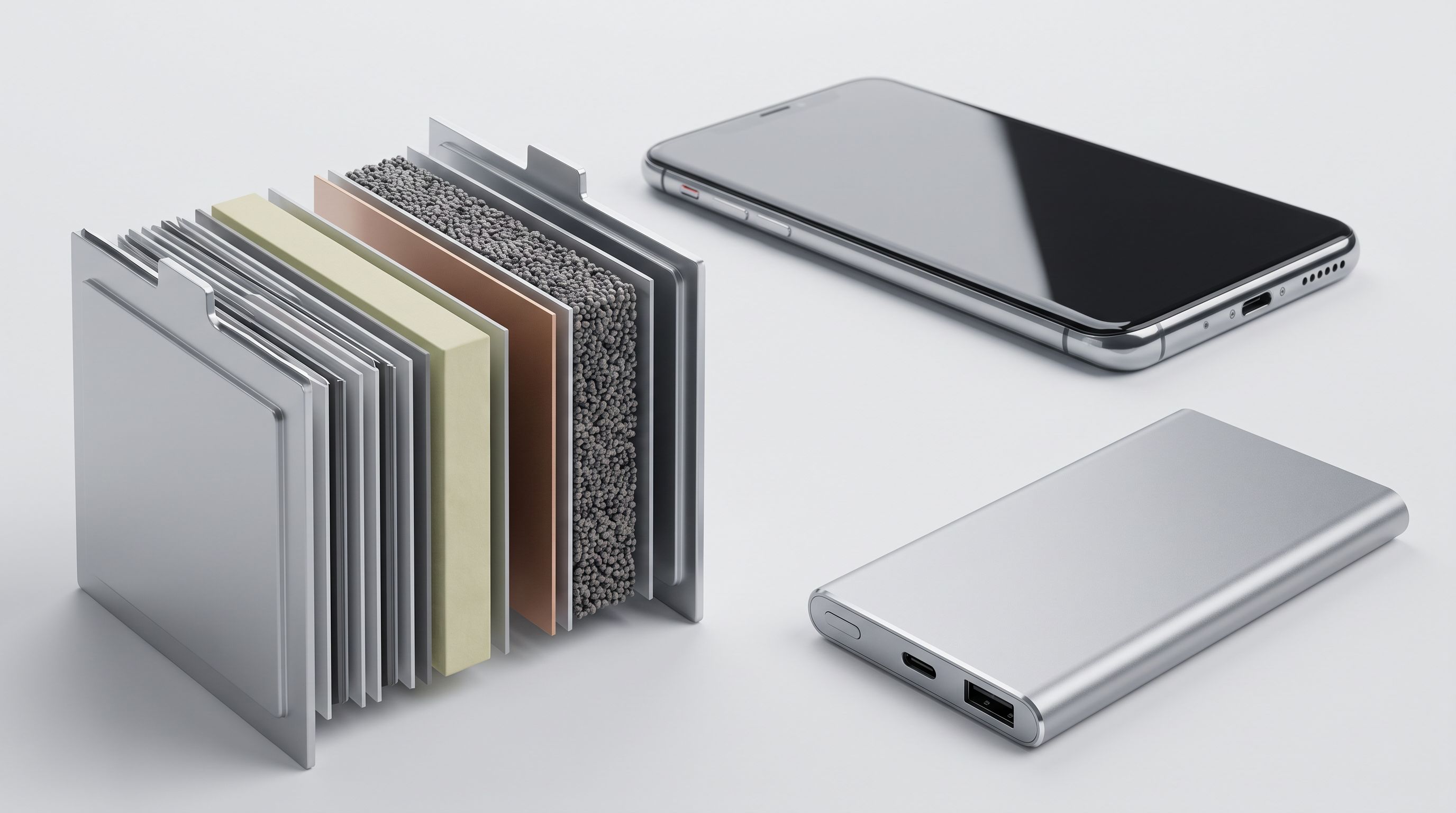
A conventional lithium-ion cell moves lithium ions between two electrodes through a liquid electrolyte — a flammable organic solvent. That liquid is the source of most of the compromises: it limits how fast you can charge without plating lithium, it degrades with heat, and it's why a punctured cell can vent and burn.
Solid-state cells replace that liquid with a solid — sulfide, oxide, or polymer. Three consequences follow:
- Higher energy density. A solid separator can tolerate a lithium-metal anode, which stores far more energy per gram than graphite. Industry targets discussed through 2026 cluster around 400–500 Wh/kg at cell level, versus roughly 250–300 Wh/kg for good current cells.
- Better safety margins. No flammable solvent means thermal runaway is much harder to trigger. That also allows simpler, lighter pack cooling and housing.
- Faster charging, in theory. Some solid electrolytes tolerate higher current densities without dendrite formation.
The catch is manufacturing. Solid-solid interfaces don't stay in perfect contact as electrodes expand and contract through cycles, so cells need stack pressure. Sulfide electrolytes react with moisture in air, forcing dry-room production. Yields on pilot lines are low and costs per kWh are multiples of current lithium-ion. Most credible analysts put genuinely mass-market solid-state automotive packs in the late 2020s to early 2030s, not this year.
What's genuinely happening in 2026
2026 is the year of pilot lines and limited-run vehicles, not showrooms. Toyota, Nissan, Honda, Volkswagen (via QuantumScape), Solid Power, CATL, and ProLogium are all running pilot or demonstration production. Expect small-batch demonstration vehicles, motorsport applications, drones, and medical devices — places where a high cost per kWh is acceptable because weight matters more than money.
What you will not see in 2026: a phone, laptop, power bank, or mainstream EV on a retail shelf with a true all-solid-state cell inside. If a listing claims "solid state" on a consumer power bank, treat it as marketing until a datasheet says otherwise. Some products use semi-solid or gel-polymer electrolytes, which are a real intermediate step but not the same technology, and they don't deliver the headline energy density numbers.
The upgrade you can actually buy: silicon-carbon anodes
While solid-state grabbed the headlines, silicon-carbon (Si/C) anodes quietly shipped. Instead of a pure graphite anode, these cells embed silicon in a carbon matrix. Silicon holds roughly ten times more lithium per gram, so you get meaningfully more capacity in the same volume — typically a 10–20% gain at pack level in phones.
This is why flagship phones from Honor, Xiaomi, OnePlus, and others have pushed past 6,000mAh and even 7,000mAh in bodies that didn't get thicker. The engineering problem with silicon is swelling — it expands dramatically when lithiated, which cracks the anode and kills cycle life. Carbon composites and clever binders mitigate it, but silicon-carbon cells generally still trade some long-term cycle life for that capacity.
For power banks, silicon-carbon has started appearing in a few slim models, but the dominant trend is different: higher output and integrated cables rather than radically denser cells.
Battery chemistries compared
| Chemistry | Energy density (cell) | Where it ships in 2026 | Main strength | Main limitation |
|---|---|---|---|---|
| Graphite Li-ion (NMC/LCO) | ~250–300 Wh/kg | Nearly every phone, laptop, power bank | Mature, cheap, predictable | Flammable electrolyte; density plateauing |
| LiFePO4 (LFP) | ~150–200 Wh/kg | Power stations, budget EVs, home storage | Very long cycle life, thermally stable | Heavy and bulky for its capacity |
| Silicon-carbon anode | ~15–20% above graphite | Flagship phones, a few slim banks | Real capacity gain, available today | Swelling; typically shorter cycle life |
| Semi-solid / gel polymer | Modest gain over Li-ion | Niche devices, some EV pilots | Safer than pure liquid electrolyte | Not true solid-state; limited availability |
| All-solid-state | 400–500 Wh/kg (target) | Pilot lines, demo vehicles, aerospace | Density plus intrinsic safety | Cost, yield, stack pressure, not retail yet |
What to buy instead while you wait
The rational move in 2026 is not to wait. Solid-state won't reach your gadget bag for years, and the gear available now is better than it has ever been — mostly because charging protocols, GaN power electronics, and thermal management improved, not because cells did.
For most people, the Anker Zolo Power Bank 20,000mAh 165W is the sensible centre of the range. It carries enough capacity for a laptop top-up plus a couple of phone charges, delivers real laptop-class wattage over USB-C Power Delivery, and includes a built-in cable so you stop losing them. That integrated-cable trend is the single most useful power bank change of the last two years.
 Best overall · Anker Zolo Power Bank 20,000mAh 165W — Check price on Amazon →
If you actually run a workstation laptop off battery, the Anker Prime Power Bank 26,250mAh 250W is the step up. Its value is the combination of total output across ports and a display that tells you real-time wattage and remaining runtime — which matters when you're rationing power on a flight or a shoot.
 Premium pick · Anker Prime Power Bank 26,250mAh 250W — Check price on Amazon →
For phone-only users, the Baseus PicoGo AM41 10,000mAh MagSafe Power Bank is the better shape of tool. Magnetic attachment plus a retractable USB-C cable means you top up opportunistically in short bursts, and frequent shallow charges are gentler on a lithium-ion cell than repeated 0–100% cycles.
 Best for phones · Baseus PicoGo AM41 10,000mAh MagSafe Power Bank — Check price on Amazon →
Heat, not cycle count, is what usually kills a battery early — so the charger matters as much as the cell. The UGREEN Nexode 100W USB-C GaN Charger uses gallium nitride switching to run cooler and smaller than legacy silicon chargers while negotiating proper USB-PD profiles across multiple devices, which avoids the sustained high-current-plus-high-heat combination that accelerates degradation.
 Best charger to pair · UGREEN Nexode 100W USB-C GaN Charger — Check price on Amazon →
And if you want the longevity story that solid-state promises, without waiting for it, LiFePO4 already delivers it. The EcoFlow RIVER 3 Plus Portable Power Station uses LFP cells rated for thousands of cycles with a far higher thermal runaway threshold than NMC. It's heavier per watt-hour — that's the trade — but for camping, backup power, or a desk UPS, it will outlast several generations of lithium-polymer gear.
 Best LiFePO4 pick · EcoFlow RIVER 3 Plus Portable Power Station — Check price on Amazon →
How to read battery marketing in 2026
Three quick filters. First, "solid state" on a consumer listing without a named cell supplier or electrolyte type is almost always semi-solid at best. Second, energy density claims should be stated at cell level or pack level — vendors switch between them to flatter their numbers. Third, fast-charge claims like "5 minutes" usually describe a 10–80% window under lab thermal conditions, not a full charge on your driveway.
The genuine 2026 story is unglamorous: incremental silicon-carbon gains, much smarter power delivery, and LFP quietly taking over anything that doesn't need to be light. Solid-state is coming. It's just not coming to your pocket this year.
FAQ
Can I buy a solid-state battery power bank in 2026? Not a true all-solid-state one. Some products marketed that way use semi-solid or gel-polymer electrolytes. They're a legitimate safety improvement but don't deliver the energy-density leap associated with real solid-state cells.
Which EVs have solid-state batteries right now? None at mainstream retail scale. Toyota, Nissan, Honda, Volkswagen with QuantumScape, CATL, and ProLogium are running pilot lines and demonstration vehicles in 2026, with broader production targeted later this decade.
Is silicon-carbon better than a normal lithium-ion battery? For capacity in a fixed volume, yes — typically 10–20% more. The trade-off is that silicon swelling tends to shorten cycle life somewhat, so a silicon-carbon phone battery may age slightly faster than a graphite one.
Should I delay buying a laptop or phone until solid-state arrives? No. Realistic consumer availability is years away, and you'd be trading several years of use for a vague timeline. Buy for today's needs and prioritise good thermal design and charging behaviour instead.
What actually extends my battery's life? Avoid heat, avoid sitting at 100% for long periods, and prefer moderate charging rates when you aren't in a rush. A well-behaved GaN charger and frequent partial top-ups beat repeated deep discharge cycles.
Our picks
Anker Zolo Power Bank,20,000mAh 30W Portable Charger with Built-in USB-C
High-output dual-USB-C bank with built-in cable — the practical choice while solid-state stays lab-bound.
Anker Prime Power Bank, 26,250mAh 300W Fast Charging
Laptop-class 250W output and a smart display; the closest thing to a desktop power station in a bag.
Baseus Picogo AM52 MagSafe Power Bank, Qi2.2 25W 10,000mAh Magnetic Portable Charger, 0.6" Slim 45W USB-C Fast Charging, Alloy Wireless Battery Pack for iPhone Duo/18 Pro Max/17/16/15/14/13/12 Only
Slim magnetic bank with a retractable USB-C cable — easy top-ups without stressing your phone's cell.
UGREEN Nexode 100W GaN USB C Charger, 4-Port Fast Laptop Charger
GaN charger that hits high wattage without cooking your battery — heat is the real lifespan killer.
EF ECOFLOW Portable Power Station RIVER 3 230,230 Wh,550W Up to 600W
LFP chemistry rated for thousands of cycles — today's safest, longest-lived portable pack.
Get the best tech deals in your inbox
Join the BytePlaza newsletter for hand-picked gadget deals and new buying guides. No spam, unsubscribe anytime.
Related reads
Foldables, Rollables, Tri-Folds: Where Phones Go in 2026
Tri-folds are shipping, rollables are rumored, and book-style foldables finally got good. Here's the real state of the phone form-factor race in 2026.
Robot Lawn Mowers, Explained: Why 2026 Is Different
Boundary wires are out, LiDAR and cameras are in. Here's what's actually shipping in robot lawn mowers, who the real players are, and whether to buy now.
Spatial Computing, Explained: Life After Headset Hype
Mixed-reality headsets didn't replace your laptop. Here's what spatial computing is actually good for in 2026 — and which devices are genuinely worth it.