Smartwatch Bands in 2026: Sport, Metal & Nylon, Decoded
The best smartwatch bands in 2026 for Apple Watch, Galaxy Watch and Garmin — how to match lug size, material and clasp to your wrist, sweat level and style.
Reader-supported: we may earn a commission from links on this page, at no extra cost to you. It never affects our picks. Learn more.
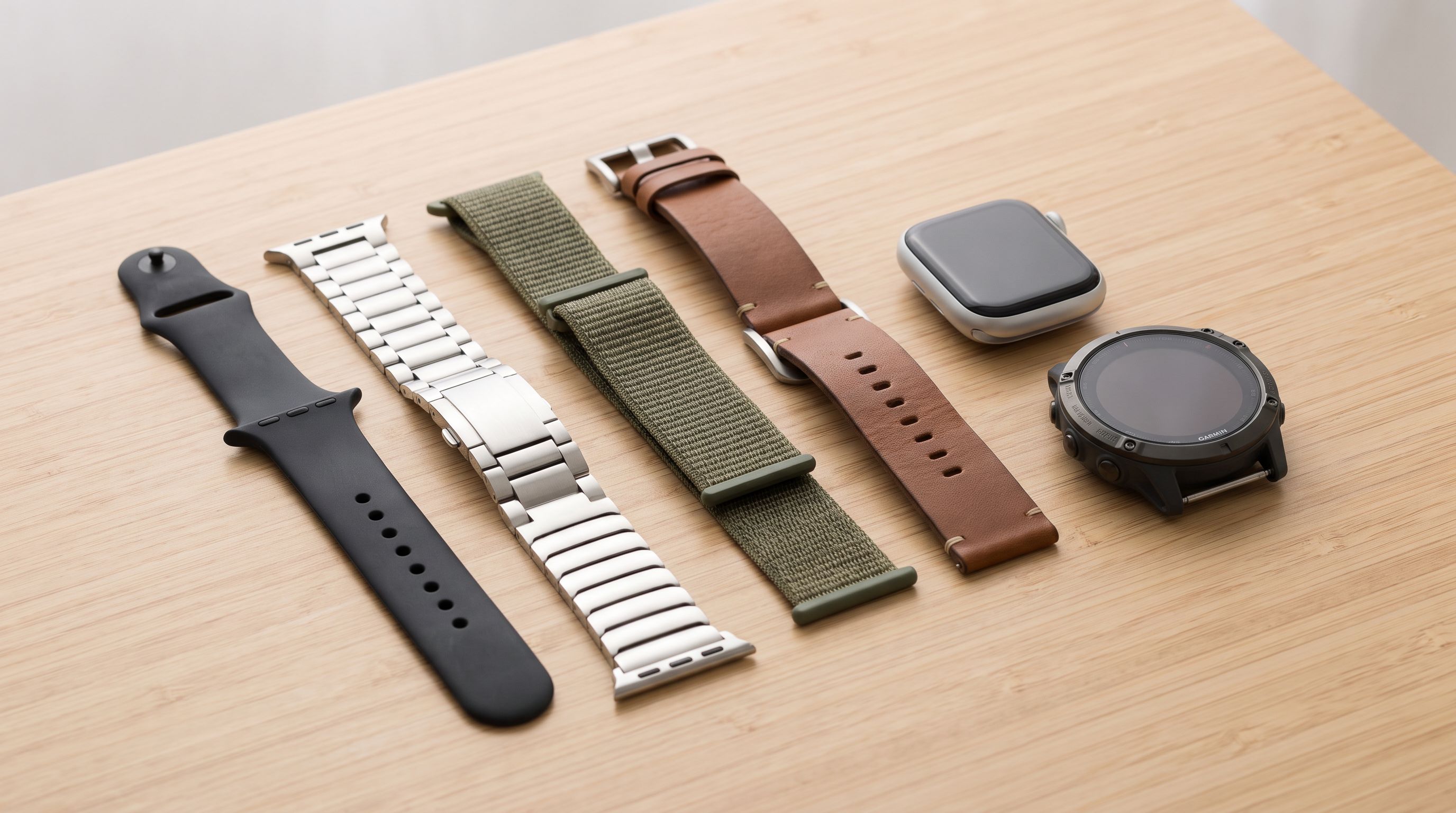
A band is the cheapest way to make a smartwatch feel new — and the fastest way to make it unwearable. Get the lug size wrong and nothing attaches. Get the material wrong and you'll have a sweaty, itchy wrist by mile three.
We compared the most popular band styles and the fitment systems used by Apple, Samsung and Garmin in 2026, drawing on manufacturer spec sheets, expert reviews and verified owner feedback. Here's how to buy a band that actually fits your watch, your wrist and your week.
Step 1: Know how your watch attaches
This is the part most people skip, and it's the part that causes returns.
Apple Watch: proprietary slide-in, sized by case
Apple Watch doesn't use lug widths in the traditional sense. Bands are sold by case size group, and in 2026 that means roughly two families:
- Small group: fits 38mm, 40mm, 41mm and 42mm cases
- Large group: fits 42mm (older), 44mm, 45mm, 46mm and 49mm Ultra cases
A 49mm Ultra accepts large-group bands, but not every band looks right against the Ultra's wider, flat-sided case — Apple's own Ocean, Trail and Alpine Loop styles are designed specifically for it. The Apple Watch Sport Loop in 46mm is the safest all-rounder for recent large cases.
Samsung Galaxy Watch: standard lugs with a quick-release twist
Galaxy Watch models use conventional spring-bar lug widths — 20mm on most 40/41/43/44mm models, 22mm on larger and Classic variants, and the Galaxy Watch Ultra uses Samsung's own Dynamic Lug system that needs a compatible strap or an adapter. The win here is huge: a 20mm Galaxy Watch can wear almost any 20mm watch strap ever made, including the Spigen Modern Fit Band in 20mm.
Measure the gap between the lugs with a ruler if you're unsure. Measure the case and you'll buy the wrong size.
Garmin: QuickFit vs. standard spring bars
Garmin splits into two camps. Fenix, Epix, Enduro and some Instinct models use QuickFit — a tabbed strap that clicks in and out with no tools, sized 20mm, 22mm or 26mm. Forerunner, Venu and Vivoactive models typically use ordinary quick-release spring bars at 18mm, 20mm or 22mm.
If you own a QuickFit watch, a Garmin QuickFit 22mm Silicone Band is the no-drama option; third-party QuickFit clones vary wildly in how securely the tabs seat.
 Best for Garmin owners · Garmin QuickFit 22mm Silicone Band — Check price on Amazon →
Step 2: Pick the material for how you actually live
| Material | Best for | Sweat & water | Comfort in heat | Watch-out |
|---|---|---|---|---|
| Silicone / fluoroelastomer | Workouts, swimming, daily wear | Excellent — rinses clean | Good, but can feel clammy | Attracts lint; cheap silicone can smell over time |
| Woven nylon (Sport Loop / NATO) | All-day wear, sleep tracking, hot climates | Good — dries fast but holds moisture briefly | Best in class | Hook-and-loop wears out after heavy use |
| Stainless steel (link or mesh) | Office, dress-up, durability | Fine, but rinse after sweat | Poor — heavy and warm | Adds real weight; link sizing can need a tool |
| Leather | Style, cooler weather | Avoid water entirely | Good once broken in | Degrades with sweat; not for gym use |
| TPU / rugged composite | Trail, job sites, Ultra-class watches | Excellent | Moderate | Bulky; can block some sensors if poorly shaped |
Silicone is the default for a reason. If you only own one band, make it silicone — ideally one with a vented or perforated underside so trapped sweat can escape. The Barton Elite Silicone Quick Release Strap is a sensible universal choice because it's offered across 18–24mm, so a single style can cover a Galaxy Watch and a Forerunner in the same drawer.
Nylon loops are the quiet comfort champion. Because adjustment is continuous rather than stepped by holes, you can get that exact tension where the sensor stays in contact without leaving a mark — which matters a lot for sleep and overnight heart-rate tracking. The Apple Watch Sport Loop remains the benchmark here; owner feedback consistently praises its weightlessness and the fact that it dries quickly after a run.
Metal looks sharpest but changes the watch's character. A full link bracelet can add noticeable mass, which some owners find makes a large case feel top-heavy. Mesh (Milanese-style) bands split the difference: lighter, and the magnetic clasp slides to any position, so there's no removing links with a pin pusher. That's exactly the appeal of the Spigen Modern Fit Band — steel looks, tool-free sizing.
Rugged cases-with-strap are their own category. If you've spent Ultra money and work with your hands, the Spigen Rugged Armor Pro Band wraps the exposed bezel edge rather than just dangling off the lugs — the practical argument for it is screen and case protection, not fashion.
Step 3: Clasp type matters more than you think
- Pin-and-tuck (classic buckle): most secure, fixed adjustment steps. Best for lifting and contact activity.
- Hook-and-loop: infinitely adjustable, fast on and off. Loses grip after months of heavy sweat.
- Magnetic (mesh, Milanese): elegant and stepless, but the weakest in a snag. Not ideal for climbing or CrossFit.
- Folding deployant (link bracelets): secure and preserves the band's length, but adds bulk under the wrist.
A practical rule: anything where the watch might get yanked — rope, bar knurling, pack straps — wants a buckle.
Step 4: Fit to your wrist, not your watch
Two numbers decide comfort. First, wrist circumference: under about 150mm, wide 22mm and 26mm straps with long tails will overhang awkwardly, and heavy link bracelets amplify that. Second, strap taper: a band that narrows toward the clasp (say 22mm down to 18mm) wears far lighter than a straight-cut one of the same width.
For optical heart-rate accuracy, independent testing and Garmin's own guidance agree on the same thing: wear the watch about a finger's width above the wrist bone, snug enough that it doesn't slide when you shake your arm, loose enough to not leave an indentation. A band that can't hold that tension will cost you data quality regardless of how good the sensor is.
Quick recommendations by owner
- Apple Watch, one band to rule them all: Apple Watch Sport Loop (46mm) — comfort, breathability, sleep-friendly.
- Apple Watch Ultra, hard use: Spigen Rugged Armor Pro Band for 49mm.
- Garmin Fenix/Epix: Garmin QuickFit 22mm Silicone Band — confirm your model's QuickFit size first.
- Galaxy Watch, dress-up: Spigen Modern Fit Band in 20mm (or 22mm for Classic sizes).
- Mixed watch collection: Barton Elite Silicone Quick Release Strap in your lug size.
 Best overall for Apple Watch · Apple Watch Sport Loop (46mm) — Check price on Amazon →
Buying tips that save returns
- Confirm lug width in millimetres before adding to cart — "fits Galaxy Watch" is not a size.
- Check the Ultra exception. Both Apple Watch Ultra and Galaxy Watch Ultra have quirks; generic listings often ignore them.
- Buy silicone from brands with stated materials. Cheap unmarked silicone is the most common source of odour and skin irritation complaints in owner reviews.
- Two bands beat one expensive one. A sport band plus a dressier option covers 95% of situations for less than a single premium bracelet.
- Keep the original. Resale value drops when the stock band is missing.
FAQ
How do I find my lug size? Measure the gap between the two lugs (the horns the strap slots into) in millimetres. Smartwatch lug sizes are almost always even numbers: 18, 20, 22, 24 or 26mm. Apple Watch is the exception — it uses case-size groups instead.
Will an Apple Watch band fit a Galaxy Watch? No. Apple's slide-in connector is proprietary. Adapters exist that convert Apple-style bands to spring bars, but they add height and are a common failure point.
Do third-party bands affect heart-rate or sleep tracking? Only indirectly. The sensor doesn't care what the band is made of — it cares whether the watch stays flush against your skin. A band that stretches, slips or can't be tightened finely will degrade readings.
Are nylon bands OK for swimming? They survive it, but they hold water and take time to dry, which can mean skin irritation. Silicone is the better choice for pool and open water.
How often should bands be replaced? Silicone and nylon used daily in workouts typically show wear in 12–24 months — cracking at the buckle holes, or hook-and-loop losing grip. Metal bands effectively last the life of the watch.
Is a leather band ever a good idea for a fitness watch? For office and evening wear, yes. For training, no — sweat breaks down leather quickly and the material traps moisture against the skin.
Our picks
Sport Band Compatible with Apple Watch Series 12 11 10 46mm, 9 8 7 45mm, 4 5 6 & SE 2 3 44mm, Ultra 49mm for Women Men, Stretchy Straps for iWatch, Breathable, Nylon Soft Loop Ideal for Outdoor
Soft woven nylon with hook-and-loop adjustment — breathable, infinitely adjustable, and sweat-friendly.
Spigen Rugged Armor Pro Band for Apple Watch Ultra 49mm
TPU strap plus a bumper-style case that shields the Ultra's flat sapphire edges during workouts.
Garmin QuickFit, 22mm Black Silicone Band
Tool-free QuickFit swap and Garmin's own silicone — the safest fit for Fenix, Forerunner and Instinct lines.

Spigen Modern Fit Compatible with MoonSwatch, Galaxy Watch 20mm Band
Stainless steel mesh with a magnetic clasp that slides to any size — no link removal tools needed.

BARTON WATCH BANDS BARTON Elite Silicone Watch Bands - Quick Release - Choose Strap Color & Buckle Color (Stainless Steel, Black PVD or Gunmetal Grey) - 18mm, 20mm, 22mm & 24mm Watch Straps
Spring-bar quick-release silicone in 18–24mm, so one strap style fits almost any standard-lug watch.
Get the best tech deals in your inbox
Join the BytePlaza newsletter for hand-picked gadget deals and new buying guides. No spam, unsubscribe anytime.
Related reads
USB-C Cable Tester Picks for 2026: Find the Fakes Fast
Which usb-c cable tester actually reveals 240W EPR support, e-marker data and real data speeds? We compared four worth owning in 2026, from $15 meters to lab tools.
Portable Document Scanner 2026: Sheetfed vs Wand, Settled
Digitizing paperwork at home? We compare the best portable document scanner picks for 2026 on speed, duplex scanning, OCR software and cloud workflows.
Laptop Backpack With USB Charging Port 2026: 5 Worth It
We compared commuter laptop backpacks with USB charging ports on padding, capacity and reported durability. Five picks for 2026, plus what the port really does.