Smart Ring vs Fitness Band in 2026: Which Tracks Better?
Smart ring vs fitness band in 2026: we compare sensor coverage, battery life, subscription costs and real-world accuracy to help you pick the right tracker.
Reader-supported: we may earn a commission from links on this page, at no extra cost to you. It never affects our picks. Learn more.
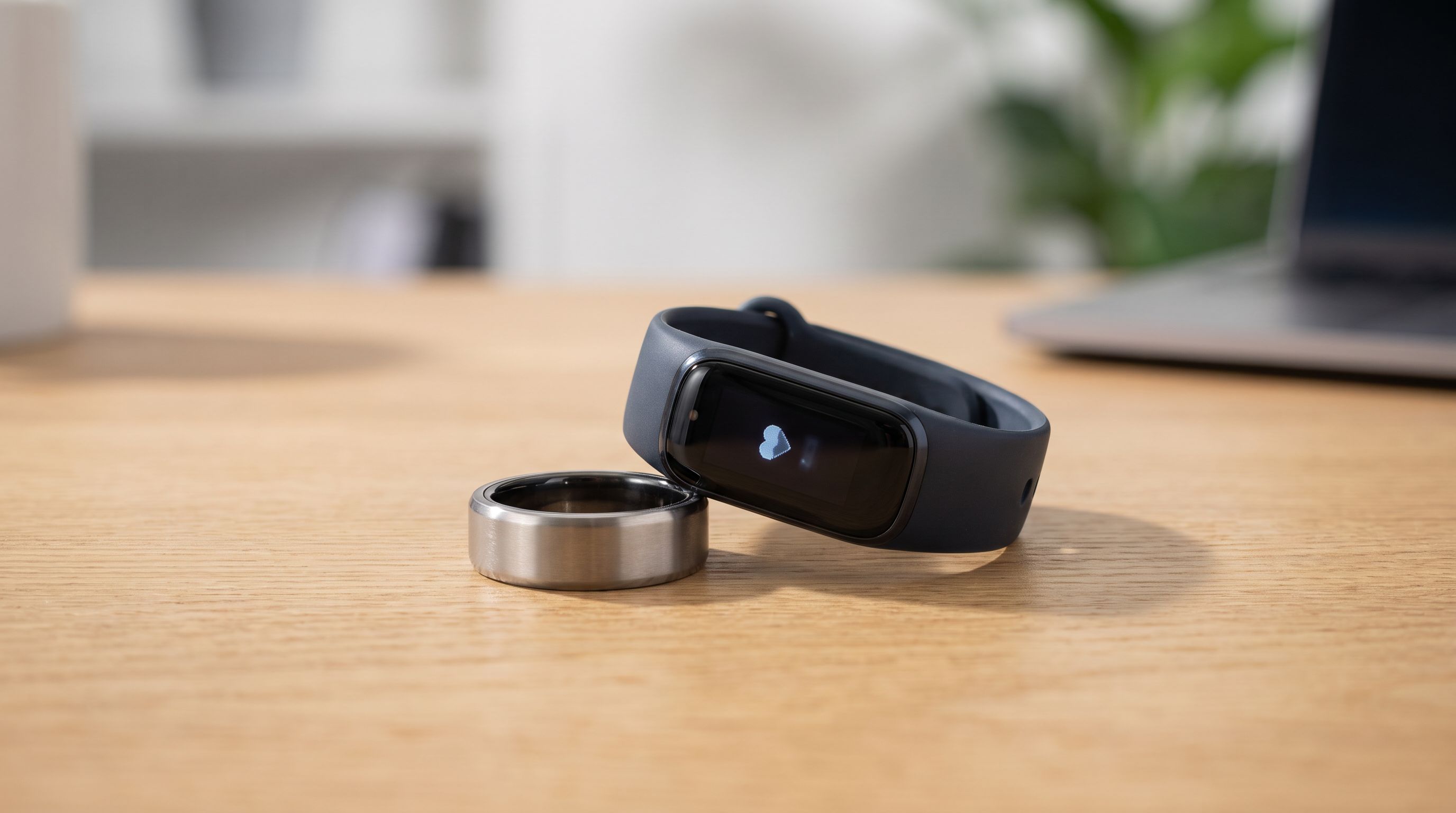
Smart rings went from novelty to mainstream fast. In 2026 you can buy a titanium band for your finger that tracks sleep stages, heart rate variability, skin temperature and blood oxygen — and never shows you a single notification. Meanwhile, the humble fitness band refuses to die: it's cheaper, it has a screen, and in most cases it has GPS.
So which one actually tracks better? We compared current models on sensor coverage, battery life, subscription cost and what owners and independent reviewers report about accuracy. The short version: rings win sleep and comfort, bands win exercise and value. The longer version matters, because the gap is narrower than either marketing department admits.
The core difference: where the sensor sits
Both form factors use photoplethysmography (PPG) — green, red and infrared LEDs shining into your skin to read blood flow. The finger is a genuinely better place to do that than the wrist. There's more capillary density, less tendon movement, and the sensor sits snugly against tissue instead of sliding around a bony wrist. That's the physiological reason rings tend to perform well on resting heart rate, HRV and overnight temperature trends.
The wrist's advantage is real estate. There's room for a display, a GPS antenna, a bigger battery and often an ECG electrode or EDA sensor. A ring has none of that space, which is why no mainstream smart ring in 2026 has onboard GPS.
That single fact drives most of the decision. If your tracking happens mostly while you're asleep or sitting still, the finger is the better sensor site. If your tracking happens while you're running, lifting or cycling, the wrist is.
Sensor coverage compared
| Smart rings | Fitness bands | |
|---|---|---|
| Resting HR & HRV | Excellent — finger PPG is stable overnight | Good, but wrist motion adds noise |
| Sleep stages & duration | Best-in-class; widely praised by owners | Decent; often over-credits time asleep |
| Skin temperature trends | Standard on most 2026 rings | Available on some mid/high-end bands |
| SpO2 | Yes, overnight spot checks | Yes on most models |
| Continuous workout HR | Weakest point — knuckle flex and grip cause dropouts | Reliable for steady cardio; chest strap still better for intervals |
| Built-in GPS | None | Common on bands like Fitbit Charge 6 |
| Step & activity counting | Good, occasionally inflated by hand gestures | Good, well-established algorithms |
| Display & notifications | None (phone app only) | Yes on most bands |
| ECG / AFib checks | Not yet on mainstream rings | Available on several bands and watches |
 Best fitness band overall · Fitbit Charge 6 — Check price on Amazon →
The workout row is where rings genuinely lose. Independent reviewers repeatedly note that gripping a barbell, a bike handlebar or kettlebell compresses the ring against your finger and corrupts the signal. Rings generally estimate workout intensity from movement and post-exercise heart rate rather than tracking it minute by minute. That's fine for a walk; it's inadequate for intervals.
Battery life: rings win, but not by as much as you think
A smart ring typically runs several days to about a week per charge, depending on size and how aggressively it samples. Bigger ring sizes hold bigger batteries, so a size 12 will outlast a size 7 of the same model. Oura Ring 4 sits comfortably in the multi-day camp, and the recessed sensor design improved both comfort and consistency over earlier generations.
 Best smart ring overall · Oura Ring 4 — Check price on Amazon →
Fitness bands are more varied. Screenless or low-power models stretch a week or more — Garmin Vivosmart 5 is a standout here, and Garmin's efficiency reputation is well earned. Feature-heavy bands with always-on displays and GPS drop to a few days, and GPS workouts drain them fast.
 Best band for battery life · Garmin Vivosmart 5 — Check price on Amazon →
The practical difference: rings charge on a tiny dock in roughly an hour and you can do it while showering. Bands charge via a proprietary clip, usually overnight — which means a night of missed sleep data. If sleep tracking is your priority, that's a real argument for a ring.
The subscription question
This is the biggest hidden cost in wearables, and it varies wildly.
- Oura requires a membership for full insights. Without it you get limited data. Factor that into the lifetime cost.
- Whoop is subscription-first by design — the hardware comes with the membership. Whoop 5.0 makes sense if you want coaching on strain and recovery and will actually act on it.
- Ultrahuman Ring AIR is the notable subscription-free ring. You buy the hardware and get the metrics. Optional add-on modules exist, but the core experience isn't paywalled.
- Fitbit Charge 6 shows core data free; Premium unlocks deeper sleep and readiness analysis. Google has folded more AI-driven health features into Premium, so the free tier feels thinner than it used to.
- Garmin Vivosmart 5 has no subscription at all. Garmin Connect is free, including sleep scores, Body Battery and training metrics.
 Best for recovery-focused training · Whoop 5.0 — Check price on Amazon →
 Best subscription-free ring · Ultrahuman Ring AIR — Check price on Amazon →
Over three years, a subscription can cost more than the device. If you're price-sensitive, Ultrahuman Ring AIR and Garmin Vivosmart 5 are the two picks that don't keep charging you.
What owners actually report about accuracy
Pulling together owner feedback and independent review testing, a few consistent themes emerge:
Rings are trusted for sleep. The most common sentiment in smart ring communities is that sleep staging feels plausible and night-to-night trends track how people actually feel. Where rings get criticised is absolute precision — stage boundaries are estimates, not EEG.
Rings over-count steps. Hand movement — washing dishes, gesturing while talking — gets read as walking. Most owners learn to treat the step count as directional rather than literal.
Bands undercount effort in strength training. Wrist PPG struggles with isometric load and bent wrists. Both form factors share this weakness; neither replaces a chest strap for serious interval work.
Fit is everything. A loose ring or a band worn slackly below the wrist bone destroys data quality on either device. Most accuracy complaints trace back to fit, not hardware.
Rings are the better all-day wear. The strongest practical argument for rings in owner reviews isn't accuracy — it's that people actually keep wearing them. A device that's never taken off collects more complete data than a more accurate device you remove at night.
Who should buy what
Buy a smart ring if you care most about sleep, recovery and long-term trends; you don't want a screen on your wrist; you already own a smartwatch for workouts; or you wear a traditional watch you don't want to replace. Oura Ring 4 is the safest pick for polish and app quality. Ultrahuman Ring AIR is the pick if ongoing fees bother you.
Buy a fitness band if you want GPS-tracked runs or rides, on-wrist pace and heart rate, notifications, and the lowest entry cost. Fitbit Charge 6 is the most well-rounded. Garmin Vivosmart 5 is for people who want long battery and no subscription. Whoop 5.0 is a different animal entirely — a coaching service for people who train with intent.
Buy both? It's not as absurd as it sounds. A ring for nights and a band or watch for workouts is a genuinely common setup, and it plays to each device's strengths. Just be ready for two apps that disagree with each other.
FAQ
Is a smart ring more accurate than a fitness band? For resting heart rate, HRV and sleep, generally yes — the finger is a more stable sensor site. For exercise heart rate and distance, no; bands with GPS are clearly better.
Do smart rings work for weightlifting? Poorly. Gripping weights compresses the ring and corrupts the PPG signal, and metal bars can scratch the finish. Most lifters wear the ring on the opposite hand or remove it and log the session manually.
Can I avoid a subscription entirely? Yes. Ultrahuman Ring AIR and Garmin Vivosmart 5 give you full core functionality without a recurring fee.
How long do smart rings last before the battery degrades? Expect meaningful capacity loss after roughly two to three years of daily charging, as with any small lithium cell. Rings are generally not user-serviceable, so treat them as a multi-year purchase, not a decade-long one.
Will a ring replace my smartwatch? Only if you don't need a screen, GPS or notifications. Many people use a ring alongside a watch rather than instead of one.
Our picks
OURA Ring 4 Smart Ring - Silver - Size 8
The most refined sleep and readiness tracking in a ring, with a recessed sensor design and multi-day battery.
ULTRAHUMAN Ring PRO Smart Ring for Women and Men, Aster Black, Size 9
Full metabolic, sleep and recovery metrics with no mandatory monthly fee — a big long-term cost saver.
Google Fitbit Charge 6 - Fitness Tracker - Obsidian/Black
Built-in GPS, a bright display and solid heart-rate tracking make it the most complete everyday band.
Garmin vívosmart® 5, Health & Fitness Tracker, S-M, Black
Roughly a week per charge, Garmin's mature sleep and stress metrics, and zero subscription required.
WHOOP 5.0/MG SuperKnit – Signature Performance Knit Accessory for Health, Fitness, & Wellness Wearable – Not Compatible with Gen 4
Screenless band built around strain, recovery and sleep coaching for people who actually train hard.
Get the best tech deals in your inbox
Join the BytePlaza newsletter for hand-picked gadget deals and new buying guides. No spam, unsubscribe anytime.
Related reads
Best Smart Rings 2026: Oura vs Samsung vs Ultrahuman
We compare the best smart rings of 2026 — Oura Ring 4, Samsung Galaxy Ring, Ultrahuman Ring Air and more — on sleep accuracy, battery life and subscription costs.

Wearable Health Tech in 2026: The Sensors Coming Next
Smart rings and watches are gaining AI, not new sensors. Here's what's actually shipping in 2026, what's still unproven, and what's worth buying now.
Sleep Trackers in 2026: Ring, Band or Under-Mattress Mat?
We compared the best sleep tracker options for 2026 — Oura Ring 4, Whoop, RingConn Gen 2 and Withings Sleep — on accuracy, subscriptions and useful data.