Best Smart Rings 2026: Oura vs Samsung vs Ultrahuman
We compare the best smart rings of 2026 — Oura Ring 4, Samsung Galaxy Ring, Ultrahuman Ring Air and more — on sleep accuracy, battery life and subscription costs.
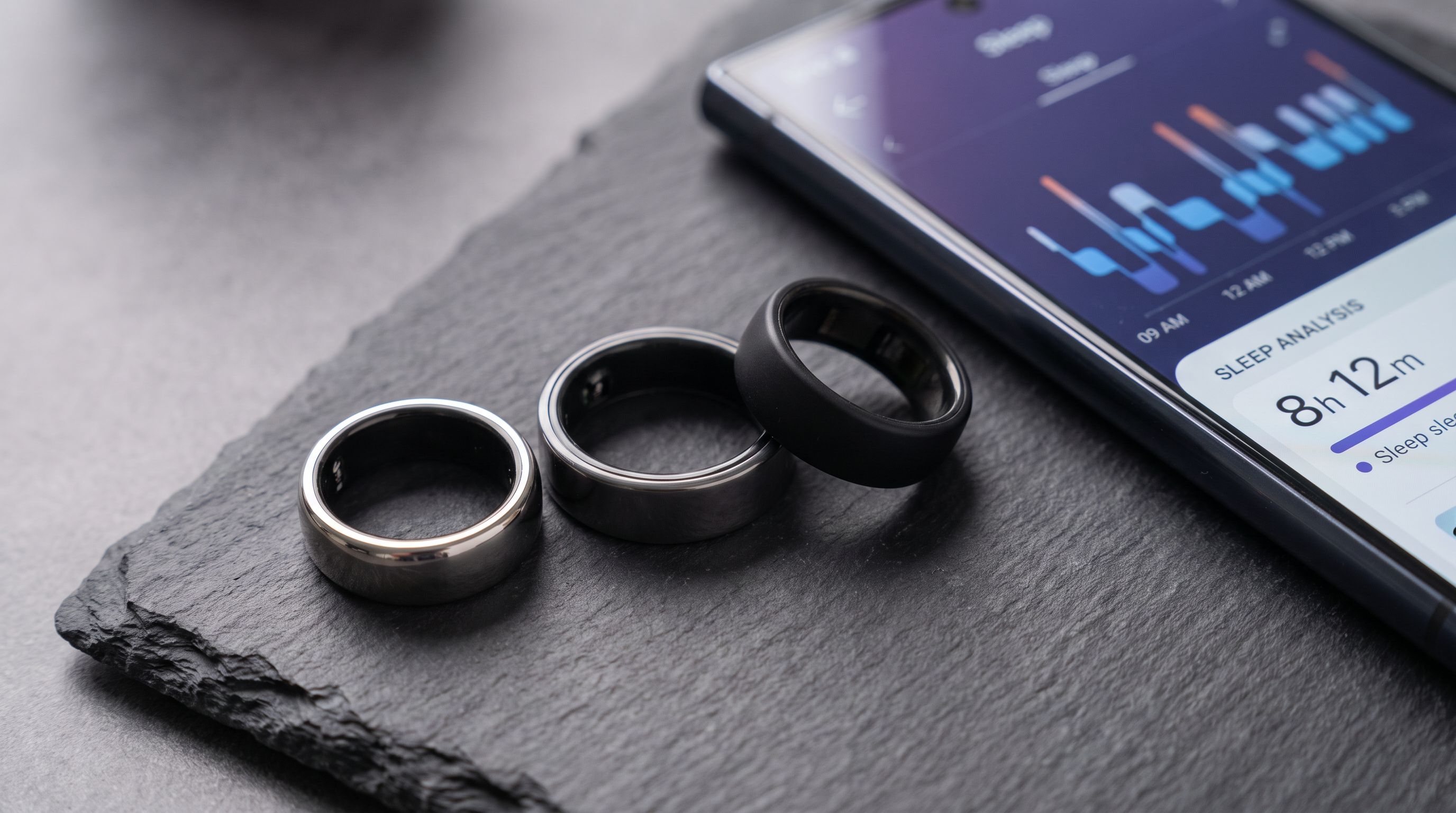
Smart rings have gone from curiosity to genuine category. They do one thing a smartwatch struggles with: they're comfortable enough to wear in bed every single night, which is exactly when the most useful health data gets collected. No screen, no notifications, no charging every evening.
But the category has also become confusing. Three brands dominate the conversation — Oura, Samsung and Ultrahuman — and they've each made very different bets on hardware, software and, crucially, whether you pay a monthly fee. This guide breaks down which one actually fits your wrist (well, finger) and your budget.
How smart rings actually work — and where they fall short
Every mainstream smart ring uses the same core sensor package: a photoplethysmography (PPG) sensor for heart rate and blood oxygen, an accelerometer for movement, and skin temperature sensors. The finger is a genuinely good place for optical heart-rate sensing — arteries sit close to the surface and there's less motion artefact at rest than at the wrist.
That's the strength. The weakness is exercise. Rings clench, slide and lose contact during weightlifting, cycling on the drops, or anything involving grip. If live workout heart rate matters to you, a chest strap or a watch is still the right tool. Rings are best understood as recovery and sleep instruments that happen to count steps.
On sleep accuracy: independent research on wearables consistently shows that the best consumer devices are reliable at detecting sleep vs. wake and total sleep time, but far less reliable at staging (light/deep/REM) compared to polysomnography. Oura has been the most frequently studied of the ring makers and has published validation work, which is a reasonable proxy for confidence — but treat any device's "you got 47 minutes of deep sleep" number as a trend line, not a lab result. Night-to-night patterns over weeks are where the real value lives.
The subscription question
This is the single biggest differentiator, and it's worth being blunt about it.
Oura requires a membership to see almost anything beyond raw numbers — Readiness, Sleep and Activity scores, trends, and the AI features all sit behind it. The hardware alone is close to useless without it. Over three years, the subscription can cost more than the ring did.
Samsung charges nothing extra for the Galaxy Ring's core features in Samsung Health. That's a deliberate competitive strike, and it's the strongest argument in the Galaxy Ring's favour.
Ultrahuman also ships subscription-free for core tracking, though it sells optional add-on "PowerPlugs" and extended features. RingConn similarly takes a no-subscription stance.
If you're the kind of person who resents recurring fees, that narrows the field fast. If you want the most polished, best-researched sleep software, Oura still leads — you just have to accept the rent.
The comparison
| Oura Ring 4 | Samsung Galaxy Ring | Ultrahuman Ring Air | RingConn Gen 2 | |
|---|---|---|---|---|
| Subscription | Required for full features | None | None for core features | None |
| Phone support | iOS + Android | Android only (full features need a Galaxy phone) | iOS + Android | iOS + Android |
| Battery (claimed) | Up to ~8 days | Up to ~7 days | Up to ~6 days | Up to ~7 days (plus charging case) |
| Material | Titanium | Titanium | Titanium | Titanium |
| Standout feature | Best-in-class sleep and readiness software | Deep Galaxy ecosystem integration, no fees | Lightest feel, metabolic/glucose-adjacent features | Charging case gives weeks off-grid |
| Best for | Serious sleep tracking | Samsung phone owners | Fee-averse data nerds | Travellers and value hunters |
Battery figures above are manufacturer claims; real-world results depend on ring size (bigger rings hold bigger cells), how often you trigger SpO2 tracking, and how many workouts you log. Expect roughly 4–6 days of realistic use from most of them.
The picks
Best overall: Oura Ring 4
Oura has a multi-year head start on everyone, and it shows in the software rather than the hardware. The Readiness score is the most useful single number in the category — a genuinely good daily prompt for whether to train hard or take it easy — and the sleep breakdown is presented with more nuance and less gamification than rivals.
The fourth-generation design moved to a fully recessed interior sensor array, which means no protruding bumps inside the band. It's more comfortable and it improved signal capture across a wider range of finger shapes. Sizing runs from small to large with a free sizing kit, and it works properly on both iOS and Android — still not true of Samsung.
The catch is the membership. Budget for it as an ongoing cost, not a one-off purchase.
Best for Samsung phone owners: Samsung Galaxy Ring
If you already carry a Galaxy phone, this is close to a no-brainer. No subscription, tight integration with Samsung Health, and neat ecosystem tricks — the ring can pair with a Galaxy Watch so the two devices split sensing duties rather than duplicating it, and gesture controls let you dismiss alarms or trigger the camera shutter with a double pinch.
The limitation is the flip side of that strength: it's Android-only, and several features are gated to Samsung devices. iPhone users should look elsewhere. Sleep tracking is solid and the "Energy Score" is a competent Readiness analogue, though the analysis isn't as deep as Oura's.
Best subscription-free alternative: Ultrahuman Ring Air
Ultrahuman's pitch is simple: comparable tracking, no recurring fee, and one of the lightest rings you can buy — around the 2.4–3.8g range depending on size, which makes it easy to forget you're wearing it.
The app leans into circadian rhythm coaching (caffeine and sunlight windows, a "stimulant window" recommendation) and Ultrahuman also sells continuous glucose monitoring separately, which some users pair for a fuller metabolic picture. Sleep staging is decent but historically a touch more variable than Oura's. The trade is fair: you're giving up some software polish to avoid a monthly bill.
Best battery life and value: RingConn Gen 2
RingConn is the underdog worth knowing about. The Gen 2 is slim, titanium, subscription-free, and ships with a charging case that holds multiple full recharges — meaning you can genuinely travel for weeks without a cable. It also added sleep apnea detection to its feature set.
The app is less refined than the big three and the ecosystem is smaller, but for the money it delivers the fundamentals — sleep duration, HRV, resting heart rate, temperature trends — without asking for anything extra.
Best for training load: Whoop 5.0
Not a ring, but worth flagging because so many people cross-shop it. Whoop is a screenless band that leads on strain and recovery analytics for athletes, with continuous heart-rate sampling that a ring can't match during hard training. It's subscription-first — the hardware is bundled into the membership — so it's the opposite philosophy to RingConn or Ultrahuman. Choose it if training load, not sleep, is your primary question.
How to choose in 30 seconds
- iPhone user who cares most about sleep: Oura Ring 4.
- Galaxy phone user: Samsung Galaxy Ring, and don't overthink it.
- Allergic to subscriptions: Ultrahuman Ring Air or RingConn Gen 2.
- Serious athlete: Whoop 5.0, or a ring plus a chest strap.
One universal tip: always order the sizing kit and wear the sizer for a full 24 hours, including overnight. Fingers swell in heat and shrink in cold, and a ring that fits at 2pm can be loose at 4am — which is precisely when bad data gets recorded. Most people end up a half-size larger than they'd guess, and the ring should sit on the index or middle finger for the most stable readings.
FAQ
Are smart rings accurate for sleep tracking? They're good at total sleep time and sleep/wake detection, and reasonable at resting heart rate and HRV. Sleep staging is the weak point across all consumer wearables — use it to spot trends over weeks, not to judge a single night.
Do I have to pay a subscription for a smart ring? Only for some. Oura requires a membership for its scores and insights. Samsung Galaxy Ring, Ultrahuman Ring Air and RingConn Gen 2 all offer core tracking with no recurring fee.
Can I wear a smart ring in the shower or pool? Most are water resistant to 100m and fine for swimming and showering. Soap residue under the ring can affect sensor contact, so rinse and dry it occasionally.
Smart ring or smartwatch? A ring for comfort, sleep and all-day passive tracking. A watch for live workout metrics, GPS, notifications and a screen. Plenty of people wear both — Samsung explicitly supports pairing a Galaxy Ring with a Galaxy Watch.
How long do smart rings last? The battery is sealed and non-replaceable, so realistically expect two to three years before capacity degrades noticeably. Factor that into the total cost, especially on subscription models.
Our picks

OURA Ring 4 Smart Ring - Silver - Size 9 | Sleep, Activity, Women’s Health, AI Advisor, Up to 8 Days of Battery Life, Size Before You Buy, Android & iOS Compatible
The most refined sleep and readiness software in the category — if you accept the membership fee.
![Samsung Galaxy Ring, AI Smart Ring, Size First w/Sizing Kit, No App Subscription, Fitness Monitor, Sleep Tracker, Up to 7-Day Battery, Size 11, Titanium Black [US Version, 1Yr Manufacturer Warranty]](https://m.media-amazon.com/images/I/71yKqHvtBsL._AC_UY218_.jpg)
Samsung Galaxy Ring, AI Smart Ring, Size First w/Sizing Kit, No App Subscription, Fitness Monitor, Sleep Tracker, Up to 7-Day Battery, Size 11, Titanium Black [US Version, 1Yr Manufacturer Warranty]
No subscription and deep Galaxy Health integration, but Android-only.

RingConn Gen 2 Air Ultra-Thin Smart Ring(Size 8, Dune Gold) | 10-Day Battery Life, Fitness/Sleep/Stress/HR Tracker for Women&Men, No App Fee for Standard Features,iOS & Android Compatible
Ultra-light titanium ring with circadian coaching and no recurring fee.

RingConn Gen 2 Smart Ring - Sleep Apnea Monitoring(Gold, Size 8) | No APP Subscription, 12-Day Battery Life, Stress/Heart Rate/Women's Health Tracker, Android & iOS Compatible
Slim, fee-free, and ships with a charging case that keeps it running for weeks.

WHOOP 5.0/MG Activity Tracker - 12 Month Membership - Health and Fitness Wearable – 24/7 Activity and Sleep Tracker, Personalized Coaching, Menstrual Cycle Insights – 14+ Days Battery Life
Not a ring, but the strongest strain and recovery analytics for serious athletes.
Get the best tech deals in your inbox
Join the BytePlaza newsletter for hand-picked gadget deals and new buying guides. No spam, unsubscribe anytime.