Projector Home Gyms in 2026: Ditching the Smart Mirror
Smart fitness mirrors are fading. Here's how to build a projector-based home gym in 2026 — the best short-throw projectors, screens and sensors, compared.
Reader-supported: we may earn a commission from links on this page, at no extra cost to you. It never affects our picks. Learn more.
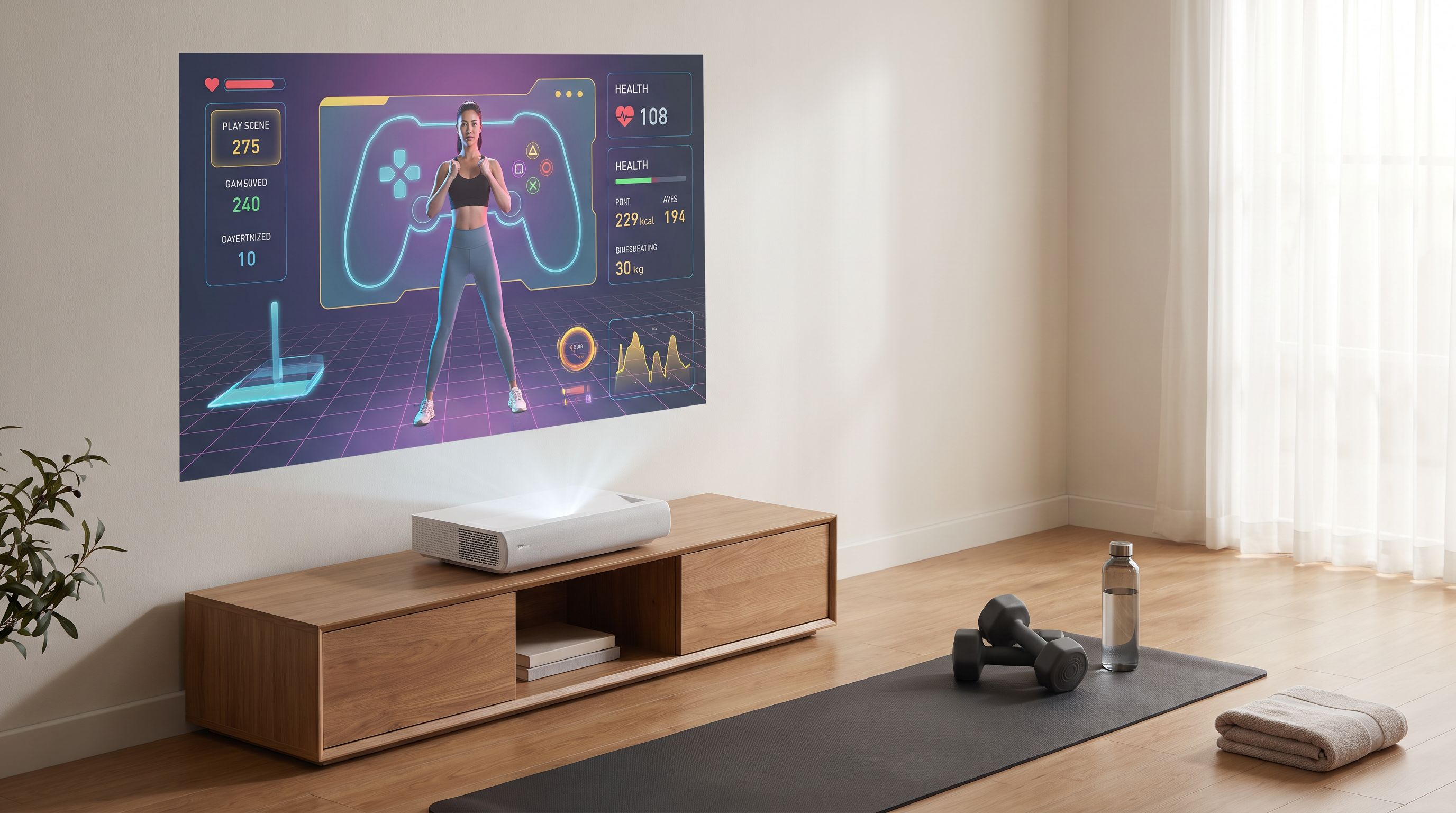
Smart fitness mirrors had a good run. A slab of reflective glass with a hidden display, a subscription, and a trainer talking you through a HIIT set — in 2020 that felt like the future. In 2026 it feels like a very expensive coat rack.
The category has contracted hard. Mirrors are single-purpose, locked to one app ecosystem, awkward to move, and most of them show a 40-something-inch image you have to stand close to. Meanwhile projectors got bright enough to use with the curtains open, cheap enough to buy on a whim, and smart enough to run the same fitness apps — and then switch to a 120-inch movie when you're done sweating.
This guide covers how to build a projector-based training setup that actually works: what brightness you need, where to put the thing so you don't stand in your own shadow, and which models we'd buy for which room.
Why projectors won the home-gym display war
Three practical advantages, none of them about picture quality snobbery.
Size. A mirror shows you a trainer at roughly life-size only if you're close. A short-throw projector puts a 100-inch class image on the wall, which means you can see foot placement and hand position from across the room — the whole point of following along.
Dual use. The mirror does one job. A projector is a workout screen before 8am and a cinema after dinner. That changes the value math completely, because you're not justifying a second screen for a third of an hour a day.
Openness. Most 2026 smart projectors run Google TV or support AirPlay/Chromecast, so you can run Peloton, Apple Fitness+, Nike Training Club, YouTube, Zwift, or just a timer app. No proprietary subscription gating the hardware you already bought.
The trade-off is honest: a mirror shows you. A projector doesn't. If seeing your own form is the main reason you'd buy, a projector plus a cheap full-length mirror angled nearby gets you there for less — and that's genuinely how most people run these setups.
Brightness is the whole ballgame
Workout rooms have windows. Workouts happen in daylight. This is where cheap projectors fall apart.
Manufacturers quote ANSI lumens (credible), "LED lumens" or "light source lumens" (inflated, sometimes wildly). Look for an ANSI figure, and treat anything under about 400 ANSI as an evening-only device.
Rough guidance based on reviewer measurements and owner reports:
- Dim room, blackout blinds: 400–700 ANSI is fine
- Normal room with lamps on: 1,000+ ANSI
- Daytime with windows, no ALR screen: 1,500+ ANSI, ideally a laser light source
Triple-laser models like the Hisense PX3-Pro sit at the top of that range and hold colour saturation under ambient light far better than LED units, which is why it's our overall pick for a dedicated space.
Throw distance: don't stand in your own shadow
This is the failure mode nobody warns you about. A standard long-throw projector mounted behind you casts your silhouette straight onto the image the moment you raise your arms.
Three ways around it:
- Ultra short throw (UST). Sits on a console inches from the wall, beams upward. Your body never crosses the light path. The Hisense PX3-Pro is the classic example.
- Ceiling mount, angled down. Works, requires installation, and a tall overhead press can still clip the beam.
- Gimbal projectors. The XGIMI Horizon S Max pivots on its base, so you can tuck it high on a shelf or in a corner and auto-correct the geometry. Far more forgiving than a fixed-lens box in an odd room.
 Best for flexible placement · XGIMI Horizon S Max — Check price on Amazon →
For garage or spare-bedroom gyms where you can't dedicate a console, the gimbal approach usually wins. For a living-room setup that doubles as the main TV, UST wins.
The picks, compared
| Model | Type | Best for | Watch out for |
|---|---|---|---|
| Hisense PX3-Pro | 4K triple-laser UST | Bright living rooms, 100"+ images, double duty as main TV | Needs a flat wall or ALR screen and a stable low console |
| XGIMI Horizon S Max | Smart gimbal projector | Awkward rooms, garages, renters who move often | Not UST — plan placement to avoid shadowing |
| Anker Nebula Capsule Air | Portable Google TV | Small rooms, travel, hotel-room workouts | Low brightness; evening or blinds-closed use only |
| Elite Screens Aeon CLR 3 | ALR screen (UST) | Pairing with a UST in a sunny room | UST-specific — won't work correctly with standard projectors |
| Apple Watch Series 10 | Wearable sensor | Heart-rate zones, rep and session tracking | iPhone-only ecosystem |
 Best overall · Hisense PX3-Pro 4K Ultra Short Throw Laser Projector — Check price on Amazon →
Hisense PX3-Pro — the mirror replacement
If you're replacing a wall-mounted fitness mirror in a shared living space, this is the straight swap. Triple-laser RGB light source, 4K, Google TV built in, and enough output that a mid-morning session doesn't look washed out. Reviewers consistently note strong colour volume and low input lag modes, which matters if you're also doing Switch Sports or Ring Fit on the same wall.
Pair it with the Elite Screens Aeon CLR 3 and the daylight problem largely disappears. ALR screens use a lenticular surface that accepts light from below (where a UST sits) and rejects light from above (lamps, windows). The difference is not subtle; it's the single highest-impact upgrade in a bright room.
XGIMI Horizon S Max — the flexible one
Gimbal base, automatic keystone, obstacle and screen-edge detection, Google TV, and a bright enough LED-laser hybrid output for evening and curtained-daytime use. The appeal for training is simple: you can place it high and behind, angled down past your head, without wrestling with mounting hardware. Owners repeatedly flag the auto-setup as genuinely hands-off, which matters when you're moving it between a spare room and the patio.
Anker Nebula Capsule Air — the no-commitment option
Soda-can sized, battery powered, Google TV on board. It will not fight sunlight. But for a garage with the door down, a basement, or a hotel room where you want a 60-inch yoga class on a blank wall, it's the lowest-friction way to try the whole concept before spending seriously.
Apple Watch Series 10 — the sensor the mirror had
Fitness mirrors bundled cameras and sensors. Projectors don't. A watch covers most of what you actually used: heart-rate zones, calorie estimates, session logging, and live metrics that overlay in Apple Fitness+ and feed Peloton and Strava. If you're on Android, a Galaxy Watch or a Whoop band fills the same slot.
Setting it up properly
- Measure the throw ratio before you buy. Every manufacturer publishes a distance-to-image-size chart. Check it against your actual wall.
- Wall colour matters. Matte white or light grey. Textured or coloured walls cost you contrast and accuracy.
- Audio is usually the weak point. Built-in speakers get drowned out by your own breathing and a fan. A cheap Bluetooth speaker or earbuds fixes it — but check for lip-sync lag; most smart projectors have an A/V delay setting.
- Add a mirror anyway. A standard leaning full-length mirror positioned at 45 degrees to the projected wall gives you form feedback for a fraction of what a smart mirror costs.
- Mind the fan noise. Brighter laser units run fans. In a quiet yoga session it's audible. Check reviewer dB measurements if you're sensitive.
Who should still buy a mirror?
Honest answer: people in very small apartments who need the display to disappear into a wall when not in use, and people deeply committed to a specific mirror-based coaching ecosystem they already love. If neither applies, a projector gives you more screen, more flexibility, and no dead-end hardware if the subscription service shuts down.
FAQ
Can I actually run Peloton or Apple Fitness+ on a projector? Yes. Google TV projectors like the Hisense PX3-Pro and XGIMI Horizon S Max run the Peloton app or cast from a phone. Apple Fitness+ works via AirPlay to a compatible projector or an Apple TV box plugged into HDMI.
Will I cast a shadow on the image? Not with an ultra short throw projector placed in front of you at floor level. With standard-throw units, mount high and angled down, and test with your arms overhead before committing to a position.
Do I need an ALR screen? Only if you train with ambient light. In a dim basement a white matte wall is fine. In a sunlit lounge, an ALR screen such as the Elite Screens Aeon CLR 3 does more for image quality than spending more on the projector.
Is a portable projector bright enough for morning workouts? Generally no, not with windows uncovered. The Anker Nebula Capsule Air is excellent in controlled light but will look washed out in direct daylight.
What about laser safety with a UST in a workout space? Certified consumer USTs include eye-protection sensors that dim the output if something blocks the lens. Still, don't look directly into the lens, and keep kids and pets from crawling across the light path.
Our picks
Hisense PX3-PRO Ultra Short Throw Triple Laser Projector, 4K UHD, 80” – 150”, 3,000 Lumens, 3000:1 Contrast, Dolby Vision & Atmos, IMAX Enhanced, 240 High Refresh Rate, Google TV, Designed for Xbox
Triple-laser UST that stays readable in daylight and throws a 100-inch class image from inches off the wall.
XGIMI HORIZON 20 Max 4K Projector Triple Laser Home Theater 5700 ISO Lumens
Gimbal-style smart projector with auto keystone and obstacle avoidance — aim it anywhere, including the floor-to-wall angle.
Anker Nebula Capsule Air
Pocketable Google TV projector for small rooms, garages and travel workouts when a wall is all you have.

Elite Screens Aeon CLR3 123" ALR Fixed Frame Projector Screen AR123H-CLR3
ALR screen built for UST projectors — kills washout from windows and lamps during daytime sessions.
Apple Watch Series 10
Reliable heart-rate and rep tracking that feeds most fitness apps, replacing the mirror's built-in sensors.
Get the best tech deals in your inbox
Join the BytePlaza newsletter for hand-picked gadget deals and new buying guides. No spam, unsubscribe anytime.
Related reads
Gaming Projectors in 2026: 4 Picks Under 20ms Input Lag
Chasing a 120-inch console setup without the lag penalty? We compared low input lag gaming projectors for 2026 — 4K/120Hz specs, HDMI 2.1, and real owner feedback.
Heart Rate Monitor Earbuds 2026: What the Sensors Really Do
Heart rate monitor earbuds in 2026 add optical HR and blood oxygen sensing to your workout. Here's which models actually ship it, how accurate it is, and who needs it.
Outdoor Projector 2026: Which One Survives Your Backyard?
Backyard movie nights need brightness, battery and weather sense. We compared the best outdoor projectors of 2026 on specs, IP ratings and owner feedback.