Portable Projector Screens in 2026: Pull-Up vs ALR
Pull-up, tripod or ALR? We compare the best portable projector screens of 2026 on gain, size and setup time for backyards, patios and small apartments.
Reader-supported: we may earn a commission from links on this page, at no extra cost to you. It never affects our picks. Learn more.
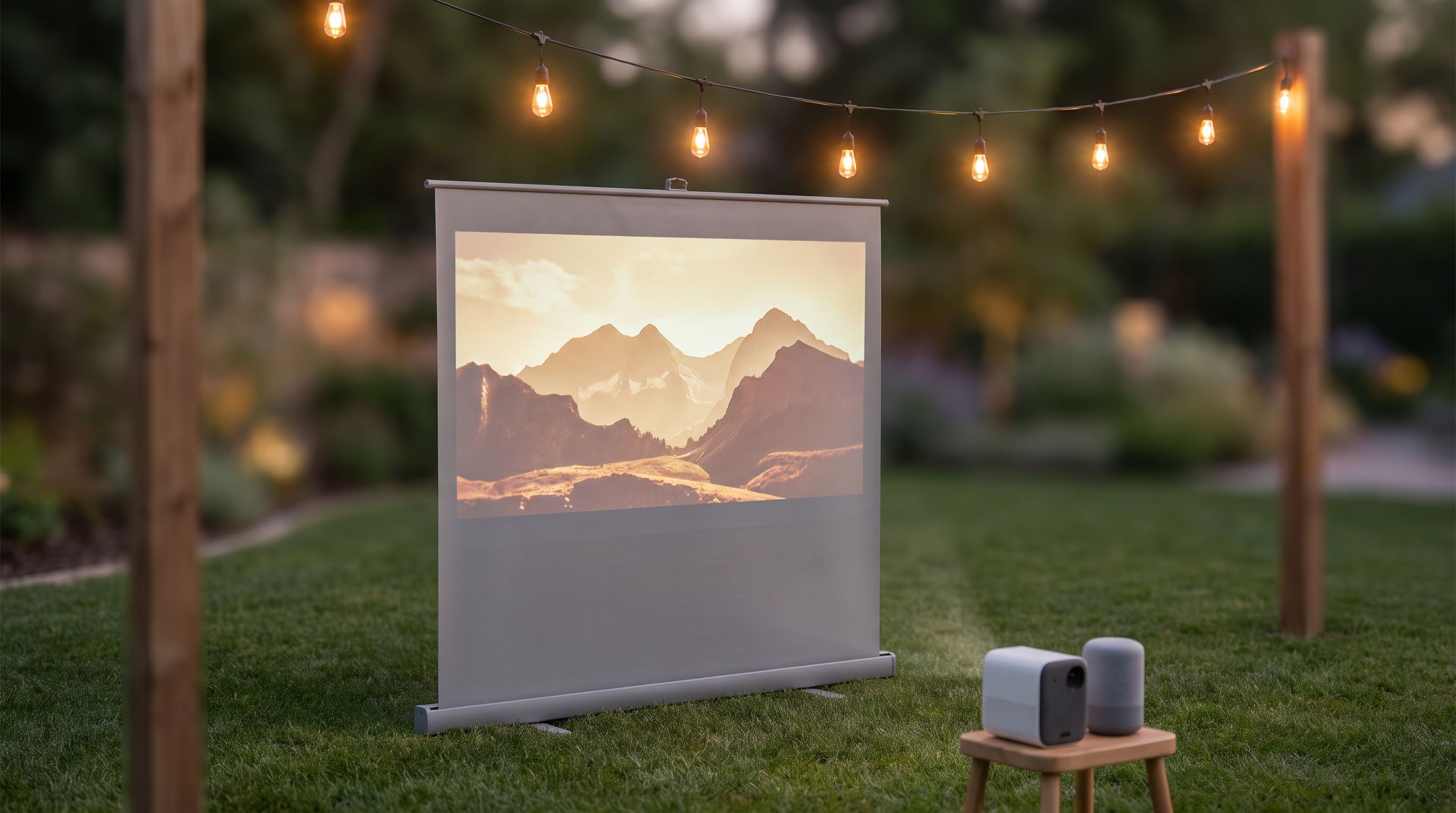
Projectors got genuinely portable years ago. Screens didn't — most people still throw an image at a bedsheet, a stucco wall, or a garage door and wonder why the picture looks washed out and vaguely green.
A proper portable screen is the cheapest upgrade in the entire projector chain. It fixes contrast, color accuracy and edge geometry in one move, and in 2026 you can get a good one that folds into a bag or rises out of a floor case. The hard part is choosing a type: pull-up tripod, folding frame, or ambient-light-rejecting (ALR). They solve different problems, and buying the wrong one is how you end up with a 120-inch screen you never take out of the closet.
Here's how we'd pick, based on manufacturer specs, independent reviews and owner feedback across the major brands.
The three formats, honestly compared
Pull-up and tripod screens: speed above all
A pull-up screen stores the fabric in a rigid aluminum case; you extend it on a tripod or scissor-arm and lock it. Setup is roughly 30–90 seconds, no tools, no assistants. The Elite Screens Tripod Series 100-inch Pull-Up Screen is the archetype — unfold legs, crank up, done.
 Fastest setup · Elite Screens Tripod Series 100-inch Pull-Up Screen — Check price on Amazon →
The compromise is the surface. Rolled fabric under spring tension is never as perfectly flat as a stretched or framed screen, so you may see gentle waves at the edges, especially in the first few uses before the material relaxes. Most tripod units also sit at a fixed low height, which means front-row heads in the frame at a crowded party. And in wind, a tripod is a sail.
Buy this if: you move the screen constantly, present in multiple rooms, or want a screen you'll actually bother to set up on a Tuesday.
Folding-frame screens: the backyard standard
Folding or snap-frame screens — the Elite Screens Yard Master 2 being the best-known example — use a sectional aluminum frame you assemble, then stretch the surface over it with snaps or clips. That tension is the whole point: the image plane is flat, so geometry is clean and there's no visible rippling.
 Best overall · Elite Screens Yard Master 2 (120-inch, 16:9) — Check price on Amazon →
Trade-off: assembly runs roughly 10–20 minutes the first time, maybe 5–10 once you know the frame. They're bulkier packed, and the bigger sizes really want two people. But for a 120-inch outdoor picture that doesn't sag, nothing else in this price band competes. The Yard Master Awning Series splits the difference with a lighter, quicker-deploying frame for patio use.
Buy this if: the screen lives in the garage and comes out for weekend movie nights at a consistent spot.
ALR screens: for rooms you can't darken
Ambient-light-rejecting surfaces use an optical structure — angular or lenticular layers — that reflects light arriving from the projector's direction while absorbing light coming from overhead lamps and windows. In a lit living room, a good ALR screen can preserve usable black levels where a plain matte-white surface turns gray.
Two caveats most listings bury. First, ALR is directional: ceiling-light-rejecting (CLR) screens are engineered for ultra-short-throw projectors sitting below the screen, while standard-throw ALR expects the projector in front at a distance. Match the screen to your projector type or you lose brightness instead of gaining contrast. Second, true ALR material is stiff and layered, which is why most ALR screens are fixed-frame or motorized rather than foldable. The VIVIDSTORM S PRO Floor Rising ALR Projector Screen is the workaround: the surface retracts into a floor case, so it's portable within a home even if it isn't going camping.
Buy this if: you watch in an apartment living room with lamps on, or you can't block a west-facing window.
Comparison at a glance
| Format | Typical setup time | Flatness | Ambient light handling | Best for | Example |
|---|---|---|---|---|---|
| Tripod pull-up | ~1 minute | Fair — minor waves possible | Poor to fair | Frequent moves, multi-room use | Elite Screens Tripod Series 100-inch |
| Folding frame | 5–20 minutes | Excellent (tensioned) | Fair (dark outdoors is ideal) | Backyard movie nights | Elite Screens Yard Master 2 |
| Awning/quick frame | ~5 minutes | Very good | Fair | Repeat patio setups | Yard Master Awning Series |
| Floor-rising ALR | ~1 minute | Very good | Excellent | Lit apartments, UST projectors | VIVIDSTORM S PRO |
| Fixed frame (not portable) | One-time install | Excellent | Depends on material | Dedicated wall | Silver Ticket STR-120H |
Gain, size and the specs that actually matter
Gain. Gain measures reflectivity relative to a reference surface. 1.0 is neutral matte white — widest viewing angle, most accurate color, the safe default for a dark backyard. Gains above 1.0 push more light back toward center seats at the cost of off-axis brightness and sometimes visible hotspotting. ALR materials often carry a nominal gain near or below 1.0 while rejecting off-axis light, which is a different mechanism entirely. Unless you have a dim projector and a narrow seating arrangement, don't chase high gain.
Size. Bigger isn't automatically better because lumens spread across area. A compact 300–500 ANSI lumen portable projector looks punchy at 80–100 inches in real darkness and thin at 150 inches. Measure your throw distance first, then size the screen to what your projector can actually fill. For backyards, 100–120 inches is the sweet spot for most portable projectors in 2026.
Black backing. Any decent screen uses an opaque black-backed surface so light doesn't pass through and bounce back off the wall behind, which kills contrast. Check for it on cheap foldable screens.
Surface material. Wrinkle-resistant, washable polyester is the norm for portable screens; it survives grass stains and folding. Framed screens using PVC or tensioned vinyl look better but pack larger.
Wind. This is the real enemy outdoors. Look for ground stakes, guy lines and sandbag loops. A frame screen staked at four corners survives a breeze that will topple a tripod.
Our recommendations by scenario
Backyard host with a yard and some storage: Elite Screens Yard Master 2. The tensioned surface and stake-down hardware address the two things that ruin outdoor movie nights — sag and wind — and the 16:9 sizing range covers most portable projectors. Reviewers consistently note the frame assembly is logical, if not instant.
Apartment dweller who can't go fully dark: VIVIDSTORM S PRO Floor Rising ALR. It stores flat against a wall, rises in seconds, and the ALR layer is what makes daytime or lamp-lit viewing tolerable. Confirm you're buying the version matched to your projector's throw type.
Anyone who values setup speed over perfection: Elite Screens Tripod Series 100-inch. It's the screen you'll use most often, which beats the screen that's technically better and stays boxed.
Patio regulars: Yard Master Awning Series, for frame rigidity without the full build time.
One wall, one budget, no portability needed: Silver Ticket STR-120H. It remains the value benchmark for fixed-frame image quality — worth the mention because plenty of "portable screen" shoppers actually want a permanent one.
Setup tips that cost nothing
- Set up at dusk, not full dark, so you can see geometry while aligning.
- Kill the keystone correction if you can. Physically move the projector instead; digital keystone throws away pixels and softens the image.
- Angle the screen slightly away from any streetlight or porch light rather than facing it head-on.
- Bring a small outdoor-rated speaker. Projector audio is the weakest link outdoors, and nobody notices the screen upgrade over a tinny built-in driver.
- Store the fabric rolled, not creased. Folding the same lines repeatedly is how you get permanent crease shadows.
FAQ
Is an ALR screen worth it outdoors at night? Usually not. In genuine darkness there's little ambient light to reject, and a quality matte-white surface gives you a wider viewing angle for less money. ALR earns its keep indoors with lamps on, or at dusk.
Can I just use a white wall? You can, and it's better than a bedsheet. But painted drywall has texture, isn't optically neutral, and reflects light onto the ceiling and back onto itself. A black-backed screen raises contrast noticeably.
What size screen for a 500-lumen portable projector? Around 80–100 inches in a dark environment. Push past 120 inches and the image gets dim enough that dark scenes lose detail.
Do I need a 4K-specific screen? Marketing aside, the practical requirement is a smooth, fine-weave surface without visible texture. Most current screens from reputable brands qualify. Don't pay a premium for a "4K" sticker alone.
Tripod or frame if I only set up twice a year? Frame. Twice a year means you'll tolerate the build time, and you'll get a flat, wind-resistant image both times.
Our picks
Elite Screens Yard Master 2 DUAL Projector Screen, 120-INCH 16:9, Front and Rear 4K/8K Ultra HD, Active 3D, HDR Ready Indoor and Outdoor Projection, OMS120H2-Dual |US Based Company 2-YEAR WARRANTY
Snap-together aluminum frame, tensioned surface and a weatherproof build made for backyard movie nights.
Elite Screens Tripod, 100-Inch 4:3 Portable Projector Screen with Stand– MaxWhite 2, 1.1 Gain, Adjustable Indoor Outdoor Pull Up Projection Screen for Home Theater, Office & Classroom, T100UWV1, Black
Classic tripod pull-up design that goes from bag to screen in about a minute, indoors or out.

VIVIDSTORM S PRO Motorized Tension Floor Rising Projector Screen 100-inch | Home Cinema Setup |Black housing,VSDSTUST100H
Floor-rising ambient-light-rejecting screen that retracts into its case — great for apartments with lamps on.

Elite Screens Yard Master Plus 135-Inch Portable Outdoor Projector Screen
Lightweight folding frame with a snap-in surface for repeat backyard use without a full tripod rig.
STR-120H Silver Ticket Fixed Frame Projector Screen (120-inch)
Not portable, but the budget benchmark for image quality if you have one wall to dedicate.
Get the best tech deals in your inbox
Join the BytePlaza newsletter for hand-picked gadget deals and new buying guides. No spam, unsubscribe anytime.
Related reads
Portable Projectors Under $400 in 2026: 4 That Earn the Wall
The best portable projector under $400 in 2026, compared on real ANSI lumens, throw distance, battery life and built-in streaming for dorms and backyards.
Mini LED vs OLED TV in 2026: Which Wins Your Room?
Mini LED vs OLED TV in 2026: how brightness, burn-in risk, room lighting and price tiers should decide your panel — plus specific picks for bright and dark rooms.
8K Streaming Media Player in 2026: Do You Actually Need One?
Is an 8K streaming media player worth it in 2026? We compare AV1-capable boxes like Fire TV Stick 4K Max, Apple TV 4K and Zidoo Z9X on real picture quality gains.