Mini LED vs OLED TV in 2026: Which Wins Your Room?
Mini LED vs OLED TV in 2026: how brightness, burn-in risk, room lighting and price tiers should decide your panel — plus specific picks for bright and dark rooms.
Reader-supported: we may earn a commission from links on this page, at no extra cost to you. It never affects our picks. Learn more.
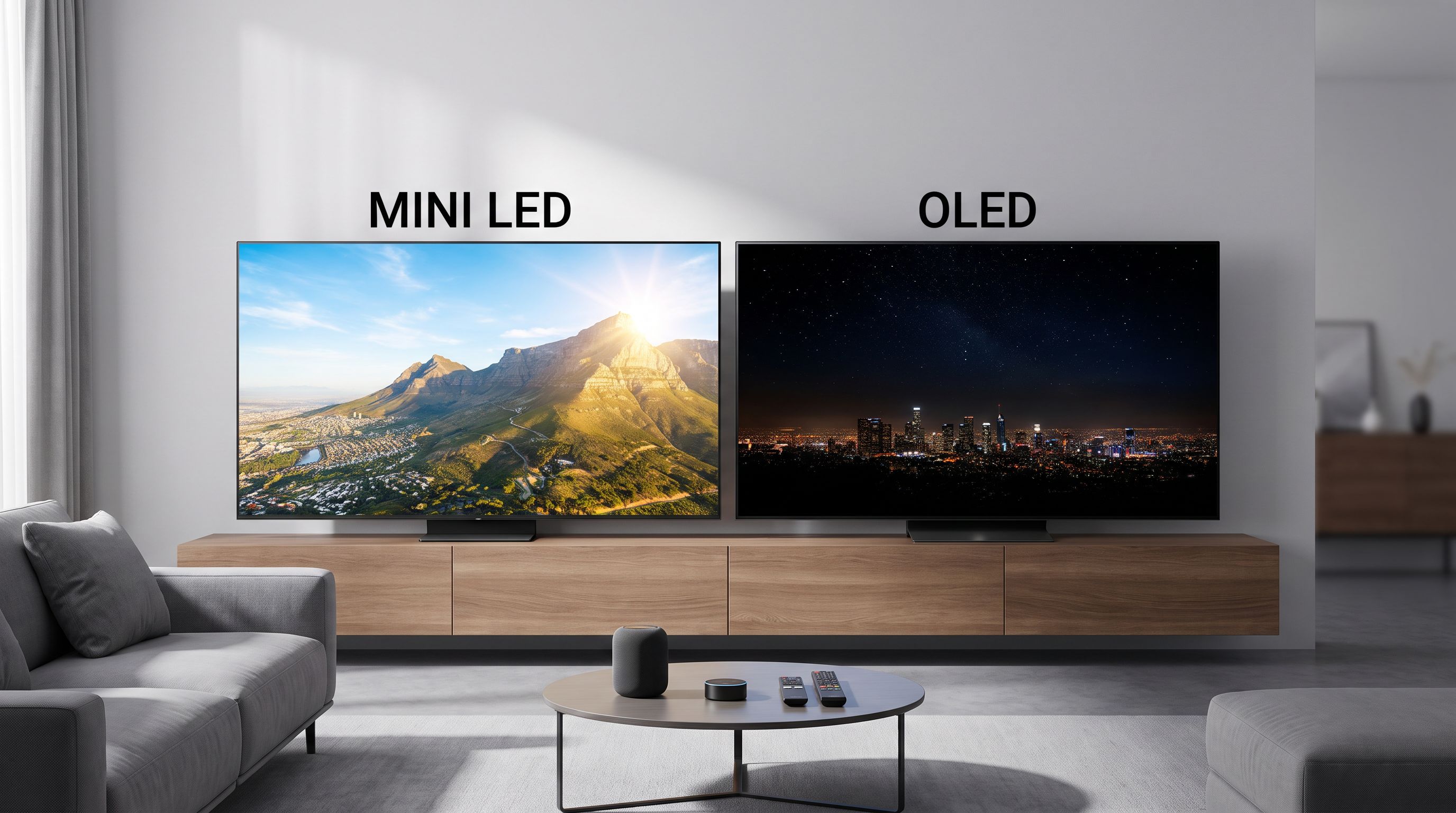
If you started shopping for a TV in 2026 expecting a clean answer, you've probably found the opposite. OLED used to be the default "best picture" recommendation. Then Mini LED got dense enough to control light convincingly, and this year's RGB Mini LED backlights added per-colour dimming that narrows OLED's colour-volume advantage. Meanwhile OLED itself got brighter, with four-stack evo panels pushing highlight output well past what OLED could manage a few years ago.
So the honest answer isn't "OLED wins" or "Mini LED wins." It's: your room decides. Below is how we'd frame the choice, based on manufacturer specs, independent review measurements, and long-run owner feedback — not on marketing slides.
The 30-second version
- Dark or dimmable room, movies and TV shows first? OLED. Nothing matches true per-pixel black.
- Bright living room with windows behind or beside you? Mini LED. Brightness and anti-glare coatings matter more than contrast ratio when the sun's out.
- A TV that shows a static news ticker, game HUD or PC taskbar for hours every day? Mini LED, for peace of mind.
- Want the biggest screen for the money? Mini LED, comfortably — especially at 85 inches and up.
How the two technologies actually differ
An OLED panel has no backlight. Each pixel makes its own light and switches fully off, which is why blacks are genuinely black and contrast is effectively infinite. There's no blooming or halo around bright objects, viewing angles stay accurate from the side, and pixel response is near-instant — great for motion clarity.
A Mini LED TV is still an LCD, but the backlight behind it is built from thousands of tiny LEDs grouped into dimming zones. More zones means finer control over which parts of the screen get lit. The 2026 flagships push this further with RGB Mini LED backlights, where the backlight itself produces red, green and blue light instead of blue LEDs with a conversion layer. The practical benefit is higher colour volume at high brightness — saturated colours stay saturated when the scene is blindingly bright.
The trade-off hasn't changed: an LCD layer can never fully block light, so a bright object on a black field can still show a faint halo. Modern zone counts make this subtle, but in a pitch-dark room with letterbox bars, you'll see it if you look.
Brightness: where Mini LED still leads
Mini LED sets remain the brightness champions, both for small highlights and — more importantly — for full-screen brightness. That second figure is the one that decides whether a daytime hockey game looks washed out. OLED's per-pixel structure limits sustained full-field output because of power and heat; LCD backlights have no such constraint.
That said, 2026's best OLEDs are not dim. The LG OLED evo G5 uses a four-stack panel design that lifted peak highlight brightness significantly over previous generations, and in a moderately lit room it's more than enough. Reviewers consistently note it's the first OLED generation where "too dark for my living room" stops being an automatic objection.
 Best OLED overall · LG OLED evo G5 — Check price on Amazon →
Glare matters as much as brightness. Samsung's matte anti-glare treatment on sets like the QN90F Neo QLED diffuses reflections rather than mirroring your window. LG's G-series uses its own low-reflection coating. If your seating faces a window, a matte screen can be a bigger real-world upgrade than another few hundred nits.
Burn-in: the risk is real but overstated
OLED burn-in is permanent image retention from uneven pixel wear. It's a genuine physical mechanism, not a myth. It's also far less common than forum panic suggests.
Modern OLEDs run pixel-shifting, logo dimming, and automatic compensation cycles. Long-term torture testing by independent outlets has generally shown that mixed, varied content over years doesn't produce visible burn-in on current panels. The risk concentrates in specific use cases: a TV used as a computer monitor with a static taskbar, a set left on a news channel with a permanent ticker for eight hours daily, or a gaming setup showing the same HUD for thousands of hours.
Mini LED has zero burn-in risk. If your household matches one of those patterns — or if you simply don't want to think about it — that alone can settle the decision.
Comparison table
| Factor | OLED | Mini LED (incl. RGB Mini LED) |
|---|---|---|
| Black level / contrast | Perfect, per-pixel | Very good; some blooming in dark scenes |
| Peak highlight brightness | High on 2026 evo panels | Highest available |
| Full-screen brightness | Moderate | Excellent |
| Bright-room performance | Good with anti-glare coating | Best |
| Viewing angles | Excellent | Narrower; varies by panel |
| Burn-in risk | Low but non-zero | None |
| Motion clarity | Near-instant pixel response | Good, slightly slower |
| Largest sizes available | Up to ~97", expensive | Routine at 85–100", cheaper |
| Price per inch | Higher | Lower at every tier |
| Best for | Film, dark rooms, mixed content | Sport, daytime viewing, gaming HUDs, big screens |
Matching a TV to your room
Dark room, movie nights, no compromises
Get an OLED. The LG OLED evo G5 is the pick if you want the brightest OLED available with LG's flush-to-wall mount design and full HDMI 2.1 support across all four ports. It's the closest thing to "OLED without the brightness caveat" on sale in 2026.
A living room with windows, but you still care about film
The LG OLED C5 is the value sweet spot. It's dimmer than the G5, but it's still bright enough for most rooms with curtains open, keeps the perfect blacks, and costs meaningfully less. If your budget has a ceiling, a larger C5 usually beats a smaller G5.
 Best value OLED · LG OLED C5 — Check price on Amazon →
Bright room, sport and gaming dominate
Samsung QN90F Neo QLED. The matte anti-glare layer is the standout feature here — it's the difference between watching the game and watching a reflection of your lamp. Add high full-screen brightness and low input lag, and it's built for daytime use.
 Best for bright, glary rooms · Samsung QN90F Neo QLED — Check price on Amazon →
Flagship Mini LED, no compromise on processing
Sony BRAVIA 9. Sony's backlight control and upscaling remain the reference for making Mini LED behave — tight highlight control, minimal blooming, and excellent handling of lower-quality streaming sources. If you want Mini LED brightness without the usual Mini LED tells, this is the one.
 Best Mini LED overall · Sony BRAVIA 9 — Check price on Amazon →
Maximum screen for the money
Hisense U8QG. It delivers genuinely high brightness and dense local dimming at a price flagship sets can't touch, which makes big sizes realistic. Processing and off-angle performance aren't Sony-class, but for a bright family room it's a lot of TV.
Things that matter more than the panel argument
- Size before technology. A larger Mini LED usually delivers a better viewing experience than a smaller OLED at the same spend.
- Gaming ports. Check that all HDMI 2.1 ports support 4K/120Hz (or 144Hz), VRR and ALLM — not just one or two of them.
- Sound. Every flat TV needs help. Budget for a soundbar from the start.
- Picture mode. Filmmaker Mode or Cinema is almost always closer to correct than the out-of-box Vivid setting, on either technology.
FAQ
Is RGB Mini LED worth waiting for at every price tier? No. In 2026 it's a flagship feature. Conventional Mini LED with a high zone count still performs very well, and the money is often better spent on a bigger screen.
Will an OLED burn in if I game on it every day? Unlikely with varied games and normal breaks, thanks to pixel shifting and compensation cycles. The risk rises with the same static HUD for many hours daily over years. If that's you, choose Mini LED.
Does OLED get bright enough for a sunny room now? The brightest 2026 OLEDs handle moderately bright rooms well, especially with anti-glare coatings. For a room with direct sun on the screen, Mini LED is still the safer choice.
Which lasts longer? Both should last many years. LCD backlights dim gradually and predictably; OLED pixels wear based on use. Neither is a short-lived purchase.
Is a 2026 model worth it over a discounted 2025 set? Often not. Last year's flagship at a clearance price frequently beats this year's mid-range. Compare measured brightness and zone counts rather than model years.
Our picks
Sony BRAVIA 9 K65XR90 65 inch 4K HDR Smart QLED Mini-LED TV Bundle with Premiere Movie Streaming Package & TV Setup Bundle with Wall Mount + Surge Adapter + HDMI Cable & More (2024 Model)
Sony's flagship Mini LED pairs enormous backlight control with the best-in-class processing for bright rooms.
LG 65-Inch OLED evo AI 4K G5 Series Smart TV (OLED65G5WUA, 2025)
LG's four-stack evo panel is the brightest mainstream OLED yet, closing much of the gap with LED.
Samsung 75-Inch Class Neo QLED 4K QN90F Series, Vision AI, Mini LED Smart TV (2025 Model, 75QN90F) Neo Quantum HDR+, Object Tracking Sound+ w/Dolby Atmos, Glare Free, Gaming Hub, Alexa Built-in
Anti-glare matte layer plus a punchy Mini LED backlight makes daytime sports and gaming easy.
LG 65-Inch OLED evo AI 4K C5 Series Smart TV (OLED65C5PUA, 2025)
The sweet-spot OLED: perfect blacks, four HDMI 2.1 ports, and a friendlier price than the G-series.
Hisense U8QG
Huge peak brightness and dense local dimming for far less than the flagship Mini LEDs.
Get the best tech deals in your inbox
Join the BytePlaza newsletter for hand-picked gadget deals and new buying guides. No spam, unsubscribe anytime.
Related reads
Portable Projectors Under $400 in 2026: 4 That Earn the Wall
The best portable projector under $400 in 2026, compared on real ANSI lumens, throw distance, battery life and built-in streaming for dorms and backyards.
8K Streaming Media Player in 2026: Do You Actually Need One?
Is an 8K streaming media player worth it in 2026? We compare AV1-capable boxes like Fire TV Stick 4K Max, Apple TV 4K and Zidoo Z9X on real picture quality gains.
Best 4K Projector 2026: Home Theater vs Portable
The best 4K projector 2026 picks compared: laser TVs, long-throw home theater beamers and portable smart projectors ranked on brightness, throw and room fit.