Mini Projector Under $200 in 2026: What the Specs Hide
The best mini projector under $200 in 2026, plus how to decode fake lumens, "1080p supported" resolution claims, and throw-distance math before you buy.
Reader-supported: we may earn a commission from links on this page, at no extra cost to you. It never affects our picks. Learn more.
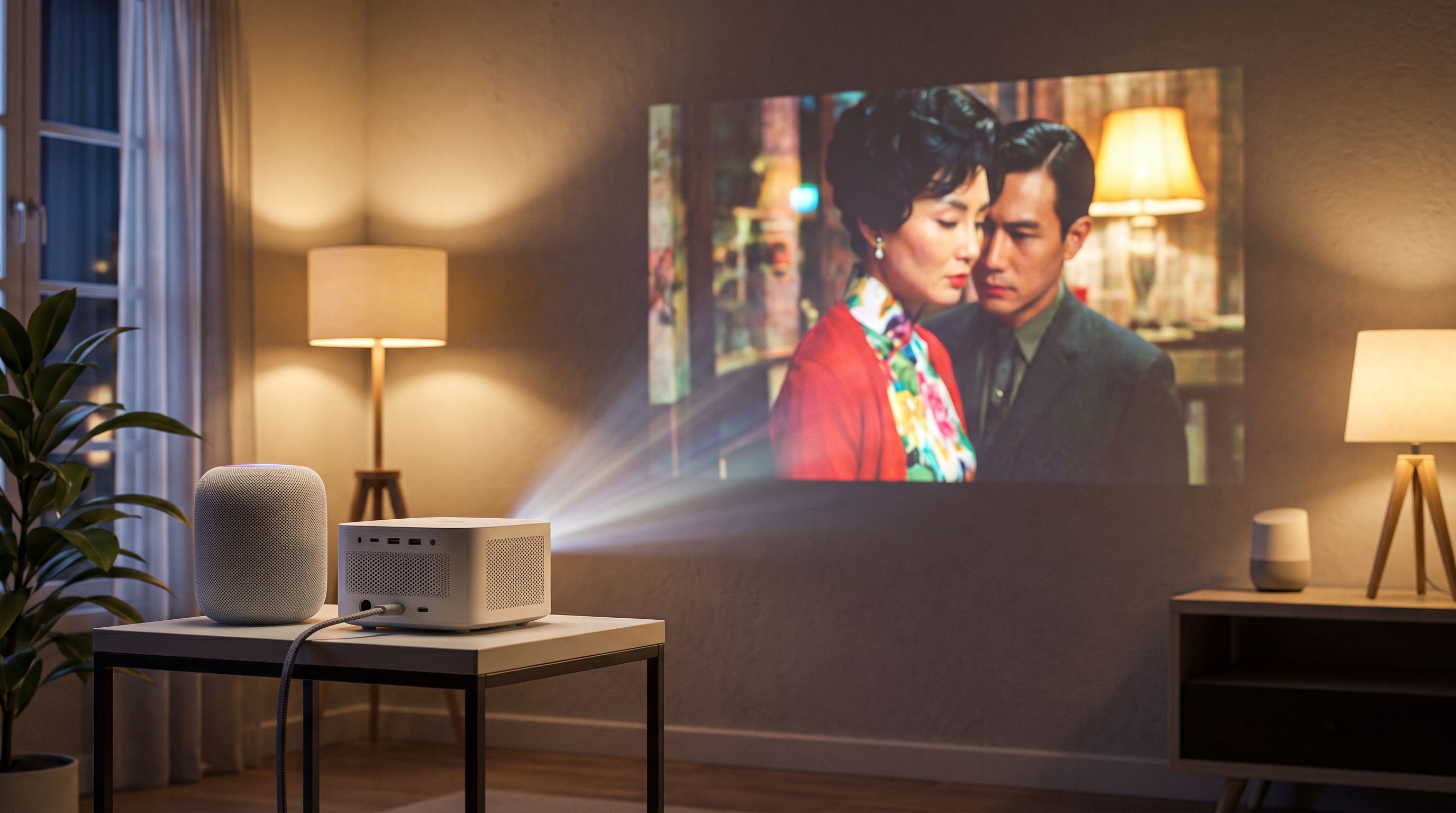
Shopping for a mini projector under $200 in 2026 is less about finding the "best" model and more about learning which numbers on the box are real. The sub-$200 category is dominated by near-identical LCD units from a rotating cast of brands, all claiming absurd lumen figures, "4K support," and 300-inch screens. Some of those claims are technically true in the most useless possible way. A few models genuinely punch above their price.
We compared current sub-$200 models against manufacturer spec sheets, independent reviews and verified owner feedback to work out which ones hold up — and, just as importantly, what you should expect from the category as a whole.
The three lies of budget projector marketing
1. Lumens that don't mean anything
Virtually every cheap projector lists a huge number followed by a word that isn't "ANSI lumens." You'll see "lumens," "LED lumens," "light source lumens," or a bare number with no unit at all. These typically measure raw LED output before the light passes through the optics, panel and lens — which is like rating a car by the energy in the fuel tank.
The only figure that correlates with what you'll actually see is ANSI lumens. As a rough conversion, the marketing number is often 5-10x the real ANSI figure. A projector advertised at "20,000 lumens" is very likely producing somewhere between 150 and 400 ANSI lumens in reality.
What those ANSI numbers mean in practice:
- Under 150 ANSI: pitch-dark room only, modest screen size, picture looks washed out if anyone turns on a lamp.
- 150-250 ANSI: usable at night with curtains drawn, ~80-100 inch image.
- 250-400 ANSI: decent night viewing at 100 inches, tolerable with dim ambient light.
- 500+ ANSI: rare under $200; this is where "watch with a lamp on" starts to become real.
Nothing in this price range is a daytime projector. If you need to watch sport on a Sunday afternoon, buy a TV.
2. "1080p supported" is not 1080p
This is the single most common trap. Many listings say "Supports 4K" or "1080p Full HD" in the headline and then, deep in the spec sheet, list a native resolution of 1280x720 — or even 854x480. "Supported" just means the projector will accept the signal and downscale it. A 480p panel fed a 4K file is still a 480p picture.
Look specifically for the words native resolution and 1920x1080. Native 1080p panels are now common under $200, which was not true a couple of years ago, so there's no reason to settle.
3. Throw distance and "up to 300 inches"
Max screen size specs are almost always quoted at the point where the image is dimmest and softest. A projector with a 1.2:1 throw ratio needs roughly 10 feet of distance for a 100-inch image. If your sofa is eight feet from the wall, you're getting about 80 inches — and that's fine, because 80 bright inches beats 150 dim ones every time.
Measure your room before you shop. Then check the throw ratio, not the headline screen size.
Our picks for 2026
NexiGo PJ40 Pro is the one we'd point most people toward. It uses native 1080p panels, and in independent round-ups comparing a wide spread of $100-$500 projectors it has repeatedly come out ahead of similarly priced competition on image consistency. Crucially, its auto-keystone and autofocus actually work — on a lot of cheap projectors these features flail around and you end up disabling them. It also has real smart functionality rather than a half-broken Android fork.
 Best overall · NexiGo PJ40 Pro — Check price on Amazon →
Magcubic HY300 Pro+ is the budget-of-the-budget option and the model you've probably seen all over social media. It's tiny, has a flip-out stand-style body, and runs an Android-based OS. Expect modest brightness and a picture that only looks good with the lights off. For a dorm room, a kid's bedroom ceiling, or occasional backyard use, it's a lot of entertainment for very little money. Note that most Magcubic units lack a battery — plan for a power outlet.
 Budget pick · Magcubic HY300 Pro+ — Check price on Amazon →
Magcubic HY320 Pro is the sensible upgrade within the same family: brighter, native 1080p, and generally better-reviewed for larger images. If the HY300 Pro+ feels too dim for your room, this is the fix before you jump brands.
 Best value smart projector · Magcubic HY320 Pro — Check price on Amazon →
WiMiUS K8 sits at the brighter end of the LCD budget pack and is the pick if your "dark room" is more of a "dimly lit room." It supports 5G Wi-Fi for less stuttery casting and Bluetooth output so you can pair a decent speaker — important, because every projector in this price range has weak built-in audio.
Anker Nebula Capsule 3 FHD breaks the $200 rule, and we're including it deliberately. It's a DLP unit with native 1080p, a built-in battery, and licensed Google TV with proper Netflix support. If you're buying a mini projector primarily for portability — camping, travel, moving between rooms — the gap in build quality and software reliability between this and the sub-$200 crowd is large enough to justify saving a bit longer.
Comparison table
| Model | Panel type | Native resolution | Battery | Smart OS | Best for |
|---|---|---|---|---|---|
| NexiGo PJ40 Pro | LCD | 1080p | No | Yes | Best all-round picture under $200 |
| Magcubic HY300 Pro+ | LCD | 1080p-class (check listing) | No | Android-based | Cheapest entry, small dark rooms |
| Magcubic HY320 Pro | LCD | 1080p | No | Android-based | Value step-up, bigger images |
| WiMiUS K8 | LCD | 1080p | No | Yes | Brighter rooms, bigger screens |
| Anker Nebula Capsule 3 FHD | DLP | 1080p | Yes | Google TV | True portability, travel |
Always verify the exact spec on the listing you're buying — budget brands revise hardware under the same model name more often than they should.
What you give up under $200
Be realistic about the trade-offs. At this price you should expect:
- Fan noise. LED lamps run hot in small chassis. Most of these are audible in quiet scenes.
- Mediocre contrast. LCD budget projectors have grey-ish blacks. Dark films look murky.
- Weak speakers. Plan on Bluetooth or a 3.5mm speaker. Also check for Bluetooth audio-out latency; some cheap units have noticeable lip-sync drift.
- Streaming app limitations. Unlicensed Android builds often can't run Netflix or Disney+ at full resolution, or at all. The common workaround is plugging in a Fire TV Stick or Chromecast via HDMI — budget for one.
- No real zoom. You position by moving the projector, not by twisting a ring.
How to get the best picture from a cheap projector
A few free improvements matter more than spending another $50:
- Kill ambient light. Blackout curtains do more for contrast than any spec upgrade.
- Project onto a proper surface. A matte white wall is acceptable; a cheap white screen is better. Avoid glossy or coloured walls.
- Place it square to the wall. Keystone correction fixes geometry by throwing away pixels — the less you use, the sharper the image.
- Shrink the image. Going from 120 inches to 90 inches noticeably increases perceived brightness.
- Turn off "dynamic" picture modes if they introduce flicker, and lower brightness slightly to reduce fan noise during quiet content.
Who should skip this category entirely
If you want to watch during the day, want HDR that looks like HDR, or care about motion handling for sport, a sub-$200 projector will disappoint you. A budget 55-inch TV will beat it on every image-quality metric. Mini projectors win on screen size per dollar, portability, and the simple novelty of a 100-inch image in a room that could never fit a 100-inch TV — and at night, in the dark, that's a genuinely good trade.
FAQ
Are "20,000 lumen" budget projectors lying? Not technically — they're quoting LED source output, not calibrated ANSI lumens. The usable brightness is typically a fraction of the advertised figure. Search reviews for a measured ANSI number before trusting any brightness claim.
Can I watch Netflix on a cheap mini projector? Often not natively, because unlicensed Android builds lack Widevine L1 certification. The reliable fix is an HDMI streaming stick such as a Fire TV Stick or Google TV Streamer.
Do I need a projector screen? No, but it helps. A smooth, matte, white wall works fine. Even an inexpensive pull-down or fixed-frame matte white screen will visibly improve uniformity and contrast.
Is DLP better than LCD at this price? DLP generally gives better contrast and sharpness per lumen, but true DLP units are rare under $200 — which is why the Anker Nebula Capsule 3 FHD sits above the budget cutoff. Most sub-$200 models are LCD, and a good LCD beats a bad DLP.
Should I buy a model with a built-in battery? Only if you'll genuinely use it outdoors. Batteries add cost and weight and reduce brightness in battery mode. For home use, a mains-powered unit gives you more lumens per dollar.
Our picks
NexiGo PJ40 Pro Google TV Projector, Native 1080p, 4K Support, AI Image Enhancement, 800 ANSI Lumens, Smart Projector with Auto Keystone, 20 W Speakers, Backlit Remote, Wi-Fi & Bluetooth
Native 1080p, genuinely usable auto-keystone and autofocus, and the most consistent image in the sub-$200 class.
Magcubic 2026 Upgraded HY300PRO Mini Projector with WiFi and Bluetooth, Portable Projector 4K Support, Auto Keystone, 180 Degree Rotation, Smart Proyector for Home Outdoor
Tiny, cheap, battery-free Android-style smart OS — fine for a dark bedroom wall and casual viewing.
Mini Projector with Wifi 6 and Bluetooth 5.4, Smart Portable Projector 4K Support, Android 14 & 400 ANSI, Auto Focus & Keystone, 1080P Small Proyector Magcubic HY320Pro for Bedroom, Movie, Outdoor
Brighter than the HY300 line with native 1080p panels and built-in streaming apps for not much more money.
WiMiUS K8
One of the brighter LCD budget units, with 5G Wi-Fi, Bluetooth audio out and real 1080p panels.
Anker Nebula Capsule 3 FHD
True DLP 1080p, built-in battery and Google TV in a can-sized body — the step up when $200 isn't enough.
Get the best tech deals in your inbox
Join the BytePlaza newsletter for hand-picked gadget deals and new buying guides. No spam, unsubscribe anytime.
Related reads
Portable Projectors Under $400 in 2026: 4 That Earn the Wall
The best portable projector under $400 in 2026, compared on real ANSI lumens, throw distance, battery life and built-in streaming for dorms and backyards.
Best 4K Projector 2026: Home Theater vs Portable
The best 4K projector 2026 picks compared: laser TVs, long-throw home theater beamers and portable smart projectors ranked on brightness, throw and room fit.
Portable Projector Screens in 2026: Pull-Up vs ALR
Pull-up, tripod or ALR? We compare the best portable projector screens of 2026 on gain, size and setup time for backyards, patios and small apartments.