Best 4K Projector 2026: Home Theater vs Portable
The best 4K projector 2026 picks compared: laser TVs, long-throw home theater beamers and portable smart projectors ranked on brightness, throw and room fit.
Reader-supported: we may earn a commission from links on this page, at no extra cost to you. It never affects our picks. Learn more.
Picking the best 4K projector in 2026 is really a decision about your room, not about spec sheets. A projector that looks stunning in a light-controlled basement can look washed out in a sunny apartment, and a portable that's brilliant on a patio will disappoint on a 120-inch screen.
BytePlaza researched current models against manufacturer specs, independent lab measurements and verified owner feedback to build this guide. We don't physically test units — instead we compare and rank what credible third-party testing and long-term owner reports actually show.
The three types of 4K projector, quickly
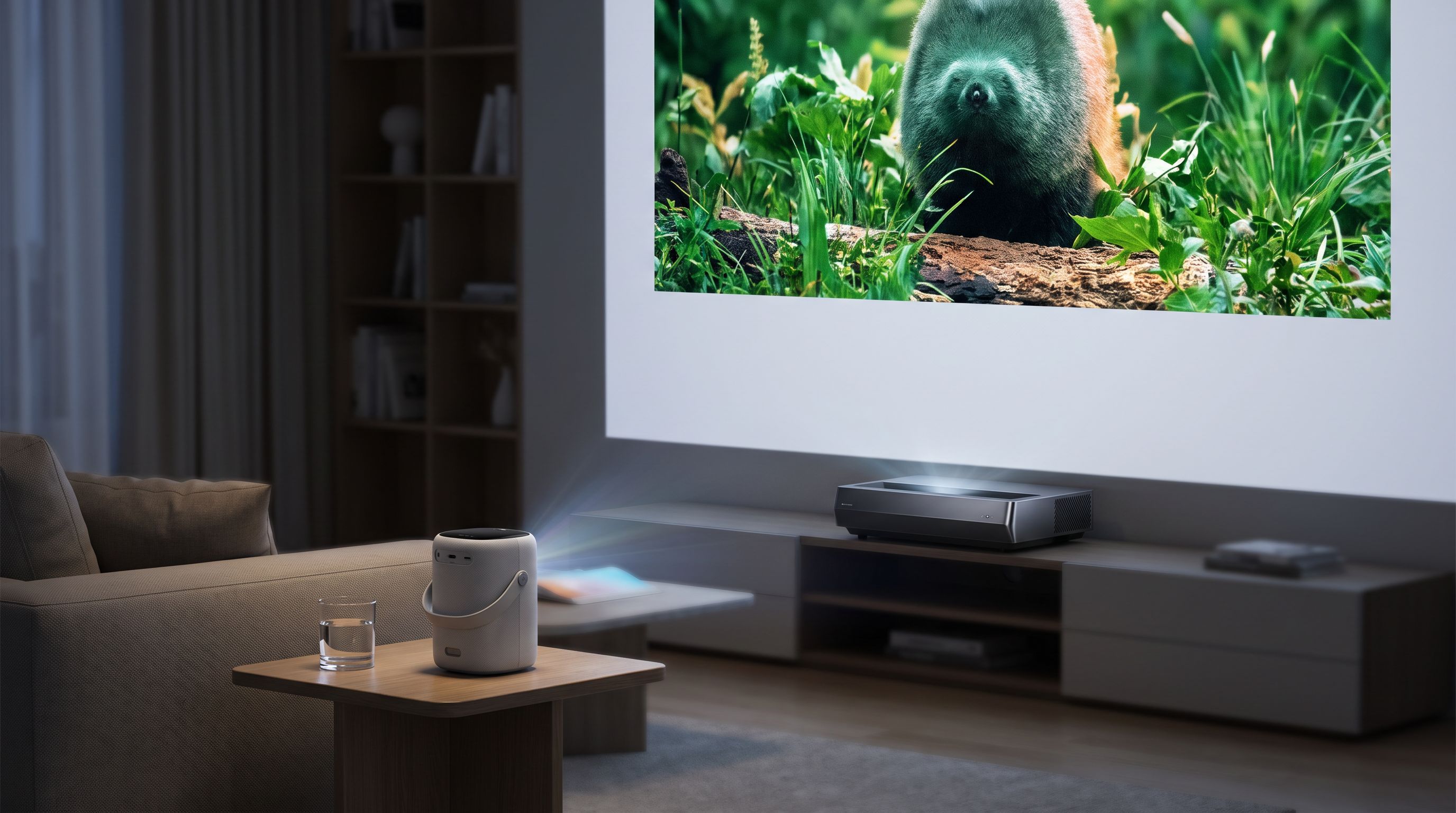
Ultra short throw (UST / "laser TV") sits inches from the wall and throws a 100–120-inch image. It replaces a TV. Best for living rooms with furniture, no ceiling mount, and some ambient light — especially paired with an ambient-light-rejecting (ALR) screen. Trade-off: UST optics are geometry-sensitive and demand a very flat wall or a proper screen.
Long throw (traditional home theater) sits behind or above the seating and projects across the room. It generally delivers the best contrast, the best lens flexibility (zoom and lens shift), and the most screen-size headroom. Trade-off: it needs a dark room and a permanent install to look its best.
Portable smart projector runs on battery or a single cable, auto-focuses, and streams natively. Best for bedrooms, dorms, camping and backyards. Trade-off: brightness and true 4K resolution are usually the compromise.
Brightness: what the numbers actually mean
Brightness claims are where projector marketing gets loose. Look for these distinctions:
- ANSI lumens is the meaningful figure — measured across nine points of the image. Prefer it over "LED lumens", "light source lumens" or unlabeled "lumens".
- Roughly 2,000+ ANSI lumens is the practical floor for a 100-inch image with lamps on or curtains half open.
- Under ~600 ANSI lumens (typical of small portables) means night-time viewing or a smaller image, full stop.
- Brightness on a projector also drops fast as screen size grows. Going from 100 to 120 inches costs you about 30% of your perceived brightness.
Contrast matters more than peak brightness for movie quality in a dark room. Native contrast (what the panel does without dimming tricks) is why native-4K SXRD and LCoS designs like the Sony VPL-XW5000ES still look richer with dark films than brighter DLP rivals.
 Premium pick · Sony VPL-XW5000ES — Check price on Amazon →
Throw ratio: the spec that decides where it goes
Throw ratio = distance ÷ image width. A 1.5 throw ratio needs roughly 3.3 m to fill a 100-inch (2.2 m wide) screen. USTs sit around 0.2–0.25, meaning a few inches of clearance.
Two practical rules before you buy:
- Check lens shift, not just keystone. Optical lens shift moves the image without degrading it. Digital keystone crops and softens pixels — fine for a portable on a picnic table, bad for a permanent theater. The Epson Home Cinema LS11000 is the standout here for its wide vertical and horizontal shift plus motorized zoom, which makes off-centre ceiling mounts painless.
- Measure your actual mounting distance first. Manufacturer throw calculators are free and take two minutes; returning a projector does not.
 Best long-throw home theater projector · Epson Home Cinema LS11000 — Check price on Amazon →
Comparison: how the categories stack up
| Ultra short throw (Hisense PX3-PRO) | Long throw (Epson LS11000) | Flexible cube (Hisense C2 Ultra) | Portable (XGIMI Halo+) | |
|---|---|---|---|---|
| Typical placement | Inches from wall | 3–5 m back / ceiling | Anywhere, gimbal-aimed | Table, floor, outdoors |
| Ambient light tolerance | Good (great with ALR screen) | Poor–fair | Fair–good | Poor |
| Best screen size | 90–120" | 100–150"+ | 65–120" | 40–100" |
| Setup effort | Medium (alignment critical) | High (mount + screen) | Low | Very low |
| Built-in sound | Strong | Basic | Decent | Decent for size |
| Streaming built in | Yes | No (use a stick) | Yes | Yes (Android TV) |
| Best for | Replacing a living-room TV | Dedicated theater room | Renters, mixed-use rooms | Travel, backyard, bedroom |
 Best portable pick · XGIMI Halo+ — Check price on Amazon →
 Best all-rounder for flexible placement · Hisense C2 Ultra — Check price on Amazon →
 Best overall (ultra short throw) · Hisense PX3-PRO — Check price on Amazon →
Our picks and who each one suits
Hisense PX3-PRO — best overall for most homes
Triple-laser (RGB) light engines cover far more of the BT.2020 color space than single-laser or lamp designs, and the PX3-PRO is one of the brighter USTs you can buy without going into custom-install territory. Reviews consistently praise its color volume and HDR punch, and it includes proper gaming features like 240Hz at 1080p. Budget for an ALR screen — it's not optional if your room has windows.
Epson Home Cinema LS11000 — best long-throw home theater projector
Widely cited by reviewers as the reference "big room" choice. It uses 3LCD with pixel shifting rather than native 4K panels, so purists will note it isn't a true 4K imager, but its color brightness equals white brightness (a genuine 3LCD advantage) and it avoids DLP rainbow artifacts entirely. The motorized lens with memory positions makes it the friendliest of the bunch for 2.35:1 scope screens.
Hisense C2 Ultra — best all-rounder for flexible placement
If you can't commit to a wall or a ceiling mount, this compact triple-laser cube on a gimbal is the most adaptable option here. Auto keystone, auto focus and obstacle avoidance mean you can put it on a coffee table tonight and a shelf next month. It also has a very short minimum throw for its class, so short rooms are workable.
XGIMI Halo+ — best portable pick
It's 1080p, not 4K — and that's the honest trade for a battery-powered, one-hand-carry projector with Android TV and Harman Kardon speakers built in. Owner feedback repeatedly highlights the auto-keystone and focus as the fastest set-up-anywhere experience. Treat it as a second projector or a first one for casual use, not a home theater centerpiece.
Sony VPL-XW5000ES — premium pick
Native 4K SXRD panels, laser light source, and Sony's motion processing. It isn't the brightest and it lacks the smart features of the others, but for a dark, dedicated room it delivers the most filmic image on this list. Pair it with a quality AV receiver — there's no meaningful onboard audio.
Screens, sound and the details people skip
- A screen is not optional if there's daylight. For UST, buy a UST-specific ALR screen (lenticular); standard ALR material can misbehave with a steep throw angle.
- A gray, matte-painted wall is a reasonable budget fallback for a dark room only.
- Sound: long-throw units generally need external audio. USTs like the PX3-PRO have surprisingly capable built-in systems, but an eARC soundbar still improves things markedly.
- Laser life on current models is typically rated in the 20,000–25,000 hour range — effectively a decade of normal use with no lamp replacements.
- Gaming: check input lag at your resolution. Many projectors hit low lag only at 1080p/120Hz, not 4K.
The short version
Living room, want it to replace a TV: Hisense PX3-PRO. Dedicated dark room, big screen: Epson Home Cinema LS11000, or Sony VPL-XW5000ES if image purity outranks brightness. Can't commit to placement: Hisense C2 Ultra. Want to carry it outside: XGIMI Halo+.
FAQ
Is a 4K projector better than a large TV? For image size per dollar, yes — nothing matches a 100-inch-plus projected image. For brightness, HDR highlights and daytime viewing, a good TV still wins. USTs narrow the gap considerably in a controlled room.
Do I need native 4K, or is pixel shifting fine? At normal seating distances on a 100-inch screen, most viewers can't reliably distinguish pixel-shifted 4K (as in the Epson LS11000) from native 4K. Contrast and color accuracy affect perceived quality far more than pixel count.
How many ANSI lumens do I need? Dark room, 100-inch screen: 1,500–2,000 is comfortable. Some ambient light: 2,500+. Bright living room with an ALR screen: aim as high as your budget allows.
Can I use a portable projector as my main screen? Only in a room you can fully darken, and ideally at 80–100 inches or less. Otherwise you'll be disappointed by the contrast, not the resolution.
Does throw ratio affect image quality? Indirectly. Very short throws demand precise alignment and a perfectly flat surface; misalignment causes edge softness. Long throws are more forgiving optically but need the room depth to match.
Our picks
Hisense PX3-PRO Ultra Short Throw Triple Laser Projector, 4K UHD, 80” – 150”, 3,000 Lumens, 3000:1 Contrast, Dolby Vision & Atmos, IMAX Enhanced, 240 High Refresh Rate, Google TV, Designed for Xbox
Triple-laser UST with excellent wide color and enough brightness for living rooms with ambient light.
Epson Home Cinema 1100 3-Chip 3LCD 1080p Home Theater Projector | 3400 Lumens Color and White Brightness Wireless Streaming Apple AirPlay Miracast Built-in Speaker 2x HDMI Ports
Laser 4K PRO-UHD with wide lens shift and motorized zoom — the easiest big-room install to get right.
Hisense C2 Ultra, Triple Laser Smart Portable Projector, 4K UHD, 3,000 Lumens, 65” – 300”, Dolby Vision, IMAX Enhanced, Sound by JBL, Netflix Included, Designed for Xbox, Optical Zoom
Compact triple-laser cube with a gimbal stand, auto keystone and strong color for near-any room.
XGIMI Halo+ Portable Projector, Google TV, Licensed Netflix, 700 ISO Lumens | 1080P Home Projector, Auto Focus, Built-in Battery with 2.5 Hours Playtime, 2 x 5W Harman Kardon Speakers, Home & Outdoor
Battery-powered smart projector with Android TV, auto focus and genuinely watchable output outdoors.
Sony VPL-XW5000ES 4K HDR Laser Home Theater Projector with Native 4K SXRD Panel, Black
Native 4K SXRD panels and laser light for filmic motion and contrast that DLP rivals struggle to match.
Get the best tech deals in your inbox
Join the BytePlaza newsletter for hand-picked gadget deals and new buying guides. No spam, unsubscribe anytime.
Related reads
Portable Projectors Under $400 in 2026: 4 That Earn the Wall
The best portable projector under $400 in 2026, compared on real ANSI lumens, throw distance, battery life and built-in streaming for dorms and backyards.
Mini LED vs OLED TV in 2026: Which Wins Your Room?
Mini LED vs OLED TV in 2026: how brightness, burn-in risk, room lighting and price tiers should decide your panel — plus specific picks for bright and dark rooms.
8K Streaming Media Player in 2026: Do You Actually Need One?
Is an 8K streaming media player worth it in 2026? We compare AV1-capable boxes like Fire TV Stick 4K Max, Apple TV 4K and Zidoo Z9X on real picture quality gains.