Dive Smartwatches in 2026: 4 Picks That Earn Their Depth Rating
Which is the best dive smartwatch in 2026? We compare depth rating, dive modes, surface GPS, battery life and straps on Garmin, Suunto and Apple Watch Ultra.
Reader-supported: we may earn a commission from links on this page, at no extra cost to you. It never affects our picks. Learn more.
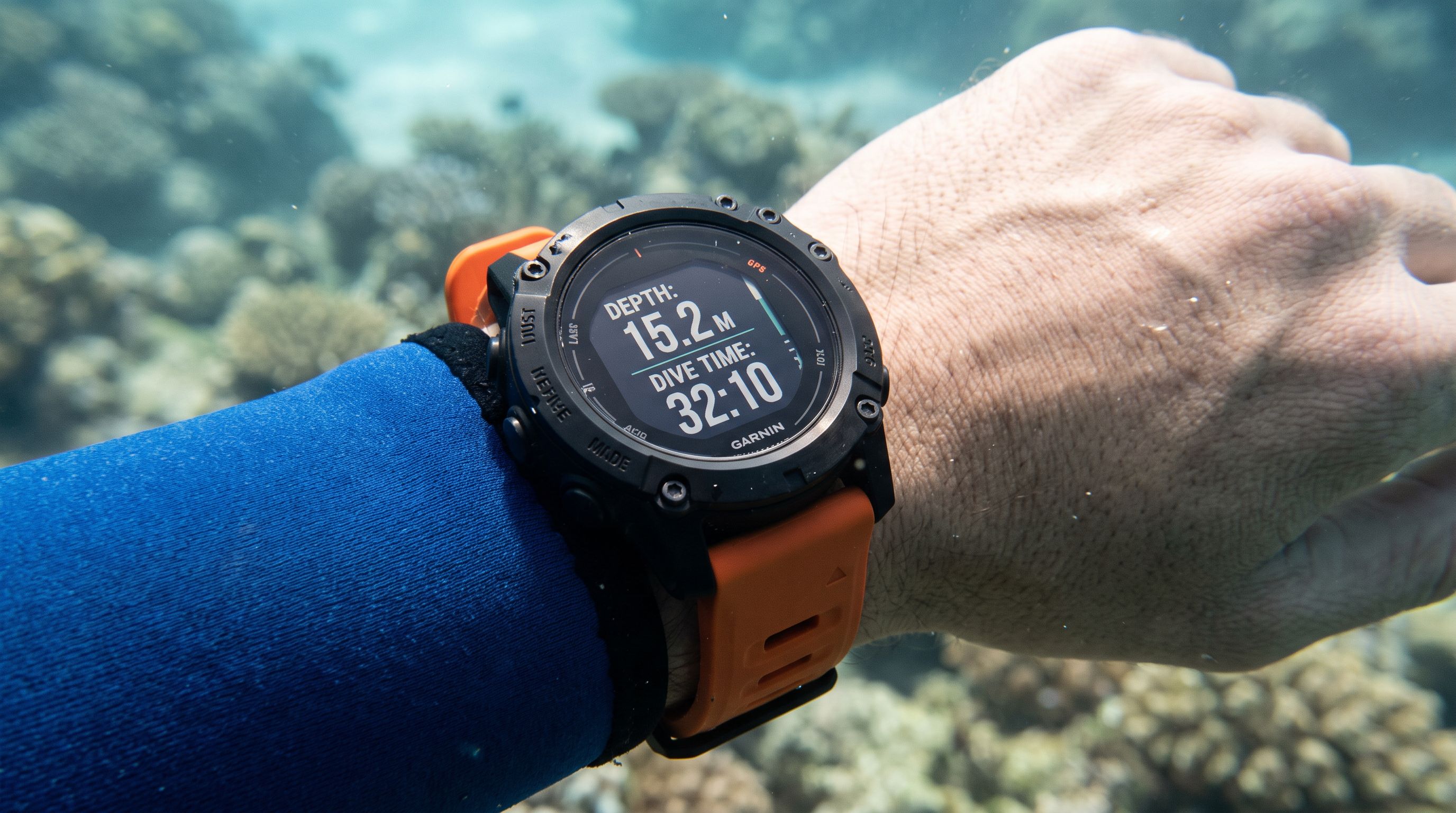
GPS doesn't work underwater. That single fact explains almost everything about how a "dive smartwatch" is designed — and why the category looks so different from a mechanical dive watch with a rotating bezel.
Radio signals die within centimetres of the surface, so every GPS dive watch works the same way: it grabs a fix at the start of your dive, goes dark on positioning while you're down, then re-acquires when you surface and drops an entry/exit pin on the map. That's genuinely useful for shore dives, drift dives, spearfishing and freediving sessions where you want to find your way back to the boat or the car park. It is not underwater navigation. Anyone promising that is selling you something.
So the real buying decision comes down to four things: certified depth rating, dive-mode software (which algorithms and disciplines it actually supports), battery life in the modes you'll use, and how the thing attaches to your wrist over a 7mm wetsuit. Below we compare the main contenders for the best dive smartwatch in 2026, based on manufacturer spec sheets, independent dive-publication reviews and owner reports.
Depth rating vs. dive certification — not the same thing
A watch rated "100m water resistant" is not automatically a dive computer. Water resistance ratings are static pressure tests; a dive computer needs an accurate, calibrated depth sensor and decompression software.
The marker to look for is EN 13319, the European standard for depth-measuring dive accessories. Apple Watch Ultra 2 carries it, as do Garmin's Descent line and the Suunto Ocean. If a fitness watch claims 100m water resistance but has no EN 13319 depth sensor and no dive mode, treat it as a swim watch that survives snorkelling.
 Best dive-brand value · Suunto Ocean — Check price on Amazon →
 Best smartwatch-first option · Apple Watch Ultra 2 — Check price on Amazon →
The second number is the operating depth of dive mode, which is always shallower than the case's water-resistance rating. Apple Watch Ultra 2 is rated to 100m water resistance but its Oceanic+ dive app is certified for recreational no-decompression diving to 40m. Garmin's Descent watches support meaningfully deeper, mixed-gas, decompression profiles. That gap is the single biggest fork in the road for buyers.
The four picks, compared
| Model | Dive disciplines | Approx. display | Air integration | Notes |
|---|---|---|---|---|
| Garmin Descent Mk3i 51mm | Single/multi-gas, CCR, gauge, apnea, apnea hunt | AMOLED, large | Yes, with SubWave sonar + diver messaging | Deepest feature set; biggest case |
| Garmin Descent Mk3 43mm | Same dive modes as Mk3i (no sonar transceiver) | AMOLED, compact | Via compatible transmitter (no SubWave) | Best fit for smaller wrists |
| Apple Watch Ultra 2 | Recreational no-deco + freedive via Oceanic+ | AMOLED, very bright | No | Best daily smartwatch; app-dependent |
| Suunto Ocean | Nitrox, gauge, freedive, with Suunto algorithms | AMOLED | Yes, with Suunto Tank POD | Dive heritage, sports-watch battery |
| Garmin Descent G2 | Single/multi-gas, gauge, apnea | MIP, solar-assisted | No | Lightest, longest battery, no touchscreen glitz |
 Budget pick · Garmin Descent G2 — Check price on Amazon →
 Best for smaller wrists · Garmin Descent Mk3 43mm — Check price on Amazon →
 Best overall · Garmin Descent Mk3i 51mm — Check price on Amazon →
Garmin Descent Mk3i 51mm — best overall
The Mk3i is the most complete device in the category. It covers open-circuit single and multi-gas, closed-circuit rebreather, gauge, apnea and apnea hunt modes, and it pairs with Garmin's air-integration transmitter. Its headline trick is SubWave sonar, which lets it exchange short text messages and buddy distance/direction with another Mk3i or a paired transceiver underwater — a feature divers in owner forums consistently rate as the first genuinely new thing in wrist computers in years, with the caveat that range depends heavily on conditions and line of sight.
Topside, it's a full Garmin multisport watch: mapping, multi-band GNSS, training metrics, music. Battery life is measured in weeks in smartwatch mode and tens of hours in dive mode, with GPS activity life in the tens of hours too — meaning a liveaboard week is realistic without a charger, though you'll want one anyway if you run AMOLED at high brightness.
The honest downside is size. At 51mm it is a large, heavy watch; owner reports from divers with wrists under about 17cm frequently mention it catching on wetsuit sleeves and BCD straps.
Garmin Descent Mk3 43mm — same brain, smaller body
If the Mk3i is too much watch, the 43mm Descent Mk3 runs the same dive software stack in a case that's actually pleasant to wear to work. You give up the SubWave sonar transceiver and some battery headroom, and the smaller screen is noticeably busier when a deco schedule is showing. For most recreational divers who want one watch for everything, this is the sensible version.
Apple Watch Ultra 2 — best if the watch part matters most
If you dive a handful of times a year and wear a smartwatch every day, the Ultra 2 is a very rational choice. The depth sensor is EN 13319 certified, the 100m water-resistance rating and titanium case are real, and the Oceanic+ app turns it into a competent recreational dive computer with a no-deco planner, surface interval tracking, logbook and freedive mode.
Limitations are clear-eyed: it's for recreational no-deco diving, not technical profiles; there's no air integration; and dive mode is a meaningful battery drain, so a day of repetitive dives will likely need a top-up. Also note Oceanic+ is a subscription-tiered app, which is a recurring cost mechanical-watch buyers won't be used to.
Suunto Ocean — the dive-brand alternative
Suunto has been making dive computers far longer than anyone's been making smartwatches, and the Ocean brings that algorithm pedigree to a modern AMOLED sports watch with a titanium bezel. It supports nitrox, gauge and freedive modes and pairs with Suunto's Tank POD for air integration. Compared with Garmin, the sports-tracking ecosystem is leaner and third-party app support is thinner, but divers who already trust Suunto's decompression model and app logbook will find it the most familiar transition.
Garmin Descent G2 — budget and battery
The G2 drops the AMOLED screen for a solar-assisted MIP display, and that trade pays off enormously in runtime: it's the one watch here you can take on a multi-day trip and genuinely forget the charger. It's light, it's legible in bright sun (MIP actually gets better in direct sunlight), and it still does multi-gas, gauge and apnea with surface GPS. You lose air integration, maps and the glossy display. For a lot of divers, that's a fair swap.
Straps: the part everyone underestimates
A dive computer you can't fit over a drysuit sleeve is a dive computer you leave in the bag.
- Silicone (stock) — fine over a 3mm wetsuit; usually too short over thick neoprene.
- Extension strap — Garmin and Suunto both sell dive extensions; buy one at the same time as the watch, not after your first cold-water trip.
- Bungee / elastic mount — the preferred setup for many technical divers, because it slips over a sleeve in one motion and self-tensions at depth as neoprene compresses.
- Titanium or steel bracelet — looks great at dinner, bad choice in salt water unless you rinse religiously.
Whatever you choose, rinse in fresh water after every dive and run the buttons under the tap. Salt crystallisation in button seals is the most common cause of failure reported by owners of every brand here.
How we chose
We compared published manufacturer specifications (depth ratings, certified dive modes, stated battery figures), independent dive-publication reviews, and recurring themes in verified owner feedback — particularly around strap fit, screen legibility in turbid water and real-world battery drain. BytePlaza does not perform its own underwater testing; where depth or decompression performance is claimed, it comes from the manufacturer's certification or third-party review sources.
FAQ
Does GPS work underwater on any of these? No. All of them log a surface fix at descent and another at ascent, then connect the two on a map. Underwater positioning requires acoustic systems, not GNSS.
Can I dive with a regular smartwatch rated 100m? Only in the loosest sense. Without an EN 13319 depth sensor and dive software, it's a watch that survives water, not a dive computer. Never use one as your primary depth or deco reference.
Do I still need a dedicated dive computer as backup? Standard practice is yes — a backup computer or at minimum depth gauge, timer and tables. These watches are capable primaries, but single-point-of-failure diving is still bad practice.
Which is best for freediving specifically? The Garmin Descent line's apnea and apnea-hunt modes are the most developed, with configurable depth alarms and fast sampling. Oceanic+ on the Apple Watch Ultra 2 has a solid freedive mode, and Suunto Ocean draws on Suunto's long freediving history.
Is AMOLED or MIP better for diving? MIP (as on the Descent G2) is more readable in bright surface sun and far kinder to battery. AMOLED is dramatically better in dark or murky water. Most divers prefer AMOLED for the depth readout and accept the charging.
Our picks
Garmin Descent™ Mk3i, Watch-Style Dive Computer, 51mm, Black
Full multi-gas dive computer with SubWave sonar messaging, air integration and multiday GPS battery.
Garmin Descent™ Mk3, Watch-Style Dive Computer, 43mm, Fog Gray
Same dive software as the Mk3i in a 43mm case that still works as an everyday GPS watch.
Titanium Watch Band T01 Max - Fits Apple Watch ULTRA 4 & ULTRA 3/2/1 (49mm) - Adjustable Titanium Apple Watch Band with Secure Clasp - Premium Color Matching Band (T01 Max | ULTRA Silver)
100m water resistance, EN13319 depth gauge and Oceanic+ for recreational no-deco dives.
SUUNTO Ocean Dive Computer, GPS Multisport Watch for Training, Sand
Suunto's dive algorithms plus GPS sports tracking and a bright AMOLED in a titanium bezel case.
Garmin Descent™ G2, Watch-Style Dive Computer, 46mm, Black
Solar-charged, lightweight MIP-display dive computer with surface GPS and long battery life.
Get the best tech deals in your inbox
Join the BytePlaza newsletter for hand-picked gadget deals and new buying guides. No spam, unsubscribe anytime.
Related reads
Smart Ring vs Fitness Band in 2026: Which Tracks Better?
Smart ring vs fitness band in 2026: we compare sensor coverage, battery life, subscription costs and real-world accuracy to help you pick the right tracker.
Heart Rate Monitor Earbuds 2026: What the Sensors Really Do
Heart rate monitor earbuds in 2026 add optical HR and blood oxygen sensing to your workout. Here's which models actually ship it, how accurate it is, and who needs it.
Golf Watches in 2026: 5 GPS Picks That Actually Earn Their Place
Which golf watch should you buy in 2026? We compare Garmin, Shot Scope and Coros on course databases, shot tracking, subscriptions and battery life.