Budget Mirrorless Cameras in 2026: 5 Picks Under $1,000
The best budget mirrorless camera 2026 picks under $1,000, compared on sensors, autofocus, video specs and lens ecosystems — for hobbyists upgrading from a phone.
Reader-supported: we may earn a commission from links on this page, at no extra cost to you. It never affects our picks. Learn more.
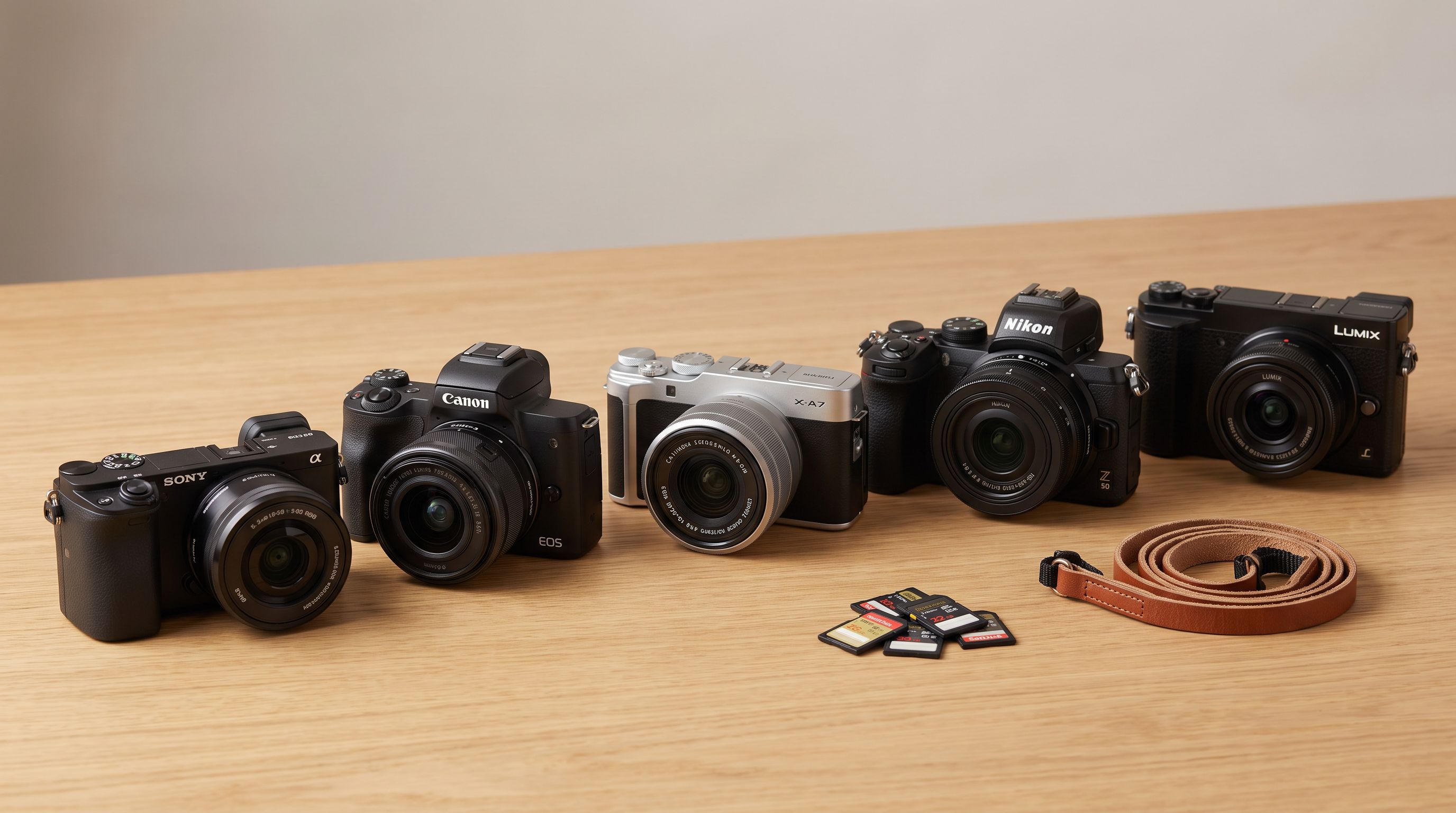
Phone cameras have plateaued. Sensor sizes stopped growing, computational tricks now produce diminishing returns, and the thing a phone still can't fake convincingly is genuine optical reach and genuine shallow depth of field from a big piece of glass. That's why entry-level mirrorless bodies are selling again — and why the sub-$1,000 tier is the most interesting part of the market in 2026.
We compared current entry-level bodies on sensor size and resolution, autofocus capability, video specs, in-body stabilization, ergonomics and — most importantly — the lens ecosystem you're committing to. Rankings are based on manufacturer specifications, independent lab and field reviews, and verified owner feedback. BytePlaza does not physically test units.
What actually matters under $1,000
The lens mount is the real purchase. A body lasts five to seven years; a lens collection lasts decades. Canon's RF-S line is still thin on native APS-C primes, though full-frame RF lenses mount fine (at full-frame prices). Sony's E-mount has the deepest third-party support — Sigma, Tamron and Viltrox make affordable, genuinely good APS-C glass. Nikon Z has fewer DX lenses but excellent ones, plus growing third-party options. Micro Four Thirds has the largest mature catalog of small, cheap, sharp lenses of any mirrorless system.
Autofocus is where budget bodies have improved most. Subject detection for humans, animals, birds and vehicles — technology that was flagship-only five years ago — now appears in entry-level cameras. This matters more than megapixels for kids, pets and sports.
Kit lens or body only? The 16-50mm-ish kit zooms bundled with most of these cameras are convenient and forgettable. If your budget allows, buy the body and pair it with a cheap fast prime (a 35mm or 50mm equivalent f/1.8 or f/2) — the jump in image quality and background blur is far more dramatic than any body upgrade in this price band.
Ignore megapixel counts. Every camera here resolves more detail than you'll ever need for prints, social media or moderate cropping. Low-light behavior, color science and autofocus hit rate determine whether you keep the photos.
The five picks
Nikon Z50II — best overall
 Best overall · Nikon Z50II — Check price on Amazon →
The Z50II is the current value benchmark around $1,000. Nikon put its higher-end EXPEED image processor into an APS-C body, which unlocks subject-detection autofocus derived from the company's pro cameras — people, animals, birds, vehicles, aircraft — plus noticeably snappier general responsiveness than the original Z50.
Reviewers consistently call out two things: the grip, which is unusually deep and comfortable for a camera this size, and the dedicated Picture Control button that makes in-camera color recipes genuinely usable (a direct answer to Fujifilm's film simulations). It shoots 4K video, includes a fully articulating screen and a decent-resolution EVF.
The trade-off is no in-body stabilization, and the Z DX lens lineup remains modest. But you can mount any full-frame Z lens, and Nikon's 24mm and 40mm f/2 full-frame primes are affordable and pair beautifully with a DX body.
Canon EOS R50 — best for beginners
 Best for beginners · Canon EOS R50 — Check price on Amazon →
If someone in your life is buying their first real camera and might be intimidated by it, the EOS R50 is the safest recommendation. It's very small, very light, and Canon's guided interface explains what aperture and shutter speed actually do while you change them.
Underneath the friendly exterior is Dual Pixel CMOS AF II, which is still among the most reliable autofocus systems in the class — it locks onto eyes with minimal fuss and rarely hunts. The vari-angle touchscreen flips forward for self-recording, and it shoots uncropped 4K.
Compromises: no in-body stabilization, a small battery with modest rated life, and no headphone jack. The RF-S lens catalog is the weak point — plan on a couple of RF full-frame primes if you want fast glass. Canon also sells the cheaper EOS R100, which gets you into the system for less, but its fixed screen and older autofocus make the R50 the better buy for most people.
Sony ZV-E10 II — best for video and vlogging
 Best for video and vlogging · Sony ZV-E10 II — Check price on Amazon →
The ZV-E10 II is the pick if video is at least half of what you shoot. It uses a newer-generation 26MP APS-C sensor and produces 4K from oversampled capture, which looks visibly cleaner than upscaled or line-skipped 4K from older bodies. Sony's Product Showcase mode, Background Defocus button and directional three-capsule microphone are designed specifically for talking-to-camera work.
The bigger battery (Sony's larger Z-series cell) is an underrated upgrade over the original ZV-E10. Autofocus is Sony's Real-time Recognition system, which is excellent.
Know what you're giving up: there's no electronic viewfinder at all, and no in-body stabilization — digital stabilization crops in. For handheld photography in bright sun, the absence of an EVF is a real annoyance. For a tripod, gimbal or handheld vlog setup, it's irrelevant.
Sony a6100 — budget pick
 Budget pick · Sony a6100 — Check price on Amazon →
The a6100 is the oldest camera here and still one of the most sensible cheap entries into a major system. Its Real-time Tracking and Eye AF remain fast and sticky by any standard, and it has something the ZV-E10 II lacks: a viewfinder.
It's an older design — the menus are dated, the screen tilts rather than fully articulates, video is limited to 8-bit 4K with a rolling-shutter penalty, and there's no weather sealing. But E-mount is the single best-supported mount for affordable third-party lenses, and that advantage compounds over years. If your budget is tight and you want to spend the savings on glass, this is the move.
OM System OM-5 Mark II — best for travel and hiking
 Best for travel and hiking · OM System OM-5 Mark II — Check price on Amazon →
Micro Four Thirds uses a smaller sensor, which costs you some low-light performance — but buys you weather sealing, in-body image stabilization rated for many stops, and dramatically smaller, lighter, cheaper lenses. A full travel kit covering wide to telephoto fits in a jacket pocket in a way no APS-C kit does.
The OM-5 Mark II adds computational features that are genuinely unusual at this price: handheld high-resolution composite shots, live ND simulation and in-camera focus stacking. For landscape, hiking and travel shooters who value not carrying a tripod, it's a compelling argument. For low-light indoor work or maximum background blur, APS-C is the better sensor.
Comparison table
| Camera | Sensor | Best for | IBIS | Viewfinder | Key strength | Main trade-off |
|---|---|---|---|---|---|---|
| Nikon Z50II | APS-C | All-round stills + video | No | Yes | Flagship-derived AF and processor | Limited DX lens range |
| Canon EOS R50 | APS-C | First-time buyers | No | Yes | Dual Pixel AF II, guided UI | Thin RF-S lens catalog |
| Sony ZV-E10 II | APS-C | Vlogging, video | No | No | Oversampled 4K, creator tools | No EVF |
| Sony a6100 | APS-C | Tight budgets | No | Yes | Cheapest route into E-mount | Dated menus and video specs |
| OM System OM-5 Mark II | Micro Four Thirds | Travel, hiking | Yes | Yes | Weather sealing, strong IBIS | Smaller sensor in low light |
How to choose in 30 seconds
- You want one camera that does everything well: Nikon Z50II.
- It's your first camera and you want it to be easy: Canon EOS R50.
- You're filming yourself more than photographing others: Sony ZV-E10 II.
- You'd rather spend the money on lenses: Sony a6100.
- You'll carry it up mountains and into bad weather: OM System OM-5 Mark II.
Don't forget the extras
Budget roughly $80-150 beyond the camera for the boring necessities: a fast V30-rated UHS-II or UHS-I SD card (4K video will choke on a slow card), at least one spare battery, and a bag. A cheap fast prime lens will improve your photos more than any of these bodies will improve on each other.
FAQ
Is APS-C good enough, or should I save for full-frame? APS-C is more than good enough for hobbyist work, and the lens savings are substantial. Full-frame helps most in very low light and for extreme shallow depth of field. Under $1,000, a good APS-C body plus a decent lens beats a bargain full-frame body with a slow kit zoom.
Do any of these have in-body stabilization? Among these picks, only the OM System OM-5 Mark II. The APS-C bodies rely on optically stabilized lenses (most kit zooms have it) or digital stabilization in video, which crops the frame.
Is a mirrorless camera really better than a flagship phone? For sheer convenience, no. For optical reach, subject separation, low-light image quality, RAW latitude and the ability to change lenses, yes — and the gap widens the further you get from bright, static, everyday scenes.
Should I buy used to get more camera for the money? It's a reasonable strategy for bodies from reputable dealers with warranties. Check shutter count where listed and confirm return policies. New buyers who want support and warranty coverage should stick to current models.
Which mount has the best cheap lenses? Sony E-mount, by a clear margin, thanks to Sigma, Tamron and Viltrox. Micro Four Thirds is a close second for sheer catalog depth and small size. Canon RF-S and Nikon Z DX are improving but still narrower.
Our picks
Nikon Z50II Mirrorless Camera with NIKKOR Z DX 50-250mm Lens Bundle
Flagship-derived processor, excellent subject-detect AF and a deep grip — the most camera you can get near $1,000.
Canon EOS R50 Mirrorless Camera RF-S18-45mm F4.5-6.3 is STM Lens Kit
Tiny, genuinely simple to learn, with Canon's superb Dual Pixel AF II and a vari-angle screen.
Sony ZV-E10 II Camera with 16-50mm Lens Bundle
Latest-gen 26MP sensor, 4K from oversampled capture and creator-focused controls in a pocketable body.
Sony Alpha A6100 Mirrorless Camera with 16-50mm Zoom Lens, Black (ILCE6100L/B)
Still one of the cheapest ways into E-mount, with fast Real-time Tracking AF and a huge lens catalog.
OM SYSTEM OM-5 Mark II Body Black Compact Light Weight Weather Sealed 4K Video Camera Best for Outdoor Travel
Weather-sealed Micro Four Thirds body with strong stabilization and the smallest lenses of any system.
Get the best tech deals in your inbox
Join the BytePlaza newsletter for hand-picked gadget deals and new buying guides. No spam, unsubscribe anytime.
Related reads

Photo Scanners in 2026: 4 Picks for a Box of Old Prints
Feed-through, flatbed or phone app? We compare the best photo scanner options for 2026 — ranked by speed, dust handling and how gently they treat fragile prints.
Prime Big Deal Days 2026: Headphone Deals Worth Waiting For
Prime Big Deal Days 2026 runs Oct 6–7. Here's what a genuinely good headphone or earbud discount looks like, plus the AirPods, Sony, Bose and budget models to watch.
Laptop Power Banks in 2026: 5 Picks That Hit 140W
Which laptop power bank should you buy in 2026? We compare 100W–250W USB-C PD 3.1 banks on capacity, airline limits and real-world MacBook charge speeds.