Laptop Power Banks in 2026: 5 Picks That Hit 140W
Which laptop power bank should you buy in 2026? We compare 100W–250W USB-C PD 3.1 banks on capacity, airline limits and real-world MacBook charge speeds.
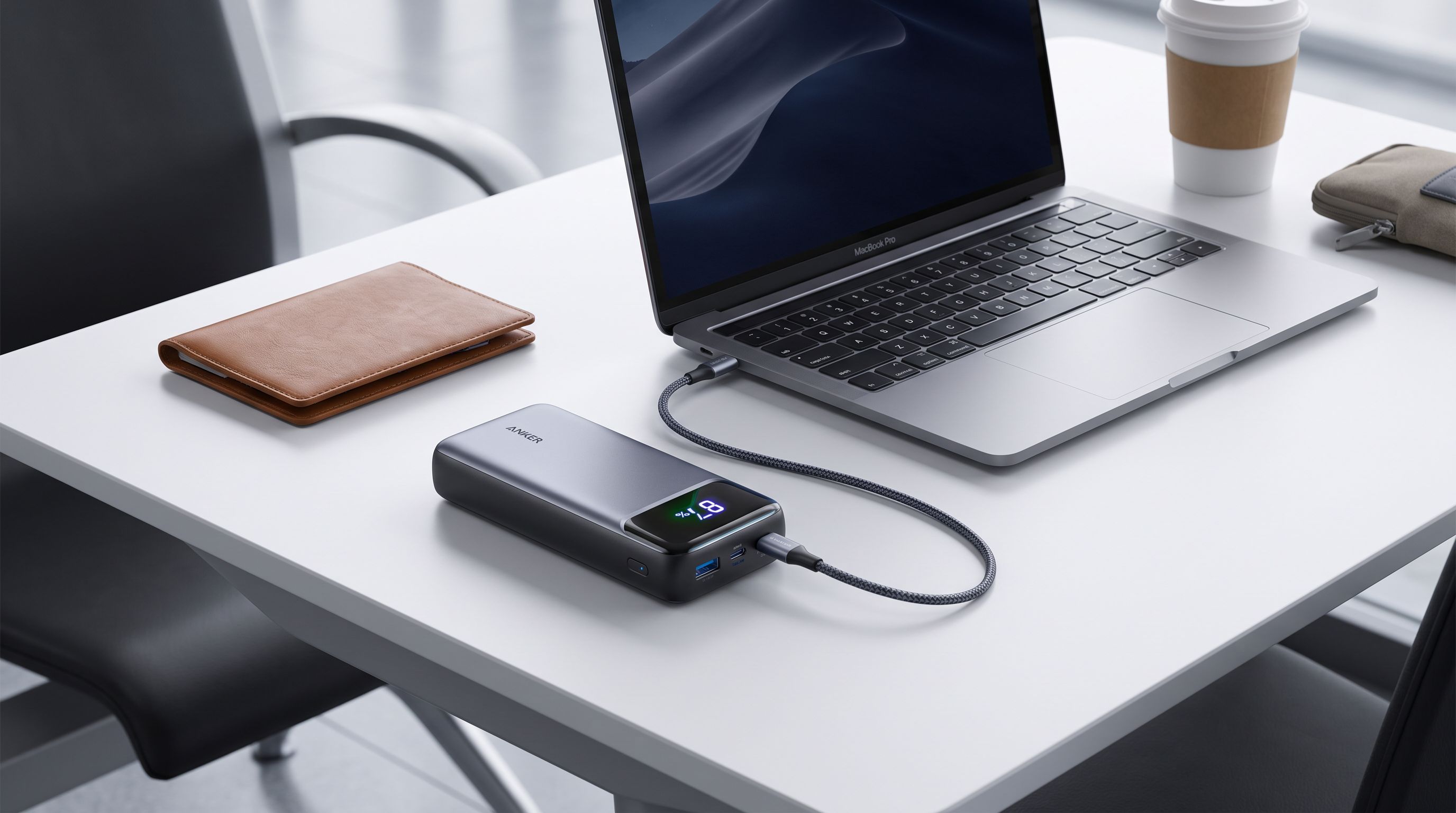
Reader-supported: we may earn a commission from links on this page, at no extra cost to you. It never affects our picks. Learn more.
Laptop charging over USB-C has quietly become a solved problem — as long as you buy the right battery. The trouble is that "100W power bank" on a listing can mean anything from a brick that genuinely refills a MacBook Pro at full tilt to one that hits 100W for thirty seconds and then throttles hard.
We compared current high-wattage USB-C Power Delivery banks on published specs, third-party lab measurements and patterns in verified owner feedback, with a focus on the three things that actually decide whether a battery is useful on a flight: usable capacity in watt-hours, sustained output per port, and whether you can legally bring it on board.
The 100Wh airline ceiling is the real spec limit
Before capacity, check watt-hours. Under FAA, IATA and most national rules, lithium batteries up to 100Wh can go in carry-on baggage without airline approval. Between 100Wh and 160Wh you typically need airline permission and are limited to two spares. Above 160Wh, it's not flying.
Power banks are advertised in mAh at the cell voltage (usually 3.6V or 3.7V), so the conversion matters:
- 20,000mAh × 3.6V ≈ 72Wh — comfortably under the limit
- 24,000mAh × 3.6V ≈ 86Wh — still fine
- 27,650mAh × 3.6V ≈ 99.5Wh — deliberately engineered to squeak under 100Wh
- 30,000mAh+ — usually over the line, and often refused at the gate
That's why almost every serious "laptop" power bank in 2026 tops out around 25,000–27,650mAh. It isn't a technical ceiling; it's a regulatory one. Look for the Wh figure printed on the casing — gate agents look for exactly that, and unlabelled banks get confiscated.
What 140W and PD 3.1 actually buy you
USB PD 3.1 introduced Extended Power Range (EPR), which adds 28V, 36V and 48V fixed voltages on top of the old 20V ceiling. In practice:
- 60W–65W: enough to charge a 13-inch ultrabook or MacBook Air at or near full speed.
- 100W (20V/5A): the old PD 3.0 maximum. Charges a 14-inch MacBook Pro at essentially full speed and a 16-inch model at a slightly reduced rate.
- 140W (28V/5A): unlocks fast charging on the 16-inch MacBook Pro and high-draw gaming/workstation laptops that ship with 140W–180W adapters.
Two caveats worth knowing. First, EPR above 100W requires a 240W-rated (5A e-marked) cable — the cable that came with your phone will silently cap you at 60W or 100W. Second, many banks advertise a total wattage across all ports. A "250W" bank usually means something like 140W from one port plus the rest split across the others; plug in a phone and your laptop's share drops.
Finally, expect roughly 85–90% real-world efficiency from cell capacity to laptop battery, less in cold weather. A 99Wh bank does not deliver 99Wh of charging — plan on about 85Wh of useful energy.
How the picks compare
| Model | Capacity | Max output | Ports | Display | Standout |
|---|---|---|---|---|---|
| Anker Prime Power Bank 27,650mAh 250W | 27,650mAh (~99.5Wh) | 250W total, 140W max single port | 2× USB-C, 1× USB-A | Yes | Most headroom under the airline limit |
| Anker Laptop Power Bank (A1289) 25,000mAh 165W | 25,000mAh (~90Wh) | 165W total, 100W max | Built-in retractable USB-C, USB-C, USB-A | Yes | Integrated cable |
| UGREEN Nexode 20,000mAh 100W | 20,000mAh (~72Wh) | 100W total | 2× USB-C, 1× USB-A | Yes | Best capacity-per-cost balance |
| Baseus Blade 2 20,000mAh 100W | 20,000mAh (~72Wh) | 100W total | 2× USB-C, 2× USB-A | Yes | Flat, sleeve-friendly shape |
| INIU P50-E1 10,000mAh 45W | 10,000mAh (~36Wh) | 45W | USB-C, USB-A | Yes | Pocketable emergency top-up |
 Best lightweight backup · INIU P50-E1 10,000mAh 45W Power Bank — Check price on Amazon →
 Slimmest for a laptop bag · Baseus Blade 2 20,000mAh 100W Power Bank — Check price on Amazon →
 Best value · UGREEN Nexode 20,000mAh 100W Power Bank — Check price on Amazon →
 Best overall · Anker Prime Power Bank 27,650mAh 250W — Check price on Amazon →
Anker Prime Power Bank 27,650mAh 250W — best overall
If you want one battery that handles a 16-inch laptop, this is the category benchmark. The 27,650mAh cell pack sits just under 100Wh, so it flies in carry-on without special permission, and the 140W single-port ceiling means a large MacBook Pro or a workstation laptop charges at close to adapter speed rather than trickling. The colour display showing input/output watts and remaining percentage is more useful than it sounds — you can see instantly whether your cable is negotiating EPR or quietly capping at 60W. Downsides: it's heavy (this is a brick, not a pocket item) and it recharges fastest with a high-wattage wall charger, which is a separate purchase.
Anker Laptop Power Bank (A1289) 25,000mAh 165W — best built-in cable
The retractable USB-C cable is the headline, and owner feedback consistently flags it as the feature people end up valuing most: no separate 5A cable to lose, and the strap doubles as a carry handle. At 25,000mAh it's still under the 100Wh line, and 100W is enough for almost every ultrabook and the 14-inch MacBook Pro. Choose this over the 250W Prime if you charge one laptop plus a phone and would rather not think about cables. Note that the integrated cable is a wear point — reviewers who retract it dozens of times a week report it's the part most likely to fail first.
UGREEN Nexode 20,000mAh 100W — best value
For most people with a MacBook Air, Dell XPS 13 or ThinkPad X-series, 72Wh and 100W is the sweet spot. It's roughly a full extra laptop charge, it's small enough to live permanently in a bag, and the display reports remaining capacity clearly. You give up the ability to fast-charge a 16-inch machine, and total output is shared, so a laptop plus phone will each get less than headline speed.
Baseus Blade 2 20,000mAh 100W — slimmest for a laptop bag
Same practical capacity as the Nexode, packaged as a flat slab that slots into a laptop sleeve instead of a water-bottle pocket. If your daily carry is a thin sleeve rather than a backpack, the shape is worth more than a spec sheet difference. Multiple ports make it a decent desk-adjacent hub for a laptop, phone and earbuds.
INIU P50-E1 10,000mAh 45W — best lightweight backup
Not a full laptop charger — 36Wh won't refill an ultrabook — but 45W is enough to hold a MacBook Air roughly steady during light work, or add meaningful runtime during a layover. Under 200g and genuinely pocketable. Buy this as a second, always-in-the-bag bank rather than a primary.
Matching a bank to your laptop
- MacBook Air, XPS 13, ThinkPad X1 Carbon: 20,000mAh / 100W is plenty. Nexode or Blade 2.
- 14-inch MacBook Pro, mid-range creator laptops: 24,000–25,000mAh / 100W minimum. The Anker A1289 is the easy answer.
- 16-inch MacBook Pro, gaming or workstation laptops: you want 140W EPR and the largest legal capacity — the Anker Prime 250W.
- Travel-heavy, minimal weight: pair the INIU P50-E1 with a compact GaN wall charger instead of a huge bank.
One last purchase to budget for: a 240W-rated USB-C cable and a 100W+ GaN wall charger. Without the first, you won't see 140W. Without the second, recharging a 99Wh bank can take most of an evening.
FAQ
Can I take a 27,650mAh power bank on a plane? Yes, in carry-on. At roughly 99.5Wh it sits just under the 100Wh threshold that requires airline approval. Keep it accessible and make sure the Wh rating is legible on the casing. Never check it in hold luggage.
Does a 140W power bank charge my laptop faster than a 100W one? Only if your laptop can draw more than 100W — mainly 16-inch MacBook Pros and high-TDP gaming and workstation machines. A MacBook Air caps out well below 100W, so 140W buys nothing.
Why is my bank only delivering 60W? Almost always the cable. PD above 60W requires a 5A e-marked cable, and above 100W a 240W-rated one. A bank with a wattage display makes this immediately obvious.
Can I use a power bank while charging it? Most of these support pass-through charging, but it generates heat and charges the bank more slowly. It's fine occasionally; it's not a good permanent desk setup.
How long do these last? Lithium-ion packs typically retain useful capacity for 500–1,000 full cycles. Avoid leaving a bank at 0% or 100% for months, and keep it out of hot cars — heat ages cells faster than cycling does.
Our picks
Anker Prime Power Bank, 27,650mAh 250W, 3-Port Portable Charger for Travel
250W total across three ports, a clear status display and enough headroom to refill a 16-inch laptop.

Anker Laptop Power Bank, 25,000mAh Travel Essential with 165W Total Output
Retractable USB-C cable plus 100W output means one less thing to forget in a hotel room.
UGREEN Nexode 100W 20000mAh Power Bank, PD Fast for MacBook
100W USB-C PD in a carry-on-friendly size, with a display that shows remaining watt-hours.
Baseus Laptop Portable Charger 100W 20000mAh, Blade Travel Power Bank Fast Charging 2 USB-C & 2 USB-A Port, Steam Deck Battery Pack for MacBook iPad iPhone 17/16/15/14/13 Samsung S24 etc.
Flat, laptop-sleeve-shaped design that slides beside an ultrabook instead of bulging a pocket.
INIU 10000mAh 45W Fast Charging Portable Charger, Smaller Travel Power Bank
Pocketable 45W top-up bank for ultrabooks and tablets when you don't need full-speed charging.
Get the best tech deals in your inbox
Join the BytePlaza newsletter for hand-picked gadget deals and new buying guides. No spam, unsubscribe anytime.
Related reads
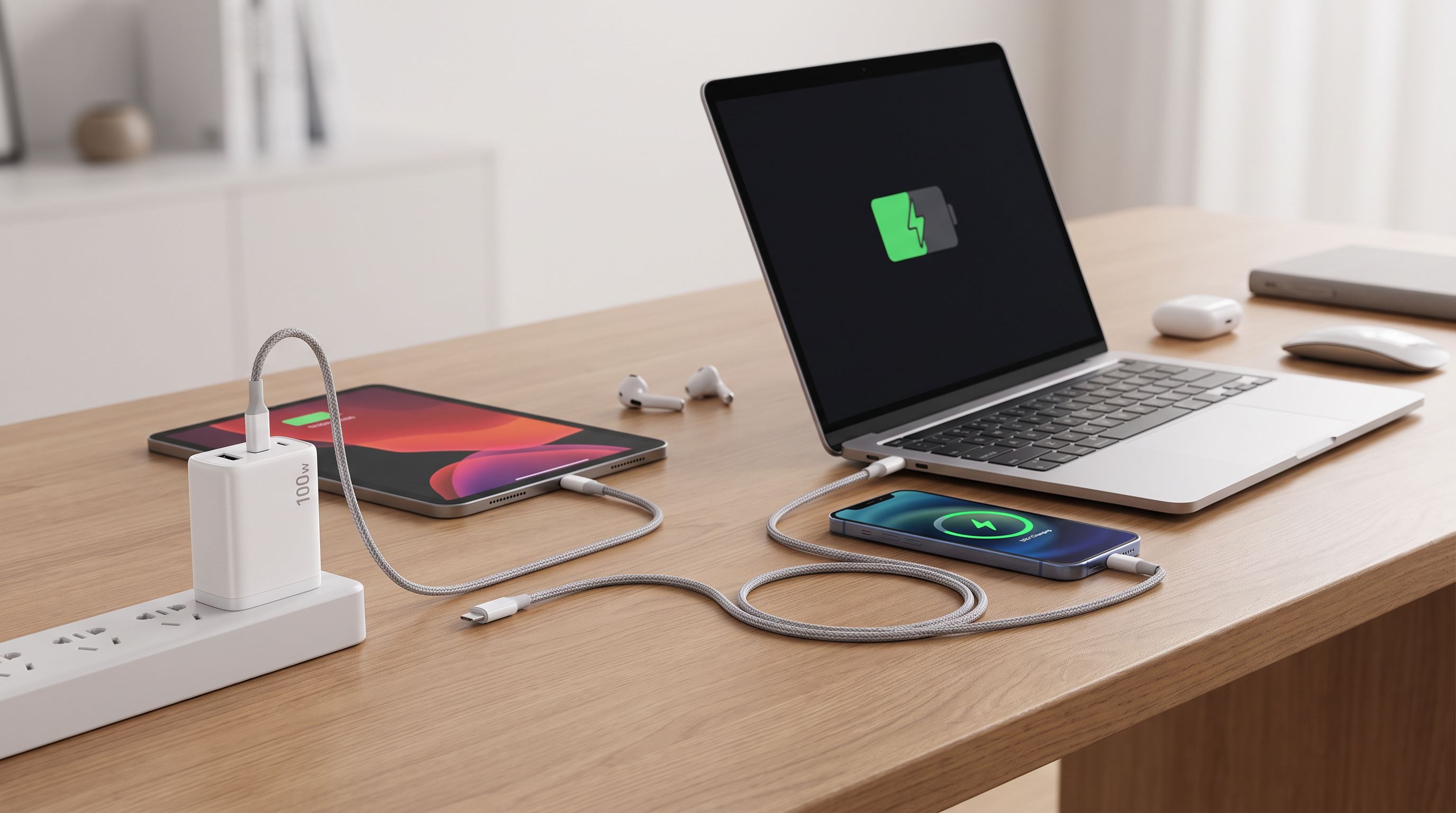
Best GaN Chargers in 2026: 100W Picks for Laptops
The best 100W GaN chargers in 2026 for laptops, tested criteria explained: port layouts, power splitting, travel size, and which models actually deliver full wattage.
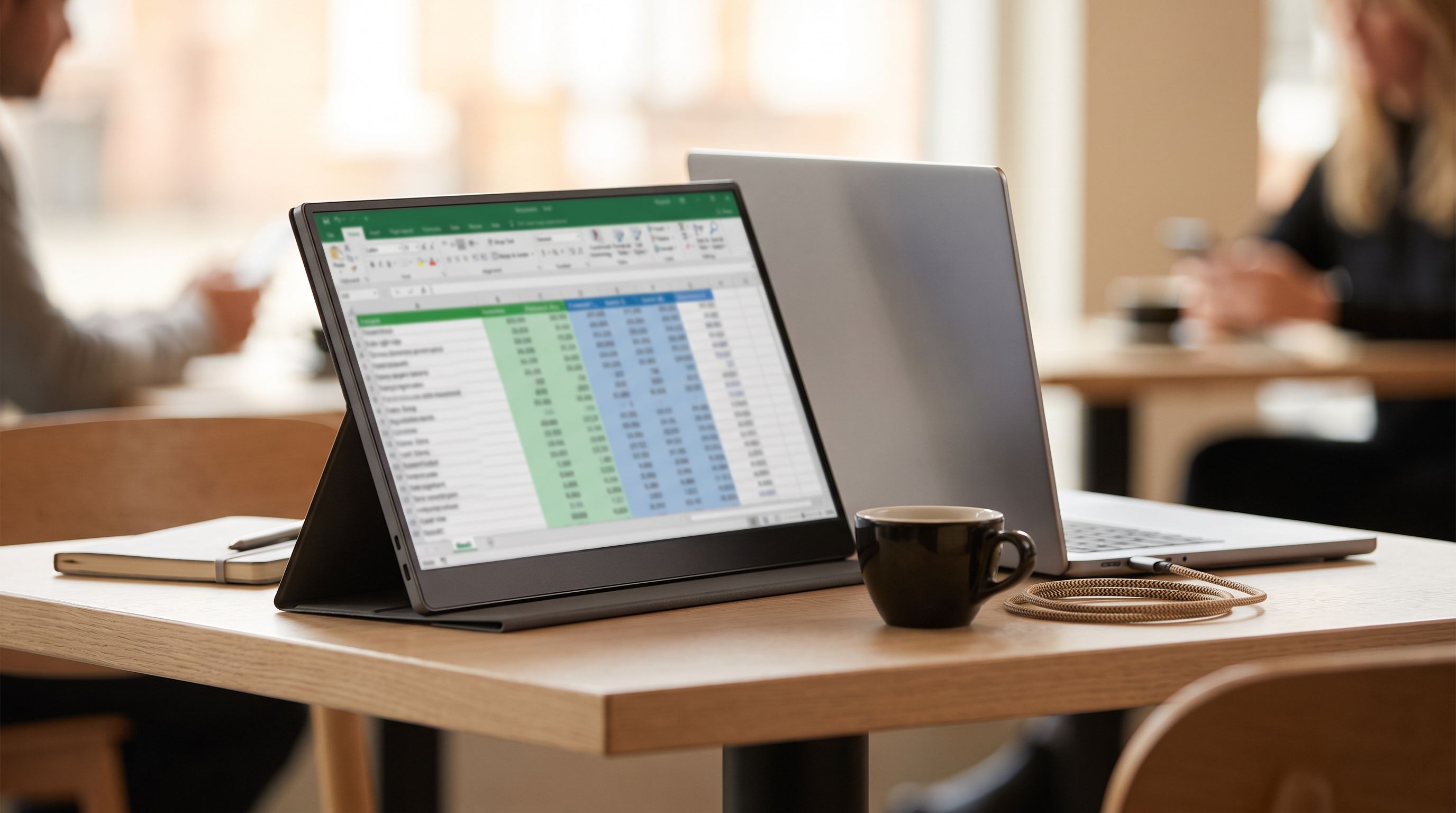
Best Portable Monitor 2026: 4K, OLED & USB-C Picks
The best portable monitor picks for 2026, from OLED travel screens to budget USB-C panels — ranked by panel quality, weight and single-cable power.
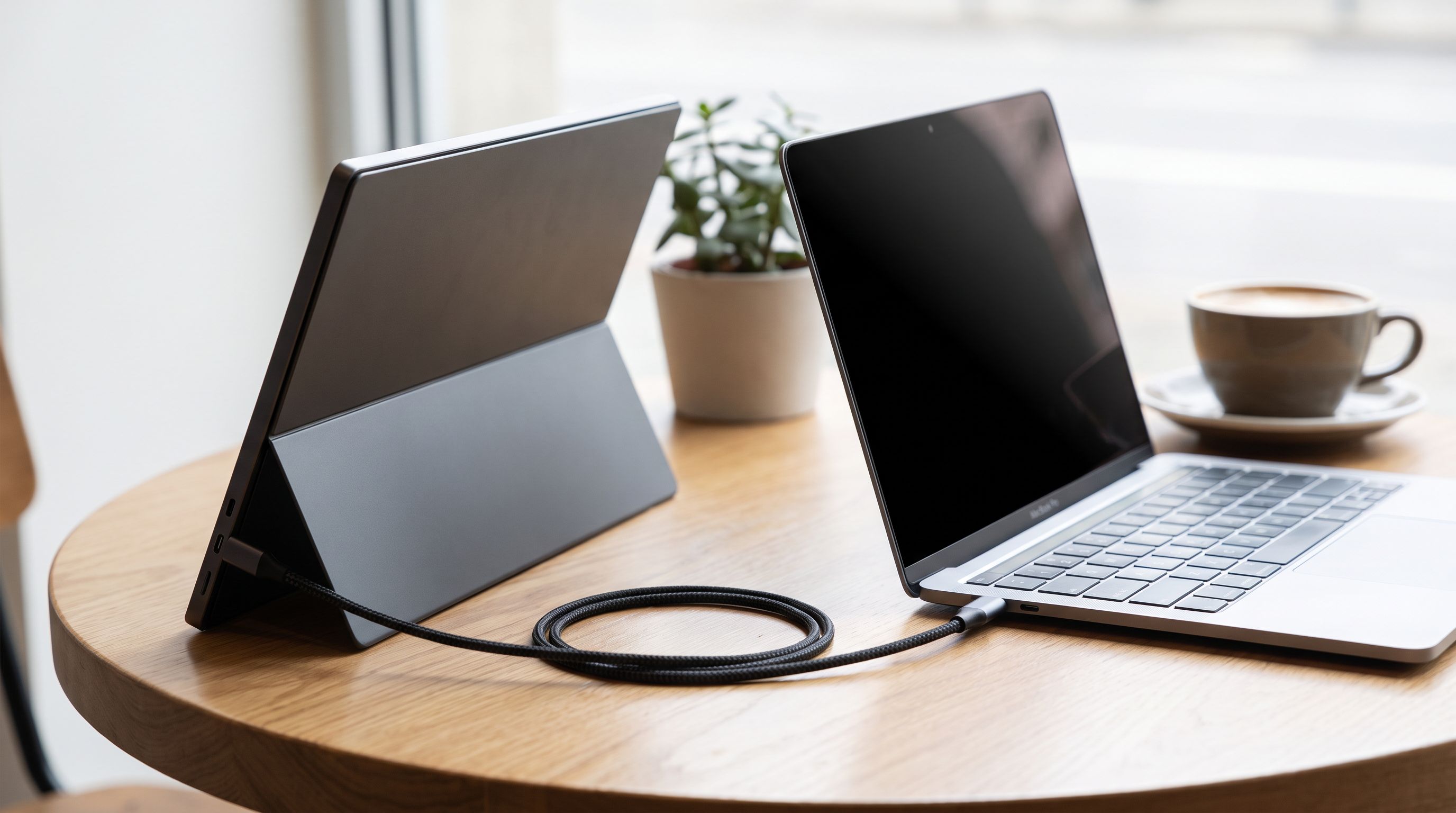
Portable Monitors for MacBook in 2026: 5 One-Cable Picks
The best portable monitor for MacBook in 2026, ranked by brightness, weight and stand design — plus which models truly run off a single USB-C cable.