Beginner Drones in 2026: 5 Sub-250g Picks Under $600
Our 2026 beginner drone guide compares sub-250g 4K models under $600 — DJI Mini 4K, Mini 3, Neo, Potensic Atom 2 — on flight time, sensors and FAA rules.
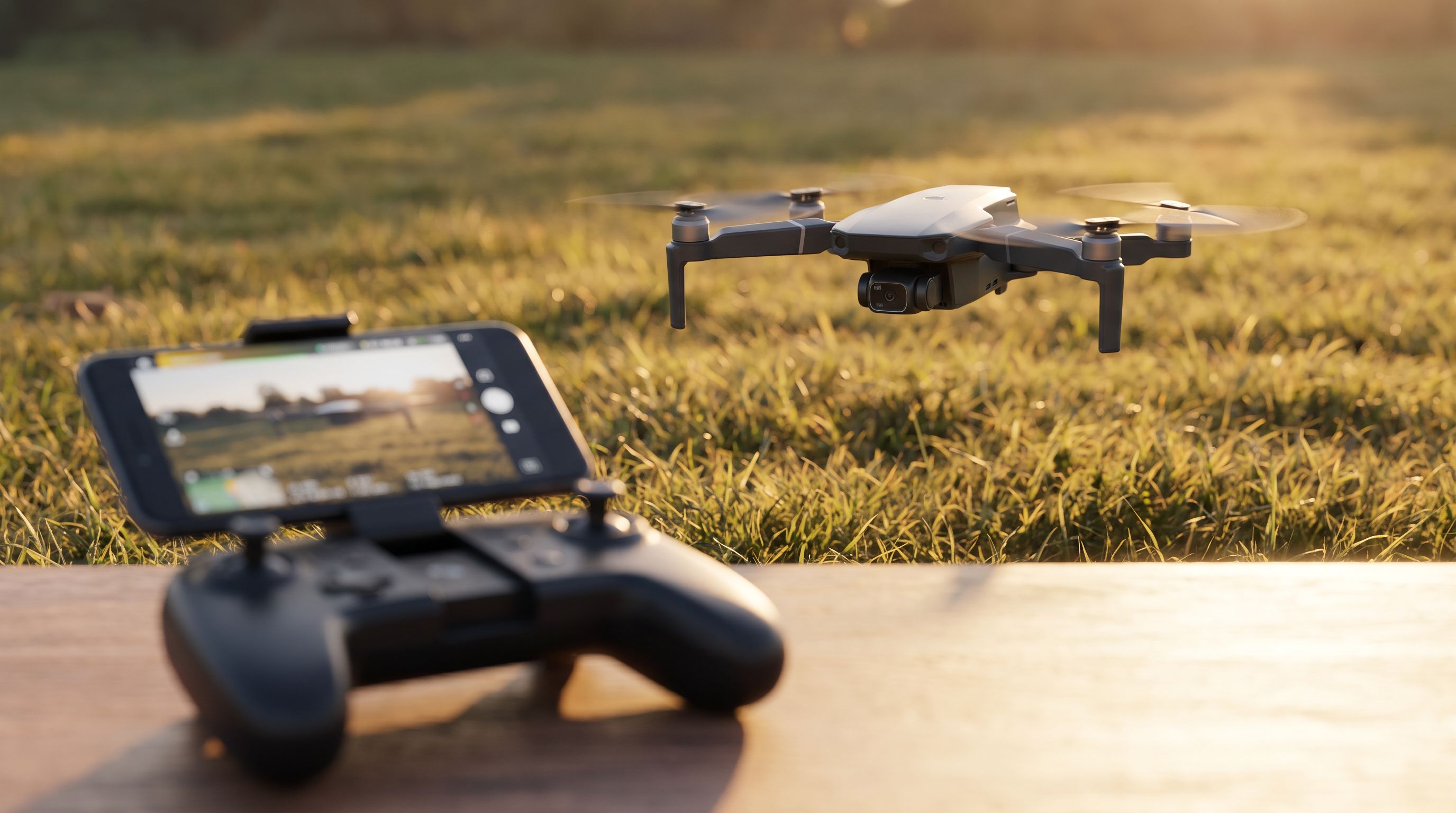
Reader-supported: we may earn a commission from links on this page, at no extra cost to you. It never affects our picks. Learn more.
Your first drone should be forgiving, legal to fly without much paperwork, and light enough that you actually take it places. That's why almost every good beginner recommendation in 2026 lands in the same bracket: sub-250 gram folding drones with a stabilized 4K camera, priced well under $600.
We compared the current entry-level lineup using manufacturer specs, independent reviews and verified owner feedback to work out which models genuinely suit first-time pilots — and which "cheap 4K drone" listings are best avoided.
Why 250 grams is the number that matters
In the United States, a drone that weighs under 250 g does not need to be registered with the FAA when flown purely recreationally. Cross that line and you're registering the aircraft, marking it with the registration number, and dealing with a bit more admin.
Two things people get wrong:
- You still need TRUST. Every recreational flyer, regardless of drone weight, must pass the free FAA TRUST (The Recreational UAS Safety Test) and carry proof. It takes about 20 minutes online.
- Remote ID still applies above 250 g, and any flying for business, content monetisation or paid work requires a Part 107 certificate no matter how small the drone.
Rules vary internationally — the EU uses C0/C1 class marks with a similar 250 g threshold, the UK requires an operator ID for camera drones — so check your national regulator before the first flight. The practical takeaway is the same everywhere: a sub-250g drone is the lowest-friction way to start.
What actually makes a drone beginner-friendly
GPS hold. This is the single biggest difference between a toy and a real drone. With GPS and downward vision sensors, the aircraft parks itself in the air when you release the sticks. Toy drones without it drift and crash.
Return-to-home. Low battery, lost signal, or a panic press of a button — the drone climbs and flies back to its takeoff point. Non-negotiable.
Wind resistance. Light drones fight breeze. Most sub-250g models are rated around Level 5 wind (roughly 19–24 mph), which is fine for calm mornings but not for coastal cliffs. Respect the rating.
Obstacle sensing. Here's the honest bit: at this price, you mostly won't get forward/backward obstacle avoidance. Full omnidirectional sensing generally starts with the DJI Mini 4 Pro tier, which sits above $600. Under $600 you typically get downward sensors for landing only. That's fine — beginners crash into trees they were looking at, and sensors don't fix bad situational awareness. Fly in open space until stick control is automatic.
Real transmission range. Ignore the marketing kilometre figure. What matters is whether the video feed holds up at a few hundred metres in a suburb with Wi-Fi noise. DJI's OcuSync-based systems and Potensic's newer link both do this far better than generic Wi-Fi drones.
The picks
DJI Mini 4K — best overall for beginners
 Best overall for beginners · DJI Mini 4K — Check price on Amazon →
The DJI Mini 4K is the cleanest answer to "what should my first drone be?" It's sub-250g, folds to roughly the size of a phone, and pairs a 1/2.3-inch sensor with a true 3-axis mechanical gimbal for 4K/30 video. Crucially, it inherits DJI's flight stack: GPS positioning, return-to-home, QuickShot automated moves, and a controller-and-app experience that hides complexity until you want it.
You're giving up the bigger sensor and vertical-video gimbal of the Mini 3, and there's no forward obstacle sensing. For learning, neither is a dealbreaker.
DJI Mini 3 — best flight time and image quality under $600
 Best flight time and image quality · DJI Mini 3 — Check price on Amazon →
If your goal is footage you'll actually publish, the DJI Mini 3 is worth the step up. It uses a larger 1/1.3-inch sensor, which is a genuine difference at sunrise, sunset and dusk — exactly when drone shots look best. The gimbal rotates to shoot true vertical for Reels and TikTok, and DJI rates it for a long flight time (longer still with the Intelligent Flight Battery Plus, though that variant pushes the weight over 250 g and back into registration territory).
Availability varies as DJI rotates its lineup, but it remains widely stocked and frequently discounted into the sweet spot.
DJI Neo — best budget and safest first flight
 Best budget / no-controller pick · DJI Neo — Check price on Amazon →
The DJI Neo rethinks the beginner problem: it has fully enclosed propeller guards, weighs well under 250 g, and can launch from your palm and fly preset shots with no controller at all. Tap a mode, let go, and it films a dronie or an orbit and comes back to your hand.
It is not a landscape-cinematography tool — the camera and wind resistance are modest, and it uses electronic stabilization rather than a full gimbal. But as a first drone, a travel drone, or something you hand to a nervous friend, it's the least stressful thing in the category. It also flies indoors, which almost nothing else here does safely.
Potensic Atom 2 — best value alternative to DJI
 Best value alternative to DJI · Potensic Atom 2 — Check price on Amazon →
The Potensic Atom 2 is the strongest non-DJI option for beginners. It's a sub-250g folder with 4K capture, a stabilized gimbal, GPS return-to-home and an intentionally gentle flight feel. Owner feedback consistently praises the handling and the bundled Fly More–style kits, which often include multiple batteries and a case — accessories that meaningfully change how much you fly.
The trade-off is transmission robustness and app polish, which still trail DJI. If you're flying open fields and parks rather than pushing range, it's a lot of drone for the money.
HoverAir X1 — best for hands-free filming
 Best for hands-free filming · HoverAir X1 — Check price on Amazon →
The HoverAir X1 isn't really a drone you pilot; it's a flying camera that follows you. Enclosed props, pocketable body, and tracking modes designed for running, biking and hiking. If your honest use case is "footage of me doing things outdoors" rather than "aerial landscapes," this removes the learning curve entirely.
Comparison table
| Model | Best for | Under 250 g | Camera | Controller included | Obstacle sensing |
|---|---|---|---|---|---|
| DJI Mini 4K | All-round first drone | Yes | 4K, 3-axis gimbal | Yes | Downward only |
| DJI Mini 3 | Image quality, vertical video | Yes (std. battery) | 4K, larger 1/1.3" sensor | Combo-dependent | Downward only |
| DJI Neo | Safest / cheapest start | Yes | 4K, enclosed props | Optional | Downward only |
| Potensic Atom 2 | Value | Yes | 4K, gimbal-stabilized | Yes | Downward only |
| HoverAir X1 | Hands-free self-filming | Yes | Stabilized, tracking modes | No (app/gestures) | Enclosed props |
Specs vary by region and bundle — confirm on the manufacturer's page before buying.
Buy the bundle, not the bare drone
One battery gets you roughly 15–30 minutes of flight depending on model and wind, and you'll burn the first ten learning. Fly More style combos with two or three batteries, a charging hub and a case are the single best upgrade at this level. Add a set of spare propellers and a landing pad if you fly from grass or gravel.
Your first-flight checklist
- Pass FAA TRUST (or your country's equivalent) and save the certificate to your phone.
- Check airspace in an app like B4UFLY or Aloft before you leave home.
- Update firmware on the drone, batteries and controller at home on Wi-Fi.
- Calibrate the compass in an open area away from cars and rebar.
- Hover at head height for five minutes and practise nose-in orientation before going high.
- Keep visual line of sight, stay under 400 ft, and land at 25–30% battery, not 5%.
FAQ
Do I need to register a sub-250g drone? For recreational flying in the US, no aircraft registration is required under 250 g — but you still need the free TRUST certificate. Any commercial use requires Part 107 regardless of weight.
Is 4K on a cheap drone actually 4K? On the models above, yes — they use real sensors with mechanical or high-quality electronic stabilization. Sub-$100 "4K" toy drones typically upscale from a low-resolution sensor and have no gimbal; avoid them.
Do I need obstacle avoidance as a beginner? It's nice, but under $600 it's mostly absent. Sensors don't prevent the most common beginner crash — flying backwards into something you can't see. Open space and good habits matter more.
How windy is too windy? If tree branches are moving noticeably, a 249 g drone is working hard. Most are rated to roughly Level 5 wind; treat that as a ceiling, not a target, and never fly downwind of yourself over water.
DJI or a cheaper brand? DJI's advantage is transmission reliability and software maturity, which is exactly what protects a beginner. Potensic's Atom 2 is the credible alternative if budget is the deciding factor.
Our picks
DJI Mini 4K Storage Bundle, Drone with 4K UHD Camera for Adults, Under 249 g, 3-Axis Gimbal Stabilization, Drone Case, Propellers Compatible, Propeller Guard, landing pad
Sub-250g, 4K/30 video, 3-axis gimbal and DJI's forgiving flight software at the lowest sensible entry price.
Mini 3 with DJI RC Remote (Fly More Combo) (CP.MA.00000613.01) Lightweight Foldable 4K Camera Quadcopter Bundle + 64GB Card + BackPack + Landing Pad + Card Reader + More
Larger 1/1.3-inch sensor, true vertical shooting and long battery life — still the sweet spot under $600.
DJI Neo, Mini Drone with 4K UHD Camera for Adults, 135g Self Flying Drone that Follows You, Palm Takeoff, Subject Tracking, QuickShots, Stabilized Video, Built-In Propeller Guard (Controller-Free) | 135g Self-Flying Drone That Follows You, Palm Takeoff, Subject Tracking, QuickShots, Stabilized Video (Controller-Free)
Palm-launch selfie drone with propeller guards built in — the safest way to learn indoors and out.
Potensic ATOM 2 Drone with Camera for Adults 4K Video, 8K Photo, Under 249g, 3-Axis Gimbal, 10KM Transmission, AI Track, Vertical Shooting, AI Night Shot, QuickShots, Fly More Combo (96-Min Flight) | 8K Photo, 4K 30FPS HDR, 96-Min Flight, AI Track, Night Shot, Vertical Shooting, Under 249g, for Beginners and Travel Creators
Sub-250g folding drone with 4K capture, GPS return-to-home and beginner-friendly handling.
HOVERAir X1 Drone with Camera, Follow-me Drone with Self-Flying Mode | Foldable Mini Drone with HDR Video Capture, Palm Takeoff, Intelligent Flight Paths, Hands-Free Control Black (Combo)
Self-flying, enclosed-prop camera drone that tracks you automatically — almost no piloting skill needed.
Get the best tech deals in your inbox
Join the BytePlaza newsletter for hand-picked gadget deals and new buying guides. No spam, unsubscribe anytime.
Related reads
Consumer Drones in 2026, Explained: Autonomy Meets Cameras
Consumer drones in 2026 are getting smarter cameras, better obstacle avoidance and 360° capture. Here's what's actually shipping — and what it means for buyers.
microSD Cards in 2026: What V30, V60 and A2 Actually Buy You
Confused by V30, V60, U3 and A2 labels? Here's what each rating means, plus the best microSD card picks for 2026 — Switch 2, action cams, drones and dash cams.
Thermal Camera for Phone 2026: Which Resolution Tier?
Picking the best thermal camera for phone 2026? We compare USB-C and Lightning clip-on imagers by resolution, NETD and app quality for home, plumbing and car work.