Bedside Projector Picks for 2026: Ceiling-Ready Under $600
We compared bedside projectors for 2026 on brightness, fan noise and auto-keystone reliability — gooseneck, short-throw and portable picks that actually work on a ceiling.
Reader-supported: we may earn a commission from links on this page, at no extra cost to you. It never affects our picks. Learn more.
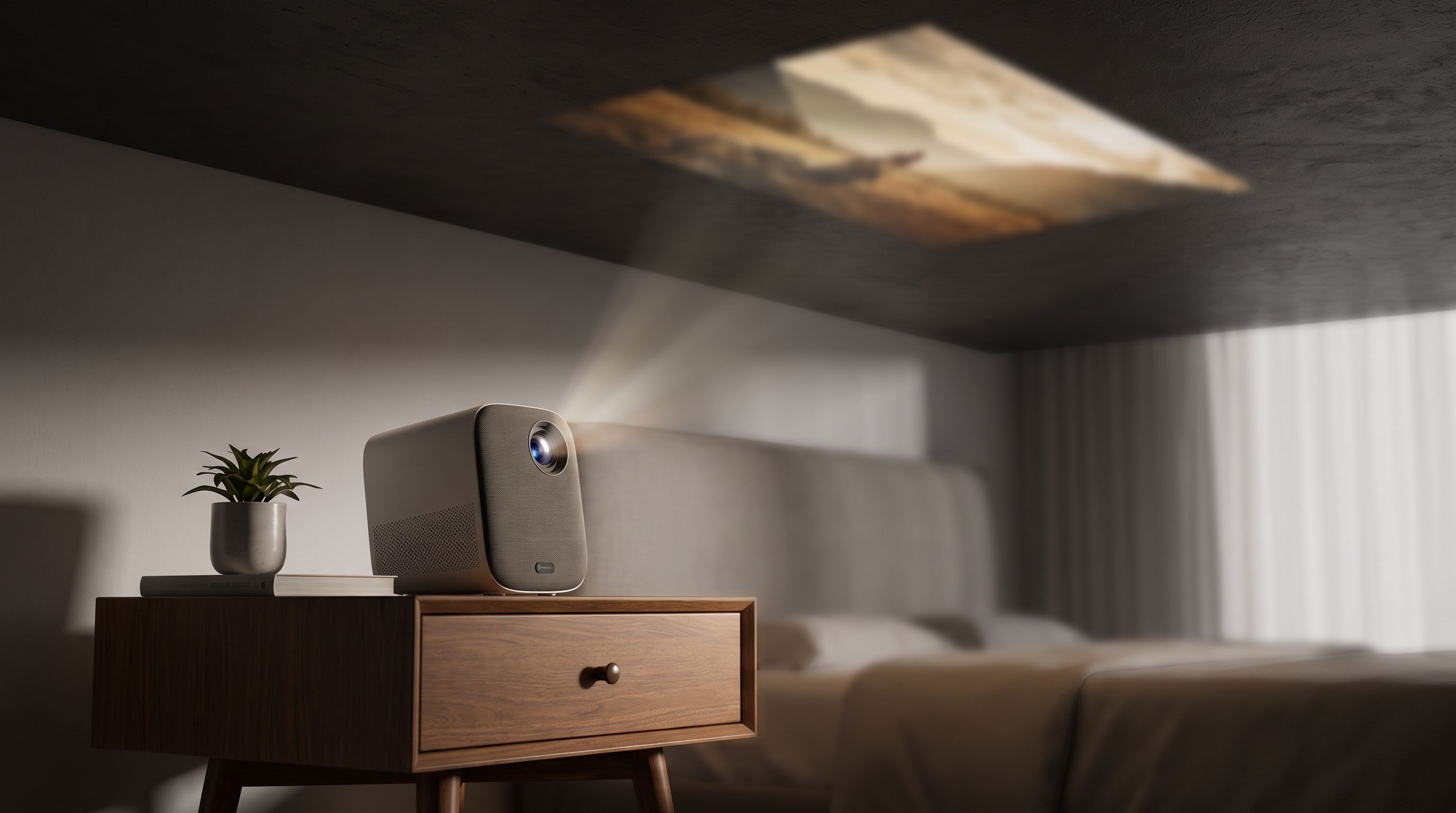
A bedside projector is a different animal from a home theater projector. It lives on a nightstand, it usually points at a ceiling or a wall above the bed, and it gets used at the exact moment you least want to deal with menus, cables or a whining fan. Brightness matters less than you'd think; noise, tilt range and auto-keystone reliability matter far more.
We compared the leading sub-$600 options using manufacturer spec sheets, independent review measurements and verified owner feedback, then ranked them for this specific use case. Here's what actually matters, and which models hold up.
What makes a projector good beside a bed
Tilt range is the whole ballgame
Most projectors are designed to sit on a table and throw forward. A bedside projector needs to throw up — often close to 90 degrees. There are three ways manufacturers solve this:
- Gimbal or rotating base (XGIMI MoGo 3 Pro, XGIMI MoGo 4): the body pivots on a built-in stand, so you tilt and you're done. Cleanest solution.
- Rotating body (BenQ GV31): the projector itself swivels within its frame, roughly 135 degrees of travel.
- Kickstand or tripod thread (Anker Nebula Capsule Air, Anker Nebula Mars 3 Air): fine for moderate angles, but straight-up ceiling throws often need a small desktop tripod. Budget for one.
 Best tilt design · BenQ GV31 — Check price on Amazon →
 Brightest under $600 · Anker Nebula Mars 3 Air — Check price on Amazon →
 Best for ceiling viewing · XGIMI MoGo 4 — Check price on Amazon →
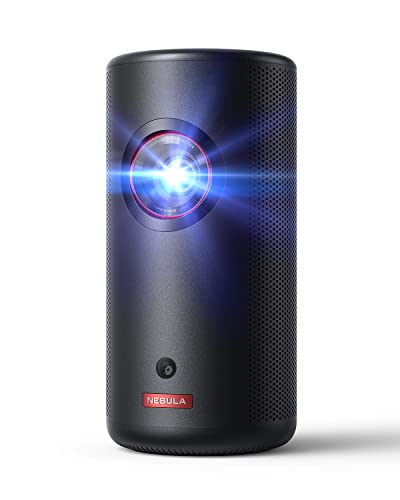 Budget pick · Anker Nebula Capsule Air — Check price on Amazon →
 Best overall · XGIMI MoGo 3 Pro — Check price on Amazon →
Avoid any "gooseneck" phone-holder-style arm marketed for projectors. They sag under weight, vibrate when the fan spins up, and the resulting image drifts over an evening. The models with engineered stands are a better answer to the same problem.
Auto-keystone is only as good as its recovery
Every modern smart projector claims auto keystone and autofocus. The difference is what happens when you nudge it at 11pm. The best implementations (XGIMI's ISA system on the MoGo 3 Pro and MoGo 4, Nebula's on recent Capsule and Mars models) re-square the image within a couple of seconds without you touching anything. Weaker ones require a trip into settings.
One caveat worth knowing: extreme ceiling angles push keystone correction near its limits, and heavy digital correction crops resolution and softens the image. If you'll point straight up most nights, favor a model whose physical tilt does the work so the software correction stays mild.
Fan noise is the most underrated spec
A projector that's inaudible across a living room can be intrusive 18 inches from your ear. Manufacturers rarely publish bedside-relevant noise figures, but owner feedback is consistent: LED models in the Capsule and MoGo families run quieter than brighter lamp-class portables, and every projector gets louder in its highest brightness mode. Running an eco or standard brightness preset at night is usually both quieter and easier on your eyes.
Brightness: less than you expect
In a dark bedroom aimed at a white ceiling, a few hundred ISO lumens is genuinely enough for a 60–80 inch image. Brightness only becomes decisive if you watch with a lamp on or during the day. That's where the Anker Nebula Mars 3 Air pulls ahead — it's the brightest of this group — though it's also the largest and least nightstand-friendly.
Ceilings are not screens
Textured or popcorn ceilings scatter light and kill contrast. Flat, matte white works surprisingly well. If your ceiling is dark, beamed or heavily textured, aim at the wall opposite the bed instead, or stick a cheap matte white vinyl panel overhead.
The picks, compared
| Model | Why it's here | Tilt approach | Built-in OS | Battery | Best for |
|---|---|---|---|---|---|
| XGIMI MoGo 3 Pro | Best overall balance | Integrated gimbal stand | Google TV | Yes | Nightly ceiling viewing with minimal fuss |
| Anker Nebula Capsule Air | Smallest and cheapest | Kickstand / tripod thread | Google TV | Yes | Tiny nightstands, travel, dorm rooms |
| XGIMI MoGo 4 | Best pure ceiling rig | Rotating base, detachable light ring | Google TV | Yes | Straight-up ceiling projection |
| Anker Nebula Mars 3 Air | Most brightness | Handle/stand, tripod thread | Google TV | Yes | Rooms where a light stays on |
| BenQ GV31 | Widest body rotation | ~135° rotating body | Android-based | Yes | Flexible angles plus better audio |
XGIMI MoGo 3 Pro — best overall
The MoGo 3 Pro is the one we'd buy for most bedrooms. Its integrated stand doubles as a gimbal, so pointing it at the ceiling takes about two seconds and it stays where you put it. XGIMI's auto keystone, autofocus and obstacle avoidance are among the most consistently praised in owner feedback, and it ships with licensed Google TV — meaning Netflix works natively, which is not a given in this category. It's a 1080p LED model rather than 4K, which is the right trade at this size and price; a bedside image doesn't benefit much from extra pixels.
Anker Nebula Capsule Air — budget pick
If your nightstand is already crowded, the Capsule Air is the answer. It's roughly soda-can sized, runs on battery, includes Google TV, and its kickstand handles moderate upward angles. You give up brightness and some tilt range compared to the MoGo models, and for a true straight-up ceiling throw you'll want a small tripod. For late-night watching in a dark room, it's more than adequate — and it's the easiest of these to pack.
XGIMI MoGo 4 — best for ceiling viewing
The MoGo 4 refines the formula with a base that rotates for easier vertical aiming and a detachable light ring that adds ambient lighting (gimmicky for some, genuinely nice as a soft night light for others). Spec-for-spec it's the most purpose-built ceiling option here. If straight-up projection is your primary use, this is worth the step up from the MoGo 3 Pro.
Anker Nebula Mars 3 Air — brightest under $600
Reviewers consistently call out the Mars 3 Air for brightness relative to its size and price, and it's the pick if your "bedside" viewing happens with a reading lamp on or in a room with streetlight spill. The trade-offs are real: it's a chunkier, lantern-style unit that needs more nightstand real estate, and running it at full brightness makes the fan more noticeable. Dial brightness back at night and it behaves.
BenQ GV31 — best tilt design
BenQ's approach is mechanical: the cylinder rotates within its stand across a wide arc, so you can land on almost any angle without a tripod. Its built-in audio is also a step above what tiny capsule-style projectors manage, which matters if you don't want to pair a speaker every night. The streaming experience is less polished than Google TV on the XGIMI and Nebula models, so plan on a Fire TV Stick or Chromecast if app support is a priority.
Practical setup tips
- Use sleep timers. Every model here has one. Falling asleep mid-episode with a projector running all night shortens LED life and wastes power.
- Pair Bluetooth audio ahead of time. Built-in speakers are fine for dialogue, but a small Bluetooth speaker or earbuds transform late-night viewing — and keep the volume off a partner.
- Mind the vents. Don't set these on a duvet or against a wall. Blocked airflow spins fans faster, which is exactly the noise you're trying to avoid.
- Lock focus once you're settled. If your projector lets you disable continuous autofocus, do it. Repeated hunting is distracting in a dark room.
FAQ
Can a bedside projector really replace a bedroom TV? For night viewing, yes — a 60–80 inch ceiling image beats most bedroom TVs for immersion. For daytime or lights-on viewing, a TV still wins unless you spend considerably more.
Do I need 4K? No. At typical bedside throw distances and image sizes, 1080p is sharp enough, and 4K models in this price bracket usually compromise elsewhere. Spend the budget on tilt flexibility and quiet operation instead.
Will auto-keystone work pointing straight up? Usually, but it's near the edge of the envelope. Models with physical tilt mechanisms — the MoGo 4, MoGo 3 Pro and GV31 — let the hardware do most of the work so correction stays light and the image stays sharp.
Does battery life matter? Less than it seems for bedside use, since you'll be near an outlet. It's useful for moving the projector to a patio or taking it on a trip, but don't pay a premium for it if the projector never leaves the nightstand.
What about projecting onto a popcorn ceiling? Expect a visibly softer, lower-contrast picture. A smooth matte white surface — even an inexpensive vinyl panel or a flat-painted section — makes a bigger difference than upgrading the projector.
Our picks
XGIMI MoGo 4 Laser Projector Collection, Outdoor Kit with PowerBase Stand | 550 ISO Lumens, Google TV , Official Netflix, 5h Battery Life – All-in-One Home Cinema Kit, 70" Screen, 4 Filters& Carry Case
Gimbal-style stand tilts to the ceiling, quiet fan, and the most reliable auto-keystone in its class.
NEBULA Capsule 3 Laser Outdoor Portable Mini Smart TV Projector | Google TV, Netflix-Certified, Dolby Digital Sound, 120" Display, 2.5H Built-In Battery, Outdoor Wi-Fi Smart TV
Soda-can size with a built-in kickstand and Google TV — the easiest true nightstand projector.
XGIMI MoGo 4 Portable Projector, Outdoor Projector, 360°Adjustable Stand | Certified Google TV & Netflix, 2.5 Hours of Playtime, 2 x 6W Harman Kardon, Wifi, Bluetooth, Include Sunset Filter
Rotating base plus detachable light ring makes straight-up ceiling throws genuinely simple.
NEBULA Mars 3 Air Portable Outdoor Projector, Built-In Battery | Google TV, 1080p, 400 ANSI Lumen, 2.5H Playtime, Netflix Officially Licensed, Dolby Digital Sound, 150" Picture
Highest usable brightness here, so it still looks good with a hallway light on.
BenQ GV32 1080p Ceiling Projector + Free carry bag
Rotates nearly 135 degrees on its own body and has a notably strong built-in speaker for its size.
Get the best tech deals in your inbox
Join the BytePlaza newsletter for hand-picked gadget deals and new buying guides. No spam, unsubscribe anytime.
Related reads
Budget OLED TVs in 2026: Where 55" and 65" Pay Off
Looking for the best budget OLED TV in 2026? We compare entry-level LG, Samsung and Sony OLEDs by panel tier, brightness and gaming specs for 55" and 65" buyers.
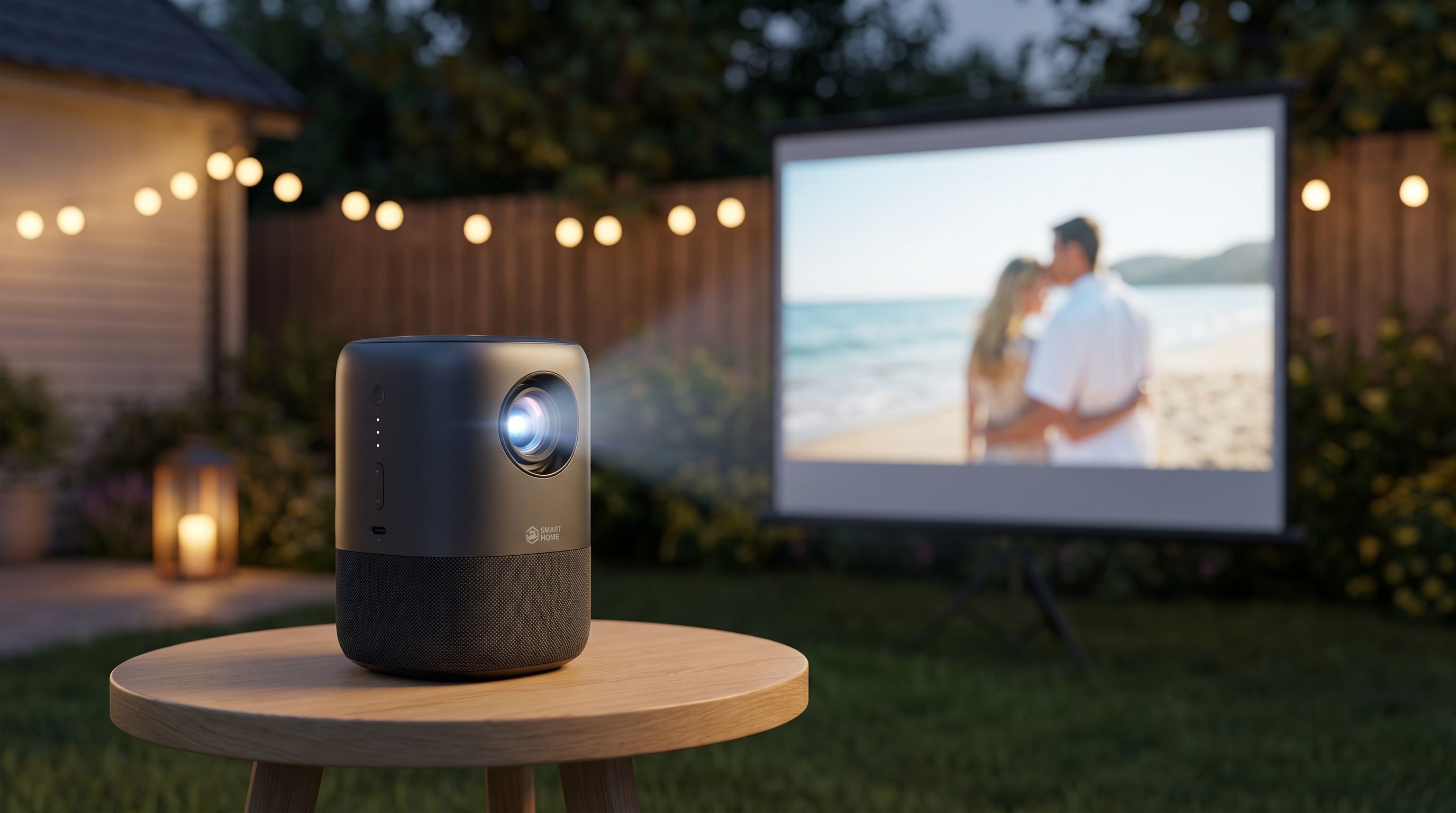
Portable Projectors Under $400 in 2026: 4 That Earn the Wall
The best portable projector under $400 in 2026, compared on real ANSI lumens, throw distance, battery life and built-in streaming for dorms and backyards.
Best 4K Projector 2026: Home Theater vs Portable
The best 4K projector 2026 picks compared: laser TVs, long-throw home theater beamers and portable smart projectors ranked on brightness, throw and room fit.