Budget OLED TVs in 2026: Where 55" and 65" Pay Off
Looking for the best budget OLED TV in 2026? We compare entry-level LG, Samsung and Sony OLEDs by panel tier, brightness and gaming specs for 55" and 65" buyers.
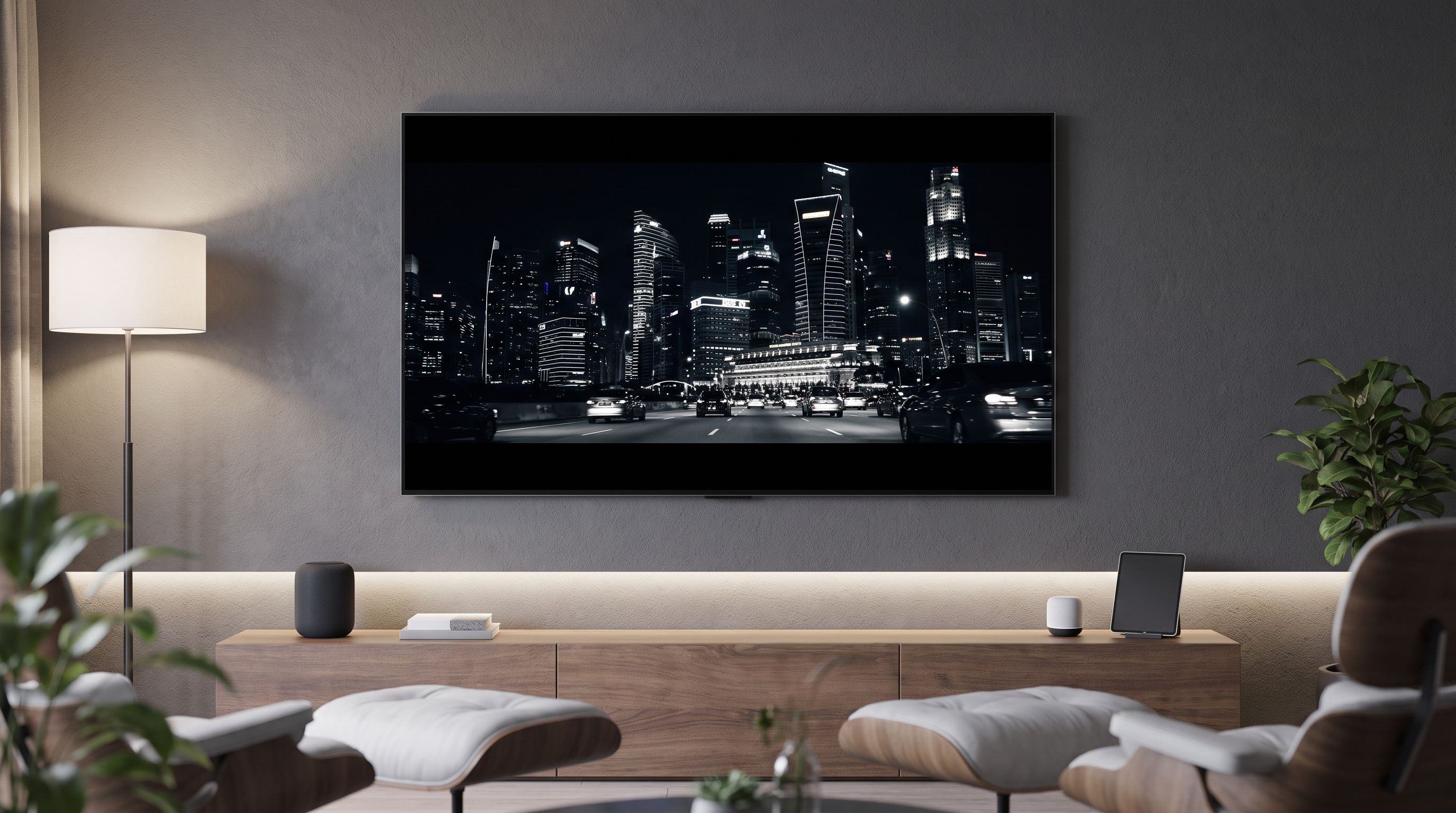
Reader-supported: we may earn a commission from links on this page, at no extra cost to you. It never affects our picks. Learn more.
"Budget OLED" is a relative term. No OLED TV is cheap next to a mid-tier Mini LED, and anyone shopping purely on price will find more sheer screen area per dollar elsewhere. What a budget OLED buys you is the thing Mini LED still can't fully replicate: per-pixel light control, so black is actually black, there's no blooming around subtitles, and contrast holds up from any seat in the room.
The good news for 2026 is that the entry tier has quietly caught up. Features that used to be reserved for flagship OLEDs — four full-bandwidth HDMI 2.1 ports, 144Hz refresh rates, VRR, and modern HDR formats — have trickled down to the cheapest OLED models most brands sell. The compromises are now mostly about brightness and processing, not capability.
Below is how we'd think about the entry-level OLED market this year, which panel tiers are worth paying for, and whether 55 or 65 inches is the smarter buy.
How budget OLEDs are tiered in 2026
Every major brand runs a three- or four-step OLED ladder. Understanding where the cuts happen saves a lot of money.
Entry tier (LG B-series, Sony's base BRAVIA OLED). These use standard WOLED panels without the brightness-boosting heatsink or micro lens array found higher up. Perfect blacks, excellent contrast, good-but-not-dazzling highlights. In 2026 the LG B6 OLED sits here and is the one most reviewers point to as the best budget OLED TV of the year — notably because LG finally gave the B-series the same four HDMI 2.1 inputs and high refresh rate support as its pricier siblings. Last year's LG B5 OLED is still floating around at steeper discounts and remains a genuinely good buy if you can find stock.
Mid tier (LG C-series, Samsung S90-series). This is where brightness jumps meaningfully — often in the ballpark of 50-70% higher peak highlights than the entry tier, depending on the measurement and review source. The LG C5 OLED, now a step-down model since the C6 arrived, is the classic "wait for the discount" play. The Samsung S90F uses QD-OLED panels (in most sizes), which trade a touch of black-level purity in bright rooms for noticeably richer color volume.
Flagship tier (LG G-series, Samsung S95, Sony's top OLED). Micro lens array panels, best-in-class processing, anti-reflective coatings. Excellent, but firmly outside any budget conversation.
The practical takeaway: in a dim or light-controlled room, the entry tier is close enough to the mid tier that most people would struggle to tell them apart. In a sunny living room with big windows, the brightness gap becomes the single most important difference.
55" vs 65": where the value actually sits
Historically, 65 inches has been the price-per-inch sweet spot in OLED, and that's still true in 2026. The 55-inch panel costs less to make, but fixed costs — processor, power supply, chassis, software development — don't shrink, so the per-inch premium on small OLEDs is steep.
A rough guide:
- 55 inches makes sense for apartments, bedrooms, or seating distances under about 7 feet. It's also the size where OLED's lack of blooming matters most, because you're sitting close enough to see halos on an LED set.
- 65 inches is where the discounts get aggressive during sales events, and it's the size most people end up wishing they'd bought. For a typical 8-10 foot viewing distance, it's the better call.
- 77 inches and up leaves budget territory entirely; a high-end Mini LED usually makes more financial sense at that size.
One caveat: if you're choosing between a 55-inch mid-tier OLED and a 65-inch entry-tier OLED at a similar price, we'd generally take the bigger entry-tier set — unless your room is bright, in which case brightness wins.
Comparison: entry and near-entry OLEDs for 2026
| Model | Panel type | Tier | HDMI 2.1 ports | Gaming | Best for |
|---|---|---|---|---|---|
| LG B6 OLED 65" | WOLED | Entry | 4 | 4K/144Hz, VRR, ALLM | Best all-round budget buy |
| LG B5 OLED 55" | WOLED | Entry (prior gen) | 4 | 4K/144Hz, VRR, ALLM | Smaller rooms, deepest discounts |
| Samsung S90F OLED 65" | QD-OLED (size dependent) | Mid | 4 | 4K/144Hz, VRR, ALLM | Bright rooms, color punch |
| LG C5 OLED 65" | WOLED w/ brightness boost | Mid (prior gen) | 4 | 4K/144Hz, VRR, ALLM | Step-up picture for near-budget money |
| Sony BRAVIA 8 OLED 55" | WOLED | Entry/mid | 2 | 4K/120Hz, VRR, ALLM | Movie watchers, processing quality |
 Best for movies · Sony BRAVIA 8 OLED 55 — Check price on Amazon →
 Best step-up pick · LG C5 OLED 65 — Check price on Amazon →
 Best brightness per dollar · Samsung S90F OLED 65 — Check price on Amazon →
 Best value as it discounts · LG B5 OLED 55 — Check price on Amazon →
 Best overall budget OLED · LG B6 OLED 65 — Check price on Amazon →
Specs vary by region and size variant — always confirm the exact panel and port count for the size you're buying, since brands occasionally differ between a 55" and 65" of the same model.
Gaming: what to insist on, what to ignore
If a console or PC is plugged in, the checklist is short.
Insist on: at least two HDMI 2.1 ports at 48Gbps, VRR support, ALLM, and low input lag (under ~13ms at 120Hz is typical for modern OLEDs). The LG B6 OLED and LG C5 OLED both deliver four such ports, which matters if you're running a PS5, an Xbox, a PC and a soundbar through eARC. The Sony BRAVIA 8 OLED is the notable exception — Sony still limits full-bandwidth ports, and one is shared with eARC, which is the main reason it's not our top pick for gamers.
Nice to have: 144Hz (useful for PC, irrelevant for consoles), Dolby Vision gaming (LG and Sony yes, Samsung no), and a game dashboard overlay.
Ignore: marketing refresh-rate numbers above the native panel spec, and most "AI" picture modes.
One OLED-specific note for gamers: burn-in risk on modern panels is low with mixed viewing, but static HUDs for many hours a day are the worst-case scenario. All current models run pixel-shifting and panel refresh routines automatically. Use them, don't disable them, and don't leave a paused game on screen overnight.
Which one should you buy?
For most people: the LG B6 OLED at 65 inches. It's the clearest expression of what 2026's entry tier does well — full gaming feature set, perfect blacks, webOS with every major app, and the lowest realistic entry point into OLED at a sensible size.
If you want the most picture per dollar: watch the Samsung S90F. Its QD-OLED panel punches above entry tier on brightness and color, and it discounts hard. Skip it if you're committed to Dolby Vision content, which Samsung still doesn't support.
If you're shopping purely on price: the LG B5 OLED at 55 inches. Last-generation entry OLEDs get the deepest cuts, and the real-world gap to the B6 is small.
If films matter more than games: the Sony BRAVIA 8 OLED. Sony's upscaling and motion handling remain the benchmark, and the Acoustic Surface audio system is unusually good for a TV without a soundbar.
If you can stretch: a discounted LG C5 OLED is frequently the best value in the entire OLED market once a newer C-series launches.
FAQ
Is a budget OLED better than a high-end Mini LED at the same price?
It depends on your room. In a dim room, the OLED wins on contrast, viewing angles and motion clarity. In a bright room with lots of windows, a good Mini LED's higher peak brightness and anti-glare coating may be more satisfying. Size also factors in — the Mini LED will usually be bigger for the money.
Do entry-level OLEDs still have burn-in problems?
Risk exists but is low for typical mixed viewing. Manufacturers run pixel shifting, logo dimming and compensation cycles automatically. Heavy daily use of static content — news tickers, a single game HUD for 8 hours a day — is where problems concentrate.
Should I wait for a newer model or buy last year's?
Last year's model is usually the better buy. OLED generational improvements are incremental, and the discount on an outgoing model typically outweighs the gain. The exception is when a model year adds a structural feature — as with the B-series gaining four HDMI 2.1 ports.
Is 144Hz worth paying for on a TV?
Only for PC gaming. Consoles cap at 120Hz, so for a PS5 or Xbox the extra headroom does nothing. Don't let it be a deciding factor.
Do I need a soundbar?
Most budget OLEDs have thin cabinets and modest speakers, so yes, a soundbar meaningfully improves things. The Sony BRAVIA 8 OLED is the main exception, with a panel-vibration audio system that's noticeably better than typical built-in TV speakers.
Our picks
LG 65-Inch OLED AI 4K B6 Series Smart TV, 2026 Model
LG's entry OLED line with four HDMI 2.1 ports and 144Hz gaming — the value sweet spot at 65 inches.
LG 55-Inch OLED evo AI 4K C5 Series Smart TV (OLED55C5PUA, 2025)
Last year's entry OLED still delivers perfect blacks and full 4K/120 gaming support for less.
Samsung 65-Inch Class OLED S90F 4K Smart TV (2025 Model) NQ4 AI Gen3 Processor Upscaling Pro HDR +, Motion Xcelerator 144Hz, Vision Alexa Built-in
QD-OLED color volume and high brightness, often priced near step-down OLEDs during sales.
LG 65-Inch OLED evo AI 4K C5 Series Smart TV (OLED65C5PUA, 2025)
Brighter panel, better processing and full gaming suite — the classic mid-range OLED on discount.
Sony BRAVIA 8 II 55 inch QD-OLED 4K HDR Google TV (2025) K55XR80M2 Bundle with CPS 26‑Month Protection Plan, Deco Gear 4K HDMI Cable and Deco Gear Television Home Theater Essentials Beginner's Guide
Sony's picture processing and Acoustic Surface audio make it the cinephile's budget OLED.
Get the best tech deals in your inbox
Join the BytePlaza newsletter for hand-picked gadget deals and new buying guides. No spam, unsubscribe anytime.
Related reads
Smart Electric Toothbrushes 2026: Is App Coaching Worth It?
We compared smart electric toothbrushes for 2026 on pressure sensors, brush modes and app coaching — plus which features are actually worth paying extra for.
Pet Cameras in 2026: Treat Tossers vs Plain Watchers
Treat-tossing or plain monitoring? We compare the best pet camera 2026 options on subscription costs, app features, and owner-reported reliability.
Smart Ovens in 2026: Which Countertop Camera Actually Earns Its Keep
Looking for the best smart oven in 2026? We compare app-connected countertop ovens on capacity, probe cooking, built-in cameras and hidden subscription costs.