AI PCs, Explained: What the NPU Hype Actually Means
NPUs are now standard in new laptops, but what does one actually do for you? A grounded look at TOPS, Copilot+ features, real chips, and whether to buy now.
Reader-supported: we may earn a commission from links on this page, at no extra cost to you. It never affects our picks. Learn more.
The sticker on the laptop says "AI." The question nobody answers is: doing what?
Walk into any electronics aisle right now and nearly every new laptop carries some variation of the same badge — AI PC, Copilot+ PC, Ryzen AI, Intel Core Ultra. The marketing implies a category shift. The spec sheet gives you a number, measured in TOPS, that means nothing to most buyers. And the honest answer to "what does the NPU do for me today?" is narrower than the badge suggests — but it's also not nothing, and it's growing.
This is an attempt to separate the two. What an NPU physically is, what it currently accelerates on a shipping machine, where the chip vendors actually are, and whether any of it should change what you buy this year.
What's actually happening now
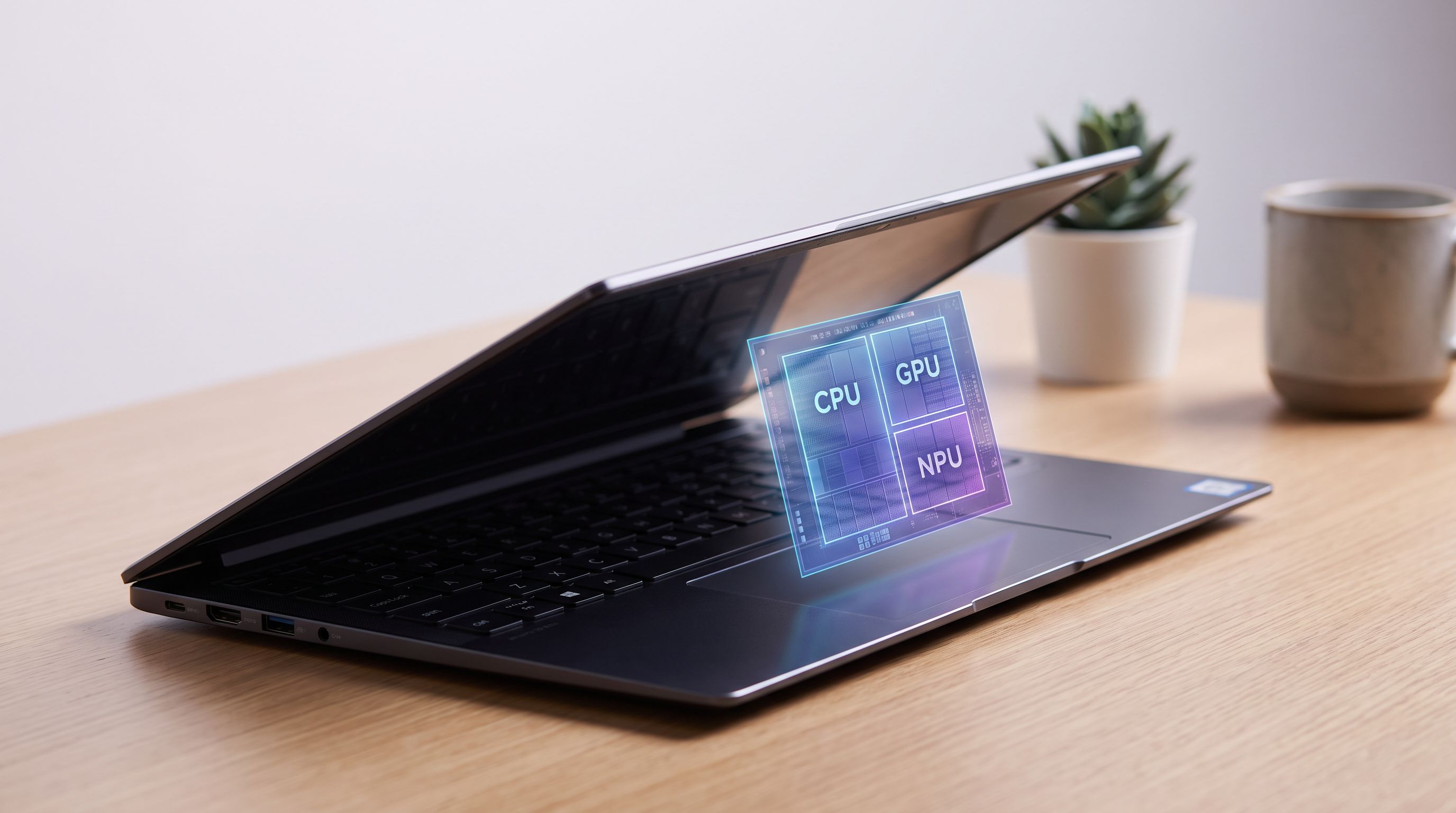
An NPU — neural processing unit — is a block of silicon inside the processor package designed to run neural network math efficiently. Lenovo's own support documentation describes it as a specialized processor for AI features like voice recognition and image processing. It is not faster than a discrete GPU at raw AI throughput. Its advantage is efficiency: it does sustained, low-intensity inference at a fraction of the power the CPU or GPU would burn on the same job, which is why the practical benefit shows up as battery life and as effects that can run continuously without spinning up fans.
Two things happened to turn that from a footnote into a marketing war. First, Microsoft drew a hard line: Copilot+ PC features require an NPU rated at roughly 40 TOPS or higher, which instantly made TOPS a shelf-talker number. Second, all three major Windows silicon vendors — Qualcomm, Intel, AMD — now ship parts that clear that bar, so the differentiator collapsed almost as fast as it appeared.
That's the useful frame from CES 2026 coverage: analysts covering the show repeatedly landed on the same conclusion — that NPUs are becoming a commodity, not a competitive advantage, and that essentially every laptop will have one within a couple of years. When a feature is universal, it stops being a reason to buy and starts being a reason not to buy something old.
The gap is software. Industry commentary around AI-enabled laptops has been consistent that most existing applications still target the CPU or GPU, and that NPU support will broaden as more AI PCs ship and developers follow the installed base. That's the whole story in one sentence: the hardware arrived first, and the apps are catching up unevenly.
The real players and what's actually shipping
Qualcomm kicked the current cycle off. Snapdragon X Elite and X Plus put a 45 TOPS Hexagon NPU into Windows laptops and, per reviews, delivered genuinely long battery life in thin machines — the first credible Arm-on-Windows push since Microsoft's earlier attempts. The tradeoff is emulation: x86 apps run through Prism translation, and compatibility, while much improved, is still the thing to check if you depend on niche software, specific VPN clients, or older creative plugins. Microsoft's own Surface Laptop with Snapdragon X is the cleanest expression of what Microsoft thinks a Copilot+ PC should be.
Intel answered with Core Ultra Series 2 (Lunar Lake), whose NPU 4 clears the Copilot+ threshold while keeping full native x86 compatibility and notably improved Xe2 integrated graphics. For most buyers this is the low-drama option: you get the AI features and nothing in your existing software library changes. Machines like the ASUS Zenbook 14 built on these chips have been widely reviewed as strong efficiency-focused thin-and-lights.
 Best x86 compatibility pick · ASUS Zenbook 14 (Intel Core Ultra Series 2) — Check price on Amazon →
AMD ships Ryzen AI 300 series with its XDNA 2 NPU, also above the 40 TOPS line, paired with unusually strong integrated Radeon graphics. AMD has been vocal about the NPU reshaping what a PC can do locally, and in practice its parts tend to be the best pick if you want AI-capable silicon that also handles light gaming and GPU-accelerated creative work. Lenovo's Yoga line has been a consistent home for these chips.
Apple is the odd one out, because it never ran the TOPS marketing campaign. The Neural Engine has been in Apple silicon since the M1, and Apple Intelligence features run on-device across current Macs. A MacBook Air with M4 is, functionally, an AI PC — it just doesn't say so on the lid.
| Platform | NPU | Copilot+ eligible | Main strength | Main caveat |
|---|---|---|---|---|
| Qualcomm Snapdragon X Elite/Plus | Hexagon, 45 TOPS | Yes | Battery life, launched Copilot+ | x86 apps run via emulation |
| Intel Core Ultra Series 2 (Lunar Lake) | NPU 4, above 40 TOPS | Yes | Native x86, solid iGPU | Fewer high-core-count options |
| AMD Ryzen AI 300 | XDNA 2, above 40 TOPS | Yes | Strong integrated graphics | Model naming is confusing |
| Apple M-series (M4) | Neural Engine | N/A (macOS) | Mature on-device AI, efficiency | macOS-only ecosystem |
What it means if you're shopping today
Here's the grounded version. The features that actually use the NPU on a Copilot+ PC right now are real but modest in scope: Windows Studio Effects for webcam background blur, eye contact and framing; live captions with translation; Cocreator and image generation in Paint and Photos; and Recall, the searchable snapshot timeline that shipped after a long privacy-driven delay and remains opt-in. Third-party creative apps are gradually adding NPU paths for things like noise suppression and background removal, but if you run heavy local LLMs or Stable Diffusion workloads, a discrete GPU still does the heavy lifting — the NPU is for the always-on, low-power stuff.
So: is the NPU a reason to buy? Not on its own. It's a reason not to buy a discounted 2023-era laptop if you plan to keep it five years. The better way to shop is to treat the NPU as a checkbox that comes free with the good chips, and then buy on the things that have always mattered — screen quality, keyboard, thermals, RAM (16GB is the sane floor now, partly because on-device models are memory-hungry), and battery.
If you want the longest unplugged runtime and your software list is mainstream, a Snapdragon X machine like the Surface Laptop is the strongest expression of the pitch. If you have any compatibility anxiety at all, an Intel Core Ultra Series 2 laptop such as the Zenbook 14 removes that variable entirely. If you want AI silicon plus real graphics headroom, Ryzen AI 300 in something like a Lenovo Yoga is the balanced choice. And if you're already in the Apple ecosystem, the M4 MacBook Air gets you mature on-device AI without any of the TOPS discourse.
What to watch next
Three things. First, whether NPU-accelerated features escape Microsoft's first-party apps — the moment Adobe, Zoom, Blackmagic and the browser vendors ship broad NPU paths, the value proposition stops being theoretical. Second, memory: local models are constrained more by RAM bandwidth and capacity than by TOPS, and the industry drift toward on-package memory changes upgradeability. Third, the TOPS number itself, which is not standardized in a way that lets you compare vendors cleanly and should be read as a threshold, not a score.
The realistic outlook is unglamorous. NPUs are becoming table stakes, like Wi-Fi or a webcam. In two years nobody will advertise them, and the laptops will simply be a bit more efficient at a set of background tasks. That's a genuine improvement. It's just not the revolution the badge is selling.
FAQ
Do I need 40+ TOPS? Only if you specifically want Microsoft's Copilot+ features, which require it. Below that threshold you still have an NPU — it just won't unlock Recall, Cocreator, or live captions with translation.
Does an NPU make my laptop faster? Not at general computing. It offloads specific AI tasks from the CPU/GPU, which mainly shows up as better battery life and effects that run without fan noise.
Can I run ChatGPT-class models locally on an NPU? Small models, yes, increasingly. Large ones remain GPU-and-RAM bound. The NPU is optimized for efficiency, not peak throughput.
Is it worth waiting for the next generation? There's always a next generation. Since NPUs above the Copilot+ threshold are already shipping across Qualcomm, Intel and AMD, waiting mostly buys you incremental gains, not a category jump.
Is Recall safe now? Microsoft shipped it opt-in, with local encryption and Windows Hello gating, after significant revisions. Whether that's sufficient is a judgment call — it can be left off entirely.
Our picks

2026 MacBook Neo 13-inch Laptop with A18 Pro chip: Built for AI and Apple Intelligence, Liquid Retina Display, 8GB Unified Memory, 512GB SSD Storage, 1080p FaceTime HD Camera, Touch ID; Blush
Apple's Neural Engine has been shipping in Macs for years — the least hype-driven on-device AI laptop.

Microsoft Surface Pro 12" Copilot+ AI PC, Snapdragon X Plus, 16GB RAM, 256GB Storage, Webcam, 2-in-1 Tablet Laptop w/ Keyboard, Stylus, MS 365, Windows 11 Home (Renewed)
First-party Copilot+ hardware with a 45 TOPS Snapdragon X NPU and long battery life in reviews.
ASUS Zenbook 14 Laptop 14" WUXGA OLED Touch (500nits HDR, 100% DCI-P3) Intel 16-core Ultra 7 255H (>Ultra 9 185H) 16GB RAM 2TB SSD Backlit for Designer Business Professional Win11 ICP Hub
Lunar Lake-class Core Ultra with a Copilot+ eligible NPU, so legacy Windows apps still run natively.

Lenovo Yoga 7 2-in-1 AI PC Laptop | 14" WUXGA OLED Touch (100% DCI-P3) | AMD Ryzen AI 5 340 (Up to 50 Tops) | 16GB DDR5 512GB SSD | for Creator Business Professional Win 11 w/DLCA Accessory
Ryzen AI 300's XDNA 2 NPU clears the 40 TOPS Copilot+ bar with capable integrated graphics alongside.
Get the best tech deals in your inbox
Join the BytePlaza newsletter for hand-picked gadget deals and new buying guides. No spam, unsubscribe anytime.
Related reads
Best AI Laptops in 2026: NPUs Ranked & Compared
Which AI laptop is actually worth buying? We compare Copilot+ PCs, NPU TOPS ratings, battery life and real-world AI features across the best 2026 picks.
14-Inch Laptops in 2026: 5 Picks That Actually Commute
The best 14 inch laptop 2026 picks compared on weight, battery, ports and screen — Windows, Mac and Chromebook ultraportables ranked for real commuters.
Portable Monitors for MacBook in 2026: 5 One-Cable Picks
The best portable monitor for MacBook in 2026, ranked by brightness, weight and stand design — plus which models truly run off a single USB-C cable.