Swimming Bone Conduction Headphones 2026: 4 That Survive the Pool
Which swimming bone conduction headphones are worth it in 2026? We compare IP68 ratings, onboard MP3 storage, battery life and fit for pool and open water.
Reader-supported: we may earn a commission from links on this page, at no extra cost to you. It never affects our picks. Learn more.
Swimming is the one sport where normal earbuds simply don't work. Bluetooth is radio, and radio doesn't travel through water — even a few centimetres of pool is enough to cut the signal between your phone on the deck and your head underwater. That's why every genuinely usable swim headset does two things: it conducts sound through your cheekbones instead of sealing your ear canal, and it stores music on the device itself so there's no wireless link to break.
We compared the current crop of waterproof bone-conduction headsets on the specs that actually decide whether you'll keep using them — IP rating and rated submersion depth, onboard storage capacity, battery life in MP3 mode versus Bluetooth, and how well the fit survives a push-off and flip turn according to owner reports and independent reviews. Here's what's worth your money in 2026.
How bone conduction works underwater (and why fit matters more than drivers)
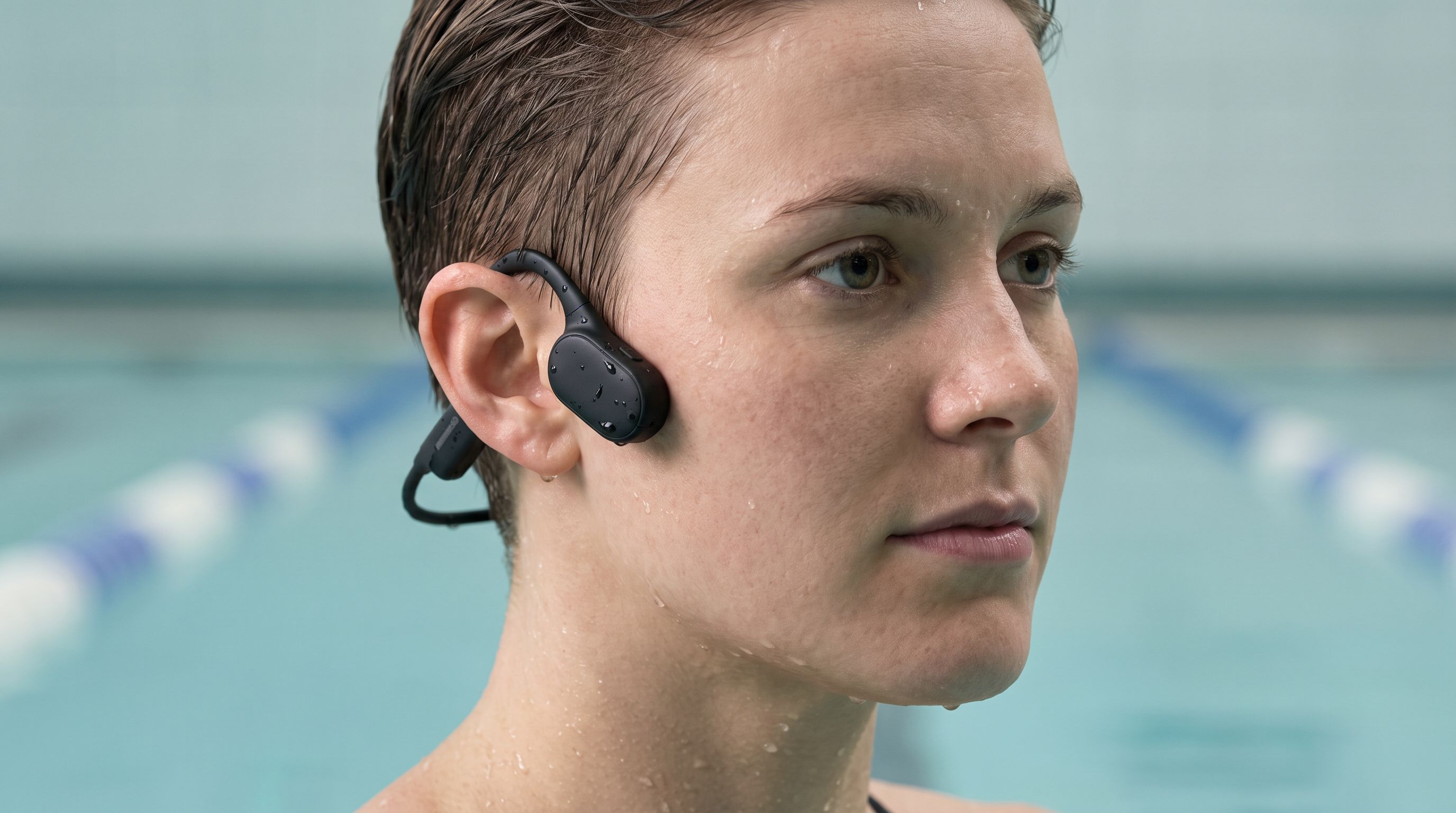
Bone-conduction transducers sit on the cheekbone just in front of the ear and vibrate your skull directly. Underwater this is a happy accident: water is a better conductor of vibration than air, so most swimmers report that bone conduction actually sounds fuller submerged than it does in the gym — more bass, less tinny.
The catch is leakage. If water floods your ear canal, you get a muffled, swimmy sound. The single biggest upgrade most swimmers can make is a pair of cheap silicone earplugs worn with the headset. It isn't a workaround for a bad product; it's how the format is designed to be used, and Shokz and H2O Audio both say as much.
The second variable is fit. A swim headset has to survive the hydrodynamic shove of a push-off, a tumble turn, and the strap of your goggles crossing the headband. Look for a thin, low-profile band that tucks under your goggle strap and swim cap, and check that the earhooks don't sit where your cap edge lands.
The picks
Shokz OpenSwim Pro — best overall
 Best overall · Shokz OpenSwim Pro — Check price on Amazon →
The OpenSwim Pro is the headset most swimmers should buy, and the reason is simple: it's the only mainstream option that handles both halves of your training week properly. It carries 32GB of onboard storage for MP3 mode in the pool, then switches to Bluetooth for runs, bike sessions and commutes — something the original OpenSwim can't do at all.
It's rated IP68, with manufacturer figures of submersion to 2 metres for up to 2 hours, and quoted battery life of around 9 hours in Bluetooth mode and roughly 6 hours in MP3 mode. In practice that's weeks of swimming between charges for most people. Reviewers consistently rank it as the best overall waterproof headphone of 2026, and owner feedback highlights the improved sound over the older OpenSwim and the faster USB-C magnetic charging. The usual gripes: it uses a proprietary magnetic charger you must not lose, and you still have to drag-and-drop files from a computer — there's no on-the-water library management.
Shokz OpenSwim — best MP3-only pick
The original OpenSwim (formerly Xtrainerz) is still on sale and still excellent for one specific buyer: the person who wants a pool device and nothing else. There's no Bluetooth at all, which sounds like a limitation until you realise it means no pairing drama, no phone on the deck, and nothing to go wrong. It offers 4GB of storage — roughly a thousand songs or a long stack of podcasts and audiobooks — with IP68 waterproofing and a quoted 8 hours of playback.
At 4GB you're curating rather than dumping your whole library, but for lap swimming that's rarely a problem. It's also lighter than the Pro and has a long track record: it's been in pools for years, and durability feedback is generally strong provided you rinse it in fresh water and dry the contacts before charging.
H2O Audio TRI 2 Multi-Sport — best for long open-water sessions
 Best for long open-water sessions · H2O Audio TRI 2 Multi-Sport — Check price on Amazon →
H2O Audio builds specifically for swimmers, and the TRI 2 Multi-Sport is the triathlete's answer. It pairs 8GB of onboard storage with Bluetooth, and its standout trick is Playlist+ — a system that lets you transfer playlists from streaming services onto the device rather than sourcing your own MP3 files, which is genuinely the biggest practical headache with every other swim headset here.
Reviewers rate the TRI 2 family highly for open-water security — the fit is tuned to stay put under a wetsuit hood and cap — and the multi-sport angle means it handles the bike and run legs too. It's the one to shortlist if your sessions run long and you want streaming-sourced music without manual file wrangling.
HAVIT E500BT — budget pick
Not everyone needs a premium swim headset to do 40 lengths twice a week. The HAVIT E500BT has become a regular recommendation in 2026 round-ups as the best value swim-capable bone-conduction option: dual-mode operation with onboard MP3 storage plus Bluetooth, IPX8-class waterproofing, and a light frame. Sound quality and build won't match Shokz — expect more plastic flex and a less refined midrange — but for lap swimming where music is rhythm rather than fidelity, it does the job for a lot less.
Be realistic about budget swim gear generally: the biggest failure mode in owner reports is charging-contact corrosion from salt or chlorine. Rinse, dry, then charge — on any of these.
Comparison table
| Model | Waterproofing | Onboard storage | Bluetooth | Quoted battery | Best for |
|---|---|---|---|---|---|
| Shokz OpenSwim Pro | IP68 (2 m / 2 hr rated) | 32GB | Yes | ~9 hr BT / ~6 hr MP3 | Swim + land training in one device |
| Shokz OpenSwim | IP68 | 4GB | No | ~8 hr MP3 | Pure pool use, zero fuss |
| H2O Audio TRI 2 Multi-Sport | Waterproof to 3.6 m (manufacturer) | 8GB | Yes | Manufacturer-rated full-session use | Open water, triathlon, streaming transfers |
| HAVIT E500BT | IPX8-class | Onboard MP3 (dual mode) | Yes | Multi-hour, varies by mode | Value-focused lap swimmers |
Figures above are manufacturer ratings. Real-world battery depends on volume, water temperature and whether you're in MP3 or Bluetooth mode — cold water and high volume both shorten runtime.
What to check before you buy
IP68 is not a depth guarantee. The "8" in IP68 means the manufacturer defines the depth and duration, which is why Shokz quotes 2 metres for 2 hours rather than a blanket promise. Fine for pools and surface open water; not scuba gear.
Storage only matters if you'll fill it. 4GB covers a year of lap-swim playlists for most people. 32GB matters if you listen to long-form audiobooks or want your whole library on board without curating.
File format support is the hidden spec. Most of these devices want MP3, and some handle other formats. DRM-protected streaming files won't transfer — which is exactly the gap H2O Audio's Playlist+ is designed to fill.
Buy earplugs. Budget a few pounds for soft silicone plugs. They transform underwater clarity on every bone-conduction headset.
Check cap and goggle compatibility. If you wear a silicone cap over the band, test the combination early — a cap that drags the headband down your cheekbones kills the sound.
FAQ
Can I use normal Bluetooth earbuds for swimming?
No. Even fully waterproof earbuds lose the Bluetooth signal underwater because 2.4GHz radio barely penetrates water. You need onboard storage — that's the defining feature of a true swim headset.
Do bone-conduction headphones sound worse in the pool?
Generally the opposite. Water transmits vibration well, so most swimmers find bass improves underwater. The main enemy is water in the ear canal, which earplugs solve.
How do I get music onto them?
Connect to a computer with the supplied magnetic USB cable and drag MP3 files across like a USB drive. The H2O Audio TRI 2 Multi-Sport is the exception, with its Playlist+ streaming transfer system.
Will they survive salt water?
Yes, all four are rated for it, but rinse them in fresh water after every sea swim and dry the charging contacts fully before plugging in. Corrosion at the contacts is the most common cause of premature failure.
Is the OpenSwim Pro worth it over the standard OpenSwim?
If you also run or ride, yes — Bluetooth plus 32GB makes it a single-device solution. If you only swim, the cheaper OpenSwim does the same core job.
Our picks
SHOKZ OpenSwim Pro Open-Ear MP3 Headphones, Grey, IP68 Waterproof, 32GB MP3
IP68, 32GB onboard MP3 storage and Bluetooth for dry-land use — the most complete swim headset.
SHOKZ OpenSwim Pro Open-Ear MP3 Headphones, Grey, IP68 Waterproof, 32GB MP3
No Bluetooth, no distractions: 4GB of music, IP68 and a proven lightweight swim fit.
H2O Audio TRI 2 PRO Multi-Sport Waterproof Bone Conduction Open Ear Headphones, Bluetooth 5.3 for Running and Cycling, MP3 Mode for Swimming, IPX8, 4GB Memory, Playlist+ App Included for Streaming
8GB storage plus Playlist+ streaming transfer and a secure multisport fit built for triathletes.
HAVIT E500BT
Dual-mode MP3 and Bluetooth with IPX8-class waterproofing at a fraction of the premium price.
Get the best tech deals in your inbox
Join the BytePlaza newsletter for hand-picked gadget deals and new buying guides. No spam, unsubscribe anytime.
Related reads
Bone Conduction vs Clip-On Earbuds: Which Wins for Runners in 2026?
Bone conduction vs clip on earbuds for running in 2026: how they compare on fit, sweat resistance, sound leakage and awareness — plus four picks worth buying.
Open-Ear Headphones in 2026: Bone vs Air Conduction
Bone conduction or air conduction? We compare the best open ear headphones for runners and cyclists in 2026, from Shokz OpenRun Pro 2 to Bose Ultra Open.
Auracast Speakers in 2026: What It Actually Changes
Auracast speakers in 2026 explained: what Bluetooth LE Audio broadcast really does, where it works today, and which JBL, Sony and Bose models support it.