Silicon Carbon Battery Phones in 2026: What Actually Changed
Silicon-carbon anodes are why 2026 phones hit 6,000-7,000mAh without getting fat. Here's how the tech works, its real trade-offs, and which handsets ship with it.
Reader-supported: we may earn a commission from links on this page, at no extra cost to you. It never affects our picks. Learn more.
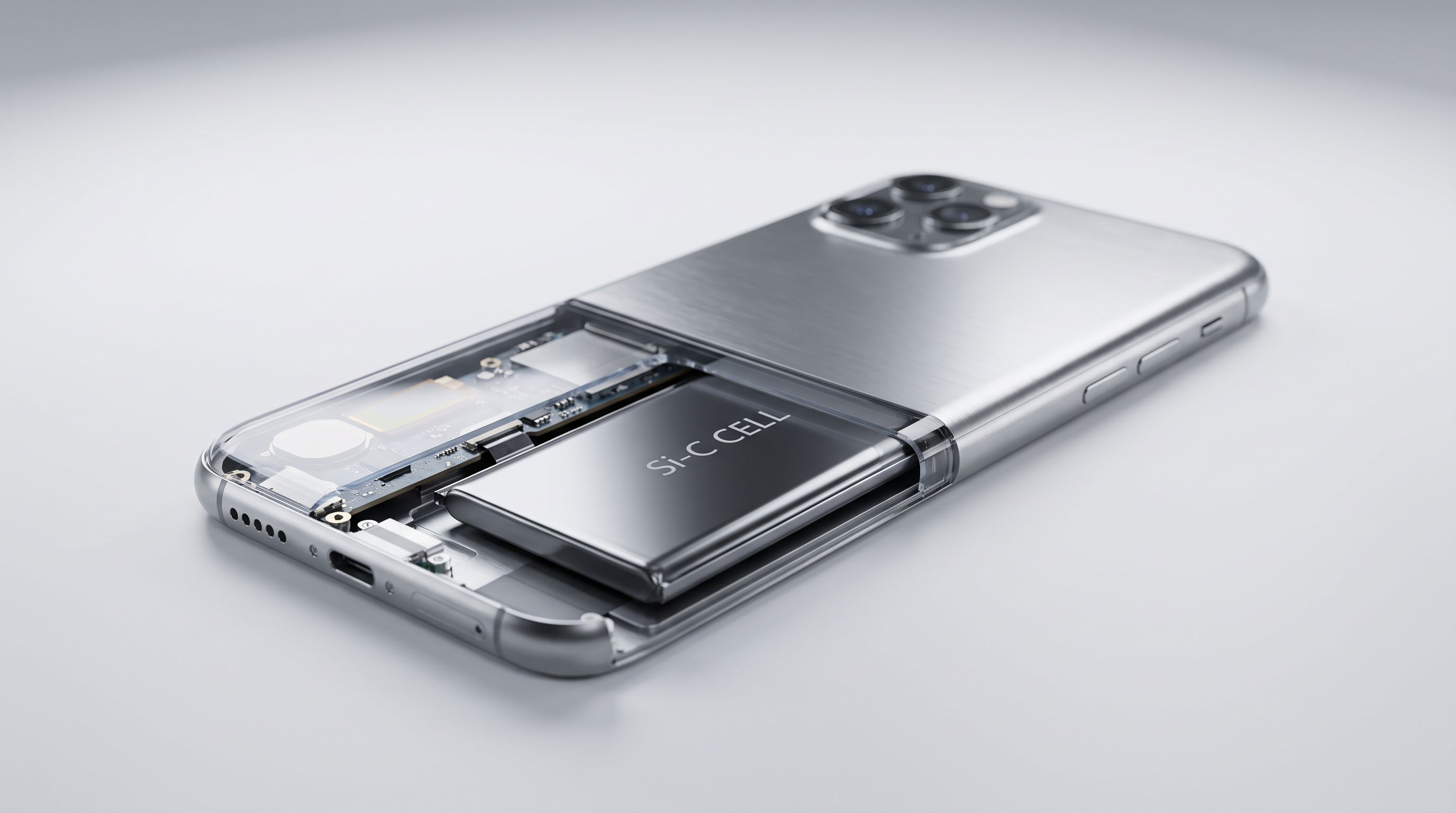
For roughly a decade, phone batteries barely moved. A flagship in 2016 shipped around 3,000mAh; a flagship in 2023 shipped around 5,000mAh, and most of that gain came from phones simply getting bigger. Then, over the last two product cycles, Chinese Android makers started shipping 6,000mAh and 7,000mAh phones that were thinner than their predecessors. The reason is a change to the anode chemistry: silicon-carbon.
If you're shopping for a silicon carbon battery phone in 2026, here's what the technology actually does, what it doesn't do, where the trade-offs hide, and which handsets genuinely ship with it.
What a silicon-carbon anode actually is
A lithium-ion cell has two electrodes. The cathode gets most of the research headlines, but the anode is where silicon-carbon changes things.
Conventional anodes are made of graphite. Graphite is cheap, stable, and well understood — it just can't hold much lithium per gram. Silicon can hold roughly ten times more lithium by weight. The catch has always been that silicon swells dramatically when it absorbs lithium, cracking the anode structure and killing the cell after a few hundred cycles.
The fix is to not use pure silicon. Silicon-carbon anodes embed nanoscale silicon particles inside a carbon matrix that acts as a sponge and a scaffold: it absorbs the expansion, maintains electrical contact, and keeps the structure intact. The practical silicon content in a shipping phone cell is modest — a single-digit percentage in most designs — but even that is enough to push energy density meaningfully higher than graphite-only cells.
The result in consumer terms: more milliamp-hours in the same physical volume.
Why that matters more than the mAh number
Capacity alone is a weak spec. A 7,000mAh phone with an inefficient chipset and a bright 120Hz panel can lose to a 5,000mAh phone with a more efficient SoC. What silicon-carbon genuinely buys manufacturers is design freedom, and they've spent it in three different ways:
- More capacity, same thickness. The flagship approach — 6,000-7,000mAh in a normal-sized chassis.
- Same capacity, thinner phone. The approach Motorola took with the Edge 70 and with foldables, where internal volume is desperately scarce.
- Same capacity, more room for other components. Bigger vapour chambers, larger camera sensors, or extra charging circuitry.
Foldables are arguably the biggest beneficiary. A folding phone splits its battery across two halves and loses volume to the hinge. Reporting around the Motorola Razr Ultra 2026 and Razr Fold — which pair silicon-carbon cells of roughly 5,000mAh and 6,000mAh respectively — suggests this is the first generation where folding phones stop being a battery compromise.
The trade-offs nobody puts on the spec sheet
Silicon-carbon isn't free. Three caveats matter when you're buying.
1. Cycle life is the open question. Silicon's expansion problem is managed, not eliminated. Early-generation silicon-carbon cells were widely expected to degrade slightly faster than mature graphite cells. Two years of real-world owner reports on phones like the OnePlus 13 have been broadly reassuring rather than alarming, but the long-tail data — what a 2024-era silicon-carbon cell looks like at four or five years — simply doesn't exist yet. If you keep phones for half a decade, that's a genuine unknown.
 Best overall · OnePlus 13 — Check price on Amazon →
2. Cold weather. Silicon-carbon cells have shown somewhat weaker performance at low temperatures in independent testing. If you spend winters outdoors, factor it in.
3. Regulatory and certification friction. This is the quiet reason Samsung and Apple moved slowly. Larger-capacity cells face shipping and airline rules, and both companies run conservative multi-year safety validation programs. Samsung's adoption, starting with the Galaxy S25 FE and continuing into the S26 generation, came years after Chinese brands shipped it at volume — not because the engineering was harder, but because the risk tolerance is different.
Which phones actually have it
The honest answer in 2026: a lot of Android phones, and the list grows every month. Below are models we're confident ship silicon-carbon cells, with what each one is actually good at. Note that capacities vary by region and SKU — always confirm the spec sheet for the exact variant sold in your market.
| Phone | What it's for | Battery approach | Notable trade-off |
|---|---|---|---|
| OnePlus 13 | All-round flagship endurance | Large Si/C cell + very fast wired and wireless charging | Now a generation old; successor pricing pressure |
| Samsung Galaxy S25 FE | Long software support, mainstream buyers | Modest Si/C capacity bump over previous FE | Less aggressive capacity than Chinese rivals |
| Motorola Edge 70 | Thin-and-light design | Si/C used to shrink thickness, not just add mAh | Camera system isn't flagship-tier |
| Xiaomi 15 Ultra | Camera-first flagship | High-capacity Si/C plus big sensor hardware | Large, heavy, limited carrier availability in some regions |
| Motorola Razr Ultra 2026 | Foldable buyers | Si/C solves the hinge volume problem | Foldable durability caveats still apply |
 Premium pick · Xiaomi 15 Ultra — Check price on Amazon →
 Best thin-and-light · Motorola Edge 70 — Check price on Amazon →
 Best mainstream pick · Samsung Galaxy S25 FE — Check price on Amazon →
How to read a listing
A few practical checks before you buy:
- Look for "Si/C", "silicon-carbon", or a stated silicon percentage in the manufacturer spec sheet. Retail listings frequently omit it.
- Check charging speed alongside capacity. A 6,000mAh cell that takes 90 minutes to fill is less useful day to day than a 5,500mAh cell that hits 50% in 15 minutes. The OnePlus 13 and Xiaomi 15 Ultra both lean hard on fast wired charging.
- Check the chipset generation. Efficiency gains from a newer SoC can rival the gains from the battery chemistry.
- Ignore marketing endurance claims. Manufacturer "two-day battery" figures use light synthetic workloads. Third-party reviewer battery tests with consistent methodology are far more useful.
Should you upgrade for this specifically?
If your current phone is three or more years old and its battery health has degraded, yes — you'll feel a large jump, though some of that is replacing a worn cell rather than the new chemistry.
If your phone is one or two years old and holds a charge fine, silicon-carbon on its own is a weak upgrade reason. A better move is a decent power bank. Something like the Anker Nano Power Bank 10000mAh covers the occasional long day for a fraction of the cost of a new handset, and it works regardless of what chemistry is inside your phone.
 Best accessory to pair · Anker Nano Power Bank 10000mAh — Check price on Amazon →
For anyone buying new anyway in 2026: silicon-carbon is now a reasonable thing to prioritise, because it's no longer exotic. It's shipping in budget Motorola and Redmi phones as well as flagships, which means it has moved from "premium differentiator" to "expected feature". If you're choosing between two otherwise similar phones and one uses silicon-carbon, that's a legitimate tiebreaker.
FAQ
Do silicon-carbon batteries charge faster? Not inherently. Charging speed is determined by the charging architecture, cell design and thermal management, not the anode material alone. Many silicon-carbon phones do charge quickly, but that's a separate engineering decision that happens to appear on the same handsets.
Will a silicon-carbon battery degrade faster than a normal one? Current evidence suggests modern silicon-carbon cells hold up comparably to graphite over typical ownership periods, and owner reports from multi-year OnePlus 13 users have been largely positive. Very long-term data is still limited. Standard battery hygiene — avoiding sustained heat and leaving the phone at 100% for days — matters more than the chemistry.
Does the iPhone use silicon-carbon? Apple has not announced silicon-carbon anodes in shipping iPhones. Apple's efficiency gains have come primarily from chip design, display power management and internal layout changes.
Is silicon-carbon the same as a solid-state battery? No. Silicon-carbon changes the anode material in a conventional liquid-electrolyte lithium-ion cell. Solid-state batteries replace the liquid electrolyte entirely and remain a future technology for phones.
Is a bigger mAh number always better? No. Real endurance is capacity multiplied by system efficiency. Compare independent reviewer battery runtime results for the specific models you're considering rather than comparing mAh figures across different chipsets and display types.
Our picks
OnePlus 13 Dual SIM, 512GB + 16GB RAM, Midnight Ocean - Unlocked (GSM Only) (International Version) (Renewed)
One of the first mainstream flagships with a large silicon-carbon cell plus 80W+ wired charging.
Samsung Galaxy S25 FE: Unlocked, 128GB Storage, JetBlack (Renewed)
Samsung's first FE to adopt silicon-carbon, with flagship software support and long update windows.
Motorola Edge 70 Pro Dual-SIM 256GB ROM + 8GB RAM (GSM Only | No CDMA) Factory Unlocked 5G Smartphone (Pantone Titan) - International Version
Proof the tech works: a genuinely slim body that still carries a big silicon-carbon pack.
XIAOMI Redmi Note 15 Pro+ Plus 5G Ai (Compatible with Tmobile Mint Tello & Global) (512GB + 12GB) NFC 6.83" 120Hz 200MP Ultra Camera Model 2510ERA8BG Unlocked Dual Sim Liberado (Black)
Huge silicon-carbon capacity paired with the most ambitious camera hardware in the lineup.
Anker Nano Power Bank,10,000mAh 30W Portable Charger,Built-in USB-C Cable | 30W Recharging and Output, USB-C and USB-A Ports, for iPhone 17 / 16 / 15 Series, MacBook, Galaxy, AirPods, and More
Useful backup for older phones that still use conventional graphite cells.
Get the best tech deals in your inbox
Join the BytePlaza newsletter for hand-picked gadget deals and new buying guides. No spam, unsubscribe anytime.
Related reads
Budget Phones That Actually Last: Best Battery Life Phone 2026
Which mid-range phone really lasts all day? We ranked 2026's best battery life phones under flagship money by capacity, charge speed and real owner screen-on time.
eSIM Phone 2026: Should Travelers Ditch the SIM Tray?
eSIM-only phones are now mainstream. Here's what travelers need to know in 2026 about dual-eSIM, roaming plans, regional quirks — plus four handsets worth buying.
Phones Under $250 in 2026: 5 Picks That Actually Last
We compared sub-$250 phones on update promises, 5G band support and battery life. Here are the best budget phones under $250 in 2026 for backups and kids.