Radar Parking Mode Dash Cams in 2026: 4 Picks That Save Your Battery
Radar parking mode dash cams in 2026 compared: how radar beats G-sensor and buffered modes on power draw, storage handling and real-world reliability.
Reader-supported: we may earn a commission from links on this page, at no extra cost to you. It never affects our picks. Learn more.
Parking mode is the feature people buy a dash cam for and then quietly turn off six months later — usually after a flat battery, a 64GB card full of nothing, or a hit-and-run that somehow didn't trigger a recording. Radar-based parking surveillance is the most meaningful fix the category has seen in years, and in 2026 it's finally available on more than one flagship.
We compared the current crop of radar-equipped and radar-adjacent models using manufacturer specifications, independent reviewer measurements, and verified owner feedback to work out which ones actually deliver on the promise: catch the event, skip the noise, and don't kill your battery.
What "radar parking mode" actually means
Most dash cams detect parking events one of three ways. Radar adds a fourth, and the differences matter more than the marketing suggests.
G-sensor (impact) mode. An accelerometer detects a jolt. The camera is essentially asleep until something physically hits the car. Power draw is the lowest of any method, but you only capture the moment of impact and whatever comes after — never the approach, and never the guy who keys your door without touching it hard enough to register.
Motion detection. The camera analyses the video frame for pixel changes. That means the image sensor and processor stay powered, so draw is high, and false triggers are relentless: shadows, headlights sweeping a garage wall, rain, a passing cat. Owners consistently report cards filling with hundreds of useless clips.
Buffered recording. Not a detection method but a storage strategy. The camera keeps a rolling few seconds of video in memory so when a trigger fires, the saved clip includes the lead-up — typically around 10 seconds before and 20 to 30 seconds after. Essential for any mode, because the unbuffered alternative starts recording after the interesting part.
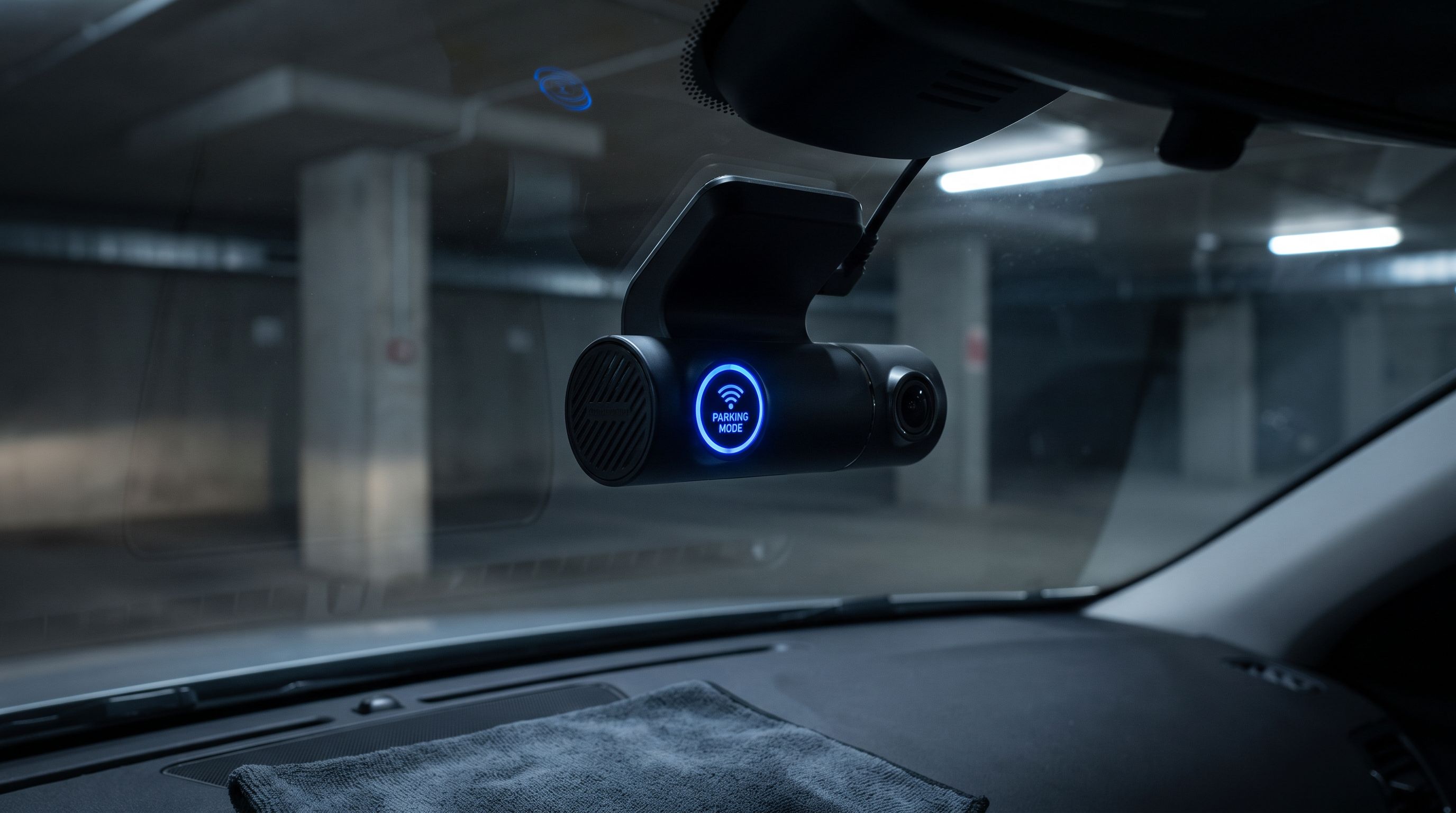
Radar. A dedicated low-power radar module senses an object approaching within a few metres and wakes the camera only then. Crucially, radar sees physical movement toward the vehicle rather than changes in light, so shadows and distant traffic don't trigger it. The camera's power-hungry imaging pipeline stays idle most of the night, which is why radar models can run meaningfully longer on the same battery than motion-detect models.
The practical upshot: radar gives you the approach footage that a G-sensor misses, with power and storage behaviour closer to impact mode than to motion mode.
The picks
Thinkware U3000 Pro — best overall
 Best overall · Thinkware U3000 Pro — Check price on Amazon →
The U3000 Pro is the reason this article exists. It has front and rear radar sensors built into the camera bodies rather than relying on an add-on, and it uses them to pre-arm the camera when someone walks up to the vehicle. Reviewers who have spent time with it in 2026 consistently single it out as the strongest radar implementation available, citing fast wake-up and alerts that fire before contact rather than after.
Thinkware's broader parking toolkit is also the most complete in the business: energy-saving modes, time-lapse parking, scheduled recording and an optional radar-triggered approach warning that can deter people outright. Pair it with Thinkware's own hardwiring kit or an OBD power cable with voltage cutoff and it behaves predictably over multi-day parking.
The trade-offs: it's a premium-priced two-channel system, installation is more involved than a suction-cup cam, and you'll want a high-endurance card sized generously because radar triggers more events than a G-sensor would.
Thinkware Q1000 — best value route into radar
 Best value radar-capable · Thinkware Q1000 — Check price on Amazon →
If the U3000 Pro is more camera than you need, the Q1000 supports Thinkware's separate Radar Module, which plugs in and provides the same approach-detection logic at a lower total outlay. You give up the Pro's resolution, rear radar and some of the newer processing, but the core benefit — low-draw surveillance that wakes on approach — is intact.
This is the sensible pick for someone who parks on a street overnight, wants real coverage, and doesn't want to spend flagship money to get it. Check that the radar accessory is in the box or budget for it separately; it is usually sold on its own.
VIOFO A329 — best non-radar parking performer
 Best buffered parking alternative · VIOFO A329 — Check price on Amazon →
Not everyone needs radar, and the A329 is the model worth considering if you don't. It's a strong 2026 pick for low-light clarity and it handles parking mode sensibly: buffered motion and impact detection, a low-bitrate parking recording mode that dramatically reduces how fast the card fills, and solid hardwire support.
What you're accepting is motion detection's higher idle draw and its false-trigger rate. In a quiet driveway that's a non-issue. In a busy apartment garage with constant foot traffic, you'll be deleting clips. Owner feedback is broadly positive on reliability and file integrity, which is not a given in this category.
BlackVue DR970X-2CH Plus — best for remote alerts
 Best for cloud-connected parking alerts · BlackVue DR970X-2CH Plus — Check price on Amazon →
Radar tells the camera when to wake up; cloud connectivity tells you. The DR970X-2CH Plus pairs BlackVue's low-power parking modes with Wi-Fi and optional LTE cloud service, so an impact push-notifies your phone with a clip you can watch from anywhere. For airport long-stays, fleet use, or anyone whose car sits unattended for days, that visibility is worth more than a marginally smarter trigger.
It's a subscription-flavoured ecosystem and the hardware sits at the premium end, but file management and app stability are areas where BlackVue has a long track record.
VIOFO HK5 ACC Hardwire Kit — the part people skip
No parking mode of any kind works without constant power, and no parking mode is safe without a voltage cutoff. A hardwire kit with an adjustable low-voltage threshold and a timer is the difference between "my dash cam caught it" and "my car won't start." Budget for one regardless of which camera you choose.
How they compare
| Model | Parking trigger | Relative idle power draw | Storage behaviour | Best for |
|---|---|---|---|---|
| Thinkware U3000 Pro | Built-in front + rear radar, plus G-sensor | Low — imaging stays idle until radar wake | Event-only clips with pre-buffer; needs a large high-endurance card | Street and garage parking where approach footage matters |
| Thinkware Q1000 | Optional Radar Module, motion, impact | Low with radar; moderate on motion | Buffered events; energy-saving mode reduces writes | Getting radar benefits at a lower total cost |
| VIOFO A329 | Buffered motion + G-sensor | Moderate — sensor active for motion | Low-bitrate parking recording keeps cards manageable | Quiet driveways and value-focused buyers |
| BlackVue DR970X-2CH Plus | Motion, impact, low-power modes | Low to moderate depending on mode | Cloud upload of event clips; local loop recording | Remote alerts while the car is unattended for days |
Buying notes that actually change the outcome
Card choice is not optional. Parking mode writes in short bursts across months. Use a high-endurance microSD rated for dash cam duty and format it in-camera periodically. Most "my dash cam lost the footage" stories are card failures.
Match the mode to the parking spot. Busy shared garage? Radar or pure impact mode. Quiet driveway? Buffered motion is fine and cheaper. Long-term airport parking? Time-lapse or radar, plus a cloud-capable camera.
Check your car's battery first. Modern start-stop vehicles with AGM batteries tolerate parasitic draw better than an ageing lead-acid unit. If your battery is more than four years old, no cutoff setting will save you — replace it or run a dedicated dash cam battery pack.
Rear coverage is where most parking damage happens. Parking lot contact disproportionately hits bumpers. A two-channel setup with rear radar, as on the U3000 Pro, covers the realistic scenario rather than the dramatic one.
FAQ
Does radar parking mode drain less battery than motion detection? Generally yes. Radar modules consume very little power and let the image sensor and processor remain idle until something approaches, whereas motion detection requires the video pipeline to stay active. Actual figures vary by model and settings, so check the manufacturer's stated parking-mode current draw.
Will radar trigger on people just walking past? It can, depending on sensitivity and range settings. Most implementations let you tune detection distance so that a pedestrian on the pavement doesn't wake the camera but someone stepping up to the door does.
Do I still need a G-sensor if I have radar? Yes, and every radar camera keeps one. Radar catches approaches; the G-sensor catches impacts that happen too fast to pre-detect, such as another car reversing in at speed.
Can I use an OBD-II power cable instead of hardwiring? Often yes, and it's easier to install. Make sure the cable has a voltage cutoff and that your vehicle's OBD port stays live with the ignition off — not all do.
How much storage should I budget for parking mode? More than you think. Radar generates more events than impact-only mode. A 256GB high-endurance card is a reasonable starting point for a two-channel setup used daily, and loop recording handles the rest.
Our picks
THINKWARE U3000 PRO Dash Cam 4K Front and 2K Rear, Dual STARVIS 2
Built-in front and rear radar sensors wake the camera only when something actually approaches.
THINKWARE 2K QHD Rear View Camera for Q1000 Dash Cam | Connecting Cable Included | 2-Channel | Dual Channel | Front and Rear | Car Taxi Rideshare
Supports Thinkware's Radar Module for low-draw parking surveillance without flagship pricing.
VIOFO A329S 4K 60FPS Dash Cam Front and Rear, STARVIS 2 HDR, Wi-Fi 6
Excellent low-bitrate parking recording and hardwire support when radar isn't in the budget.
Blackvue DR970X LTE Plus II, 4K Dash Cam Front and Rear with 4G LTE, HDR
Pairs low-power parking modes with LTE/Wi-Fi cloud push notifications while you're away.
VIOFO HK5 ACC Hardwire Kit
Voltage-cutoff hardwire kit that makes any parking mode safe for your car battery.
Get the best tech deals in your inbox
Join the BytePlaza newsletter for hand-picked gadget deals and new buying guides. No spam, unsubscribe anytime.
Related reads
Best Dash Cam 2026: 4K Front & Rear Picks Ranked
The best dash cam 2026 picks for 4K front and rear coverage, compared on night video, parking mode, cloud access and wiring — with a buying guide and FAQ.
USB-C Car Chargers in 2026: 5 Picks That Hit 65W+
The best USB-C car charger 2026 picks for laptops and phones: GaN multi-port models, real PD wattage splits, socket fit and the cables you actually need.
Portable CarPlay Screen vs Head Unit: Which Fits Your Car in 2026?
A portable CarPlay screen for car dashboards installs in minutes — but a double-DIN head unit does more. Here's how they compare in 2026, plus four solid picks.