Kids Smartwatches With GPS in 2026: 4 Picks, No Phone Needed
Compare the best kids smartwatch with GPS in 2026 — LTE calling plans, location accuracy, parental controls and battery life, ranked for parents by age.
Reader-supported: we may earn a commission from links on this page, at no extra cost to you. It never affects our picks. Learn more.
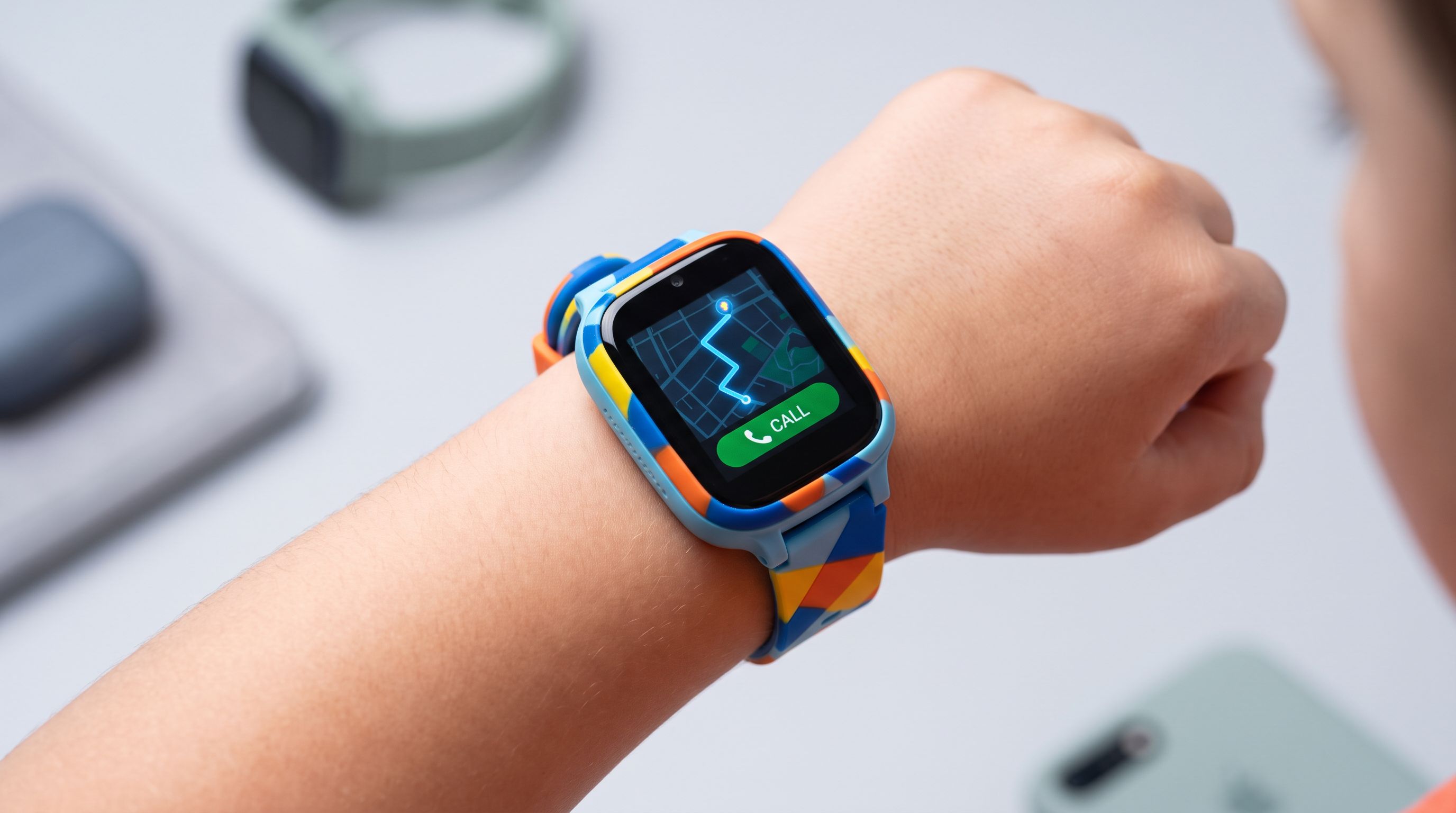
Giving a seven-year-old a smartphone feels like a big leap. Giving them a watch that can call you, text a short reply and show you where they are on a map feels like a much smaller one — and that's exactly why LTE kids smartwatches have become the default first "device" in a lot of households.
But the category is messy. Some watches are essentially locked-down phones on a wrist; others are GPS beacons with a speaker bolted on. Plans range from carrier lines you add to an existing account to standalone subscriptions with their own SIM. And location accuracy — the whole reason most parents buy one — varies wildly depending on whether the watch uses real GNSS hardware, Wi-Fi positioning, cell-tower triangulation, or some combination.
We compared the leading 2026 models using manufacturer specs, independent reviews from outlets like SafeWise, Forbes Vetted and Android Central, and verified owner feedback, then ranked them by what actually matters day to day: does the call connect, is the dot on the map in the right place, and can a parent lock the thing down during school hours.
How kids smartwatch location tracking actually works
Almost every watch here advertises "GPS," but the implementation matters:
- True GNSS (GPS/GLONASS/Galileo) gives the best outdoor accuracy — typically within a few metres in open sky. Garmin's watches lean on this heavily, unsurprisingly.
- A-GPS (assisted GPS) uses cellular data to speed up the first fix, which is why LTE watches lock on faster than pure-GPS ones.
- Wi-Fi positioning is what saves you indoors. A watch that can see nearby Wi-Fi networks will place a child inside a school or mall far more reliably than GPS alone.
- Cell-tower triangulation is the coarse fallback — useful for "which neighbourhood," useless for "which building."
The practical takeaway: prioritise watches that combine GNSS and Wi-Fi positioning. Watches that fall back to towers alone are the ones that generate the frustrated one-star reviews about a child appearing three blocks away.
Also worth knowing: no consumer kids watch is real-time in the sense of a continuous live feed. Most report location on an interval (often a few minutes) with an on-demand "locate now" refresh, because constant GPS polling would destroy battery life.
What to check before you buy
LTE coverage where you live. This is the single biggest reason a watch fails in practice. Verizon's Gizmo line runs on Verizon; TickTalk lets you choose among major US networks; Garmin and Bark use their own bundled service. Check the coverage map for your commute and your child's school, not just your house.
Plan structure. Some watches add a line to a family plan; others charge a standalone monthly subscription that includes the SIM. Neither is inherently cheaper — it depends entirely on your existing account. Always confirm whether the plan is required for the watch to function at all (on LTE models, it usually is).
Contact whitelisting. Every watch on this list restricts calls and texts to a parent-approved list. That's non-negotiable and it's why these devices are safer than a phone.
School mode. Look for a scheduled do-not-disturb that disables everything except emergency calling during class hours. Garmin calls it a school mode; Apple calls it Schooltime. Teachers will thank you.
Durability and battery. Kids are hard on hardware. Aim for at least a swim-friendly water rating (5 ATM or IP68) and be realistic about battery: LTE watches with frequent location pings often need daily or near-daily charging, while lighter-duty models stretch further.
The comparison
| Watch | Connectivity | Best for | Parent controls | Notable trade-off |
|---|---|---|---|---|
| Garmin Bounce 2 | LTE (Garmin plan) + GPS | Ages 6–11, active kids | Garmin Jr. app, school mode, chores/rewards | Fewer messaging bells and whistles than rivals |
| Verizon Gizmo Watch 3 | Verizon LTE + GPS/Wi-Fi | Reliable voice calling | Gizmo app, contact limits, boundary alerts | Locked to Verizon |
| TickTalk 5 | LTE (choice of networks) + GPS/Wi-Fi | Families outside Verizon coverage | App-based scheduling, no browser or games | Interface is less polished |
| Bark Watch | LTE (Bark plan) + GPS | Safety-first monitoring | Bark's text/content alerts plus location | Subscription-dependent feature set |
| Apple Watch SE (2nd Gen) Cellular | Carrier LTE + GPS/Wi-Fi | Tweens ready for more | Family Setup, Schooltime, Screen Time | Costs the most; needs a compatible carrier plan |
 Best for safety-focused families · Bark Watch — Check price on Amazon →
 Best carrier flexibility · TickTalk 5 — Check price on Amazon →
 Best for calling and texting · Verizon Gizmo Watch 3 — Check price on Amazon →
 Best overall · Garmin Bounce 2 — Check price on Amazon →
The picks
Garmin Bounce 2 — best overall
Garmin's advantage is that it has been doing GPS longer than anyone in this category, and it shows in how quickly the Bounce locks a position outdoors. The Bounce 2 pairs that with LTE so parents can send and receive messages and place voice calls, all managed through the Garmin Jr. app.
What pushes it to the top for most primary-age kids is the balance: it's a fitness-and-activity watch first, with tracking and messaging layered on, so it doesn't feel like surveillance to the child. Chores, rewards and step goals give it a reason to be worn. Android Central and Smartwatchbanden both landed on the Bounce as their overall pick, and the reasoning is consistent — kid-first design, solid GPS, controls a non-technical parent can actually configure. Battery life is a relative strength here versus phone-like rivals, though heavy LTE and location use still shortens it considerably.
Verizon Gizmo Watch 3 — best for calling and texting
If your household is already on Verizon, the Gizmo line is the path of least resistance. Forbes Vetted named the Gizmo Watch as its overall top pick, and the case is straightforward: calls connect, texting works with preset replies and voice-to-text, GPS location is dependable in covered areas, and adding the watch to an existing Verizon account is genuinely simple.
Parents can cap the contact list, set safe-zone arrival and departure alerts, and use scheduled quiet periods. The obvious limitation is the carrier lock — great if you're on Verizon, irrelevant if you're not. Note that Verizon has iterated this line (Gizmo Watch 3 is the widely available model, with a newer generation appearing at some retailers), so check which version a listing actually ships.
TickTalk 5 — best carrier flexibility
TickTalk's pitch is deliberately narrow: a communication and location device with no browser, no app store and no games. It supports video calling, voice calls and messaging, and crucially it isn't tied to one network — you can choose a compatible US carrier, which makes it the sensible choice if Verizon coverage is patchy where you live.
Location combines GNSS with Wi-Fi positioning, which is what you want for indoor accuracy. The software is functional rather than beautiful, and owner feedback frequently mentions occasional syncing quirks after updates, but the core job — reach my kid, find my kid — is handled well.
Bark Watch — best for safety-focused families
Bark comes at this from the content-monitoring side rather than the fitness side. The watch does LTE calling and GPS tracking, but the differentiator is Bark's alerting layer, which flags concerning content in messages and surfaces it to parents. SafeWise rated it their top overall kids watch after hands-on testing, singling out location tracking.
There are no games, no camera-driven distractions and no open internet. If your primary concern is a child communicating with people or content you can't see, this is the most opinionated option on the list. Feature availability is tied to Bark's subscription, so read the plan details closely.
Apple Watch SE (2nd Gen) GPS + Cellular — premium pick for tweens
 Premium pick · Apple Watch SE (2nd Gen) GPS + Cellular — Check price on Amazon →
Family Setup lets you configure a cellular Apple Watch for a child who doesn't have an iPhone, managed from your own device. You get Schooltime, contact restrictions, location sharing, Emergency SOS and fall detection, plus a screen and app ecosystem that will keep an 11-year-old happy far longer than a chunky kids watch will.
It's the most expensive route, it requires a compatible cellular plan from your carrier, and it's arguably more device than a six-year-old needs. But for the 10-to-13 bracket — the awkward gap between kids watch and first phone — it's the most future-proof option here.
Which one should you actually buy?
- Ages 5–8, first device: Garmin Bounce 2, or Bark Watch if monitoring is your priority.
- Already on Verizon: Gizmo Watch 3, full stop.
- Patchy Verizon coverage: TickTalk 5 for network choice.
- Ages 10–13, bridging to a phone: Apple Watch SE Cellular via Family Setup.
FAQ
Do kids smartwatches work without a phone? Yes — LTE models like the Bounce 2, Gizmo Watch 3, TickTalk 5 and Bark Watch have their own cellular connection and SIM. The child needs no phone; the parent needs a phone to run the companion app.
Is a monthly plan always required? For calling, texting and remote location, effectively yes. Some watches retain offline functions like timers and step counting without a plan, but the safety features that justify the purchase all depend on cellular service.
How accurate is the GPS? Outdoors with clear sky, a few metres on watches with true GNSS. Indoors or in dense urban areas, accuracy degrades and Wi-Fi positioning does the heavy lifting — expect building-level rather than room-level precision.
Can other people call my child? No. All these watches restrict incoming and outgoing communication to a parent-approved contact list.
How long does the battery last? It varies enormously with location-check frequency and call volume. Plan on charging most LTE kids watches daily, and treat any advertised multi-day figure as a light-use best case.
Are they waterproof? Most are rated for swimming or at least splashes and handwashing, but ratings differ by model — check the specific water rating before letting a child swim in one.
Our picks
Garmin Bounce™ 2, Kids Smartwatch, Calling & Texting, 43mm, Light Purple | Two-Way Calling, Voice Messaging, Text Messaging, Real-Time Location Tracking, Active Subsciption Required for LTE Features
LTE calling, GPS check-ins and Garmin's excellent battery life with genuinely simple parent controls.
Fitbit Google Ace LTE - Kids Smartwatch with Call, Message, GPS, and Activity-Based Games, Ace Pass Data Plan Required - Mild - Strange Arcade
Verizon's kid-friendly LTE watch nails voice calls, contact whitelists and location alerts.
TickTalk5 Kids Smart Watch with GPS Tracker, Calls, Texts & SOS Ages 3-12 | Kids Smartwatch with HD Calling, SMS, GPS Tracking, Parental Controls, Music & Wellness
Works on multiple US networks with video calls, GPS and no games or browser to distract.
JrTrack 5 Kids Smart Watch by Cosmo | Best Kid-Safe Phone Watch | Precision Real-Time GPS Tracking | Call, Text, Activity, School Settings | Spotify Music | Parental Controls | SOS & Safety Alerts
Text monitoring and content alerts layered on top of GPS tracking and LTE calling.
Apple Watch SE 3 [GPS + Cellular 40mm] Smartwatch with Midnight Aluminum Case with Midnight Sport Band - S/M. Fitness and Sleep Trackers, Heart Rate Monitor, Always-On Display, Water Resistant
Family Setup lets a child use a cellular Apple Watch with Schooltime and location sharing, no iPhone required.
Get the best tech deals in your inbox
Join the BytePlaza newsletter for hand-picked gadget deals and new buying guides. No spam, unsubscribe anytime.
Related reads
Which Smart Scale Should You Buy in 2026?
We compared the best smart scale options for 2026 on body-fat accuracy, app support (Apple Health, Google Fit, Fitbit, Garmin) and multi-user profiles.
Fitness Trackers Under $150 in 2026: 5 Bands That Last
The best fitness tracker 2026 picks under $150: slim bands with multi-day battery, accurate step and sleep tracking, and heart rate — no smartwatch price tag.
Running Smartwatches in 2026: 5 GPS Picks That Deliver
We compared the best running smartwatch options for 2026 on GPS accuracy, battery life and training metrics — from budget Garmins to the Apple Watch Ultra 3.