Heart Rate Chest Straps in 2026: 5 Picks Watches Can't Match
Why a chest strap still beats wrist sensors for interval accuracy, plus the best heart rate monitor chest strap picks of 2026 ranked by battery, ANT+ and app support.
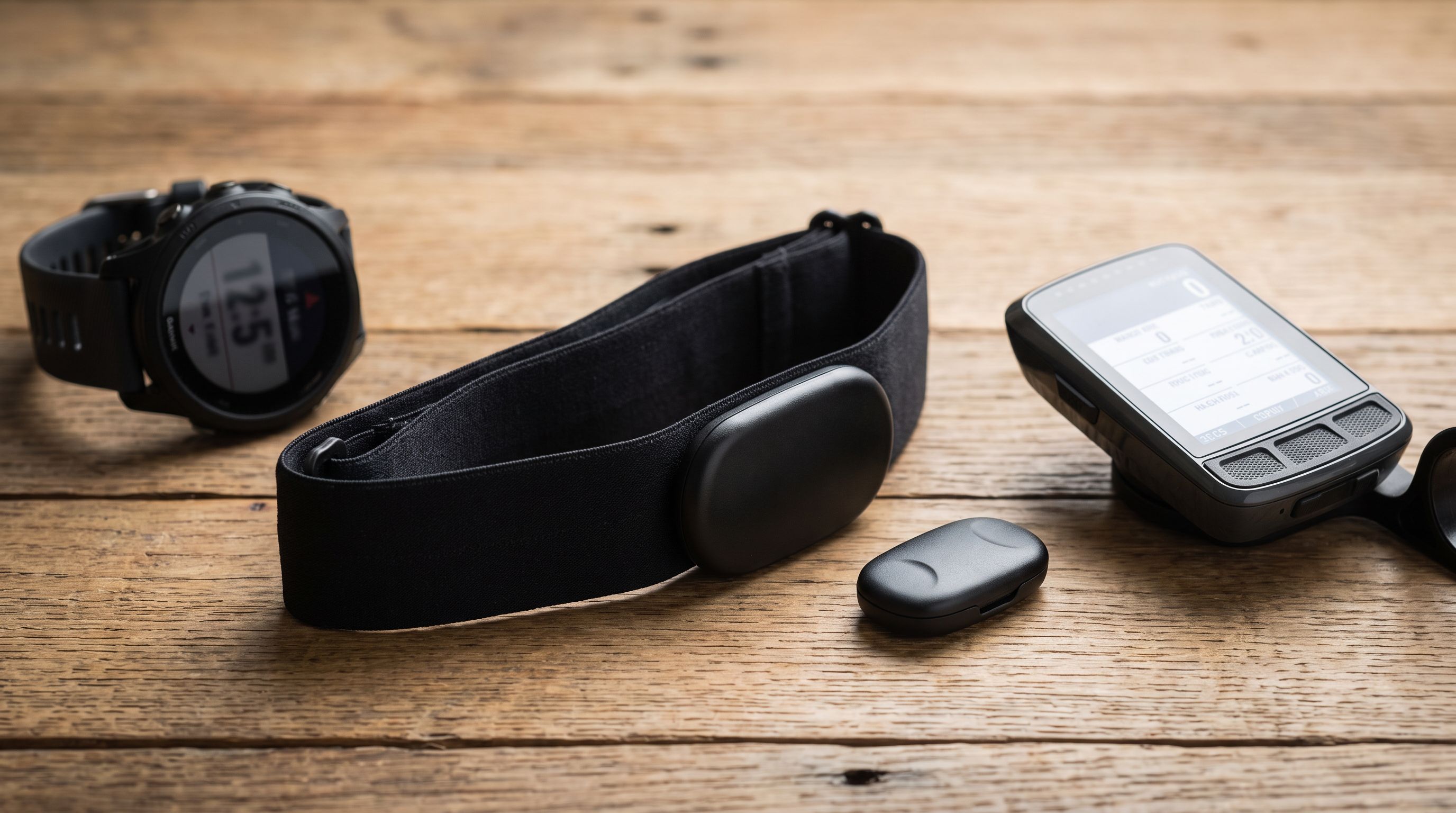
Reader-supported: we may earn a commission from links on this page, at no extra cost to you. It never affects our picks. Learn more.
Wrist-based heart rate has gotten genuinely good. Modern optical sensors on a Garmin, Apple Watch or Coros are fine for steady-state runs, easy rides and all-day resting heart rate trends. But the moment your effort changes quickly — a sprint interval, a hard surge up a climb, a set of kettlebell swings — the gap between wrist and chest opens up fast.
That's the whole argument for a strap in 2026. Not that watches are bad, but that they're solving a harder physics problem with worse tools.
Why a chest strap is still more accurate
A chest strap measures the electrical signal of your heart — essentially a single-lead ECG. A watch uses photoplethysmography (PPG): it shines light into your wrist and infers pulse from changes in blood volume. One reads the signal at the source; the other reads a downstream consequence through skin, tendon and motion.
That difference shows up in four predictable situations:
- Rapid changes in intensity. Optical sensors smooth and lag. Independent comparisons repeatedly show wrist HR trailing chest HR by several seconds and undershooting short intervals — which is exactly the data you care about in a VO2max or threshold session.
- High cadence motion. Rowing, jump rope, cycling on rough roads and lifting all cause "cadence lock," where the sensor latches onto your movement rhythm instead of your pulse.
- Cold weather. Peripheral blood flow drops in your hands and wrist. Chest readings are unaffected.
- Wrist flexion. Push-ups, barbell work and kayaking all squash the sensor against bone and tendon.
Where a chest strap doesn't help: resting HR, sleep tracking, HRV at night, and 24/7 trends. For those, a watch or ring is better simply because you'll actually wear it.
The other underrated benefit is beat-to-beat (RR interval) data. Proper HRV analysis — the kind used by apps like HRV4Training, Elite HRV and Polar's own recovery tools — needs clean RR intervals, and a good ECG strap delivers them far more reliably than an optical sensor.
How we evaluated these straps
BytePlaza doesn't physically test units. We compared manufacturer specifications, independent lab and field reviews from cycling and running publications, and verified long-term owner feedback — weighting four things in particular:
- Dual broadcasting. Bluetooth and ANT+. Bluetooth usually pairs with one device at a time; ANT+ broadcasts to unlimited receivers, which matters if you want your bike computer, Zwift and your watch all reading the same strap.
- Battery approach. Coin cell (long life, cheap replacement) versus rechargeable (no cells to buy, but needs remembering).
- Strap comfort and durability. The electrode strap, not the pod, is what fails first. Replaceable straps are a big deal.
- App ecosystem. Does it work beyond the maker's own platform?
The comparison at a glance
| Model | Connectivity | Power | Standout feature | Best for |
|---|---|---|---|---|
| Polar H10 | Bluetooth (2 channels) + ANT+ | Replaceable coin cell | Onboard memory for strap-only workouts; widely used as an accuracy benchmark | Almost everyone |
| Garmin HRM-Pro Plus | Bluetooth + ANT+ | Replaceable coin cell | Running dynamics, stored HR for swimming, treadmill pace/distance | Garmin watch owners |
| Wahoo TRACKR HEART RATE | Bluetooth + ANT+ | USB-C rechargeable | No coin cells, slim pod, broad third-party app support | Indoor trainers, gear minimalists |
| Garmin HRM-Fit | Bluetooth + ANT+ | Replaceable coin cell | Clips to a sports bra instead of a ribcage strap | Sports bra wearers |
| Polar H9 | Bluetooth + ANT+ | Replaceable coin cell | Core H10 experience at a lower tier | Budget buyers, gym classes |
 Budget pick · Polar H9 — Check price on Amazon →
 Best for sports bra wearers · Garmin HRM-Fit — Check price on Amazon →
 Best rechargeable · Wahoo TRACKR HEART RATE — Check price on Amazon →
 Best for Garmin users · Garmin HRM-Pro Plus — Check price on Amazon →
 Best overall · Polar H10 — Check price on Amazon →
The picks
Polar H10 — best overall
If you read enough comparison reviews, one pattern becomes impossible to miss: the Polar H10 is the thing other monitors get compared against. Multiple outlets, including Wirecutter and several cycling and running publications, treat it as the consumer accuracy reference, and it's been validated against medical ECG equipment in published research.
Practical reasons to pick it: dual Bluetooth channels (so you can feed Zwift and your watch simultaneously without ANT+), a grippy silicone-dotted strap that stays put, and onboard memory. That last one is quietly brilliant — you can record a swim or a gym session with the strap alone and sync it to Polar Flow later, no watch required. It also broadcasts ANT+, so bike computers and gym equipment see it instantly.
Downsides: Polar Flow is a fine app but not everyone's favourite, and the coin cell means occasional battery swaps.
Garmin HRM-Pro Plus — best if you already own a Garmin
The Garmin HRM-Pro Plus is the one to get if your watch has a Garmin logo on it. It unlocks running dynamics — vertical oscillation, ground contact time, stride length — that Garmin's wrist sensor can't produce on its own. It stores heart rate during swims and underwater activity (where Bluetooth and ANT+ won't transmit) and syncs it afterwards, and it broadcasts pace and distance indoors so treadmill runs are far less nonsense.
Cyclist magazine and other outlets consistently rate it as Garmin's flagship strap. It also broadcasts standard Bluetooth and ANT+, so it works with Zwift, TrainerRoad, Peloton and most third-party apps. It's a premium buy that makes the most sense inside Garmin's ecosystem.
Wahoo TRACKR HEART RATE — best rechargeable
Coin cells are cheap but they always die on the morning of a key session. The Wahoo TRACKR HEART RATE sidesteps that with USB-C charging and a manufacturer-quoted battery life measured in months of typical use. It's slim, dual-band, and — per Wahoo's own community and reviewers — plays nicely with basically every app that accepts a standard HR broadcast.
It's the natural choice for indoor training setups, where you're already charging a bunch of things anyway, and for anyone who'd rather top up a pod than keep CR2032s in a drawer.
Garmin HRM-Fit — best for sports bra wearers
The Garmin HRM-Fit solves a real ergonomic problem: a conventional strap under a sports bra can chafe, ride up or feel constricting. Instead, the HRM-Fit clips directly to the band of a medium- or high-support sports bra. It delivers the same running dynamics and stored-HR features as Garmin's other premium straps, and it's been named "best for women" in multiple 2026 round-ups.
The catch is compatibility — it needs a bra with a suitable band, and it's not a universal fit across every brand or cut.
Polar H9 — budget pick
The Polar H9 uses the same Polar Pro strap and the same dual Bluetooth/ANT+ broadcasting, but drops the onboard memory, the second Bluetooth channel and some of the advanced analytics. For gym classes, Zwift sessions and general training where you just need a reliable live HR number on one device, the difference from the H10 is small and the saving isn't.
Buying tips that actually matter
- Wet the electrodes before every workout. Dry electrodes are responsible for the vast majority of "my strap gives crazy readings in the first 10 minutes" complaints. Water or a dab of electrode gel fixes it.
- Don't over-tighten. Snug enough not to slide, loose enough to breathe. Too tight distorts the signal as much as too loose.
- Rinse the strap after use and let it air dry. Salt residue is what kills electrodes, not time.
- Replace the strap, not the pod. All the picks here use replaceable straps — a worn-out band is a cheap fix, not a new purchase.
- Check your app's pairing mode. If something will only connect over Bluetooth and you're already paired to a watch, you may need ANT+ or a second Bluetooth channel. This is where the H10 and dual-band straps earn their keep.
FAQ
Is a chest strap really more accurate than an Apple Watch or Garmin? For changing intensity, yes, consistently. For steady efforts and resting heart rate, a good modern watch is close enough that most people won't notice. Buy a strap because you do intervals, lift, row or ride — not because you want better sleep data.
Do I need ANT+ in 2026? Only if you use a bike computer, a gym machine, or want multiple devices reading one strap at the same time. Bluetooth alone covers phones and most watches. All five picks here do both, which future-proofs you either way.
Can I use a chest strap for swimming? Neither Bluetooth nor ANT+ transmits reliably underwater. The Garmin HRM-Pro Plus and Polar H10 store data onboard during swims and sync afterwards — that's the workaround.
How long do the batteries last? Coin-cell straps are generally rated in hundreds of hours of training; rechargeable ones like the Wahoo TRACKR are rated in months of typical use. Both are fine. Pick based on whether you'd rather swap a cell or plug in a cable.
Will one strap work with Zwift, Strava and my watch? Yes, with caveats. Strava records from your watch or phone, not the strap directly. Zwift and your watch can both read the strap simultaneously if you use ANT+ for one and Bluetooth for the other — or, with the Polar H10, two Bluetooth connections at once.
Armband instead of chest strap? Optical armbands like the Polar OH1+ sit between the two: more comfortable than a strap, more accurate than a wrist sensor, but still PPG-based and still prone to lag on hard intervals. A reasonable compromise if a chest strap genuinely bothers you.
Our picks
POLAR H10 Heart Rate Monitor Chest Strap - ANT + Bluetooth, Waterproof HR Sensor for Men and Women
The reference-grade ECG strap most lab comparisons benchmark against, with Bluetooth, ANT+ and onboard memory.
Garmin HRM 600
Adds running dynamics, stored HR for swims and treadmill pace broadcasting over ANT+ and Bluetooth.
Wahoo TRACKR Heart Rate Monitor
USB-C rechargeable pod with dual-band broadcasting — no coin cells to hunt for mid-training block.
Garmin HRM-Fit Heart Rate Monitor Purpose Built for Women
Clips to a medium- or high-support sports bra instead of circling the ribcage, with full Garmin metrics.
POLAR H9 Heart Rate Sensor
Same strap and dual Bluetooth/ANT+ broadcast as the H10, minus memory and advanced analytics.
Get the best tech deals in your inbox
Join the BytePlaza newsletter for hand-picked gadget deals and new buying guides. No spam, unsubscribe anytime.
Related reads
Smart Sleep Masks in 2026: 4 Picks That Earn Their Batteries
We compared smart sleep masks for 2026 on blackout fit, built-in audio, sunrise wake light and travel comfort — plus when a plain silk mask beats a smart one.

Wearable AI Recorders in 2026: 4 Picks That Actually Stick
Looking for the best AI voice recorder wearable in 2026? We compare Plaud, Anker Soundcore Work and Limitless on accuracy, battery, subscriptions and consent.
Sleep Trackers in 2026: Ring, Band or Under-Mattress Mat?
We compared the best sleep tracker options for 2026 — Oura Ring 4, Whoop, RingConn Gen 2 and Withings Sleep — on accuracy, subscriptions and useful data.