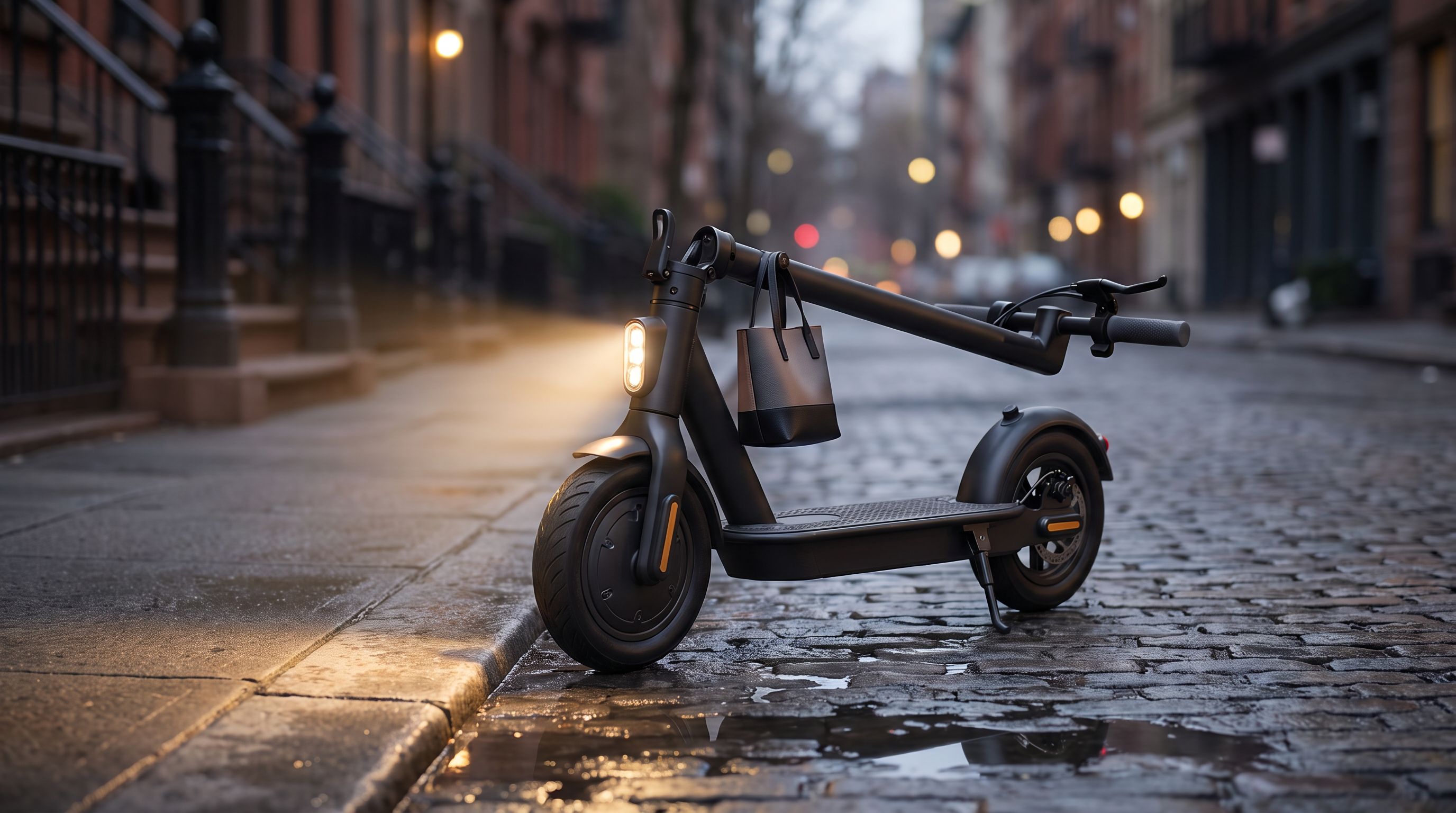
Electric Scooters in 2026: 5 Commuter Picks by Real Range
The best electric scooter 2026 picks for commuters, ranked by real-world range, motor power, weight and build quality — plus how to read inflated range claims.
Reader-supported: we may earn a commission from links on this page, at no extra cost to you. It never affects our picks. Learn more.
Range is the number every scooter brand shouts about, and it's the number most likely to disappoint you. A "40-mile" scooter tested at 165 lb, on flat ground, in eco mode, at 10 mph will not get you 40 miles in the real world. Plan on roughly 50–65% of the advertised figure for a typical adult rider in a mixed city commute, and less if you're over 200 lb or your route has hills.
We compared current commuter models on manufacturer specs, independent review-site range tests, and verified owner feedback, then sorted them by what actually matters for daily riding: usable range, motor power under load, folded weight, and build quality. Here's where we landed for the best electric scooter 2026 shortlist.
How we ranked these
Four criteria, weighted for commuters rather than thrill-seekers:
- Real-world range. We leaned on third-party range tests and owner reports rather than the spec sheet. Battery capacity in watt-hours (Wh) is a better predictor than the marketing number.
- Motor power. Nominal watts tell you cruising ability; peak watts tell you hill performance. Under 350W nominal struggles on inclines with a heavier rider.
- Weight and fold. Anything over about 45 lb stops being "carry up the subway stairs" and becomes "roll it and hope for an elevator."
- Build quality. Stem lock rigidity, tire type (tubeless beats tube beats solid for most commuters), brake hardware, and IPX water resistance.
The shortlist at a glance
| Model | Best for | Tire type | Braking | Carry friendliness |
|---|---|---|---|---|
| Segway Ninebot MAX G2 | All-round long commutes | 10" tubeless pneumatic, self-healing | Front drum + regen | Heavy — roll, don't carry |
| Segway Ninebot E3 Pro | Short-to-mid city hops | Tubeless pneumatic | Drum + regen | Easy to lift |
| NIU KQi3 Max | Rough pavement comfort | 9.5" tubeless pneumatic | Drum + E-ABS regen | Moderate |
| Gotrax G4 Pro | Budget range per dollar | 10" pneumatic | Disc + regen | Moderate-heavy |
| Segway GT3 Pro | Hills, speed, long distance | Large pneumatic, full suspension | Hydraulic discs | Not portable |
 Premium pick · Segway GT3 Pro — Check price on Amazon →
 Best value · Segway Ninebot E3 Pro — Check price on Amazon →
 Best overall · Segway Ninebot MAX G2 — Check price on Amazon →
Segway Ninebot MAX G2 — best overall
The MAX line has been the default long-range commuter recommendation for years, and the G2 is why. It pairs a big battery with a larger motor than the original MAX, adds front suspension, and runs 10-inch self-healing tubeless tires — the single most underrated commuter feature, because it means a staple or thorn usually doesn't end your week.
Reviewers consistently place it at or near the top of commuter roundups, and owner feedback repeats the same themes: it holds speed on moderate hills better than the outgoing MAX, the ride is noticeably smoother, and real-world range lands comfortably in the "ride all week, charge on Sunday" territory for a 5–8 mile each-way commute.
The trade-off is mass. This is not a scooter you casually carry three flights of stairs. If your commute involves lifting more than rolling, look at the E3 Pro instead.
Buy it if: you want one scooter that covers a 10+ mile round trip with margin, and you have somewhere to roll or store it.
Segway Ninebot E3 Pro — best value
The E3 Pro is the sensible answer for riders whose commute is three miles, not thirteen. It's lighter, cheaper, and still gets tubeless pneumatic tires plus a dual braking setup — two things budget scooters usually cut first.
Multiple 2026 roundups name it the value pick, and that tracks: you're giving up top speed and battery capacity, not safety hardware. For flat urban routes, last-mile-from-transit riding, or a second scooter for a partner, it's the most sensible money on this list.
Skip it if: your route has real hills or you're near the upper end of the weight limit. The smaller motor is where you'll feel it.
NIU KQi3 Max — best for rough roads
NIU's KQi3 Max carved out a loyal following for one reason: comfort without suspension. The wide deck, 9.5-inch tubeless tires and relatively plush setup absorb bad pavement better than the spec sheet suggests, and the drum brake plus regenerative E-ABS combination is low-maintenance — no pad changes, no rotor rub.
It sits between the E3 Pro and the MAX G2 on both range and weight, which makes it a good compromise pick if you want more than a basic city scooter but don't want to wrestle 50-plus pounds. Owner reports flag the app ecosystem and ride feel as highlights; the main criticism is that hill performance is adequate rather than strong.
Gotrax G4 Pro — best budget long-range
Gotrax's play has always been battery-per-dollar, and the G4 Pro continues it. One 2026 roundup names it best overall for adults in the US largely on value grounds. You get 10-inch pneumatic tires, a disc brake, and a battery big enough that the quoted range survives real-world derating better than you'd expect at this price.
Where it gives ground to Segway and NIU is in fit and finish: stem rigidity, app polish, and long-term parts support are all a step behind. If you ride daily for years, the premium models age better. If you need maximum range for minimum spend, this is the pick.
Segway GT3 Pro — premium pick
For riders with a long, hilly, or semi-rural commute — or anyone who simply wants performance headroom — the GT3 Pro is the superscooter that keeps showing up in 2026 best-of lists. Dual motors, full suspension, and hydraulic disc brakes turn a 15-mile commute with elevation into a non-event.
Be honest about the costs: it's heavy, it's expensive, it needs secure storage, and in many jurisdictions its top speed exceeds what's legal on bike lanes and sidewalks. Check your local rules before buying into this class.
Reading range claims without getting burned
A few practical rules:
- Divide by two as a default. Then adjust up if you're light and your route is flat, down if you're heavy or hilly.
- Watt-hours beat miles. Roughly 20–30 Wh per mile is a realistic consumption range for an adult commuter. A 550 Wh pack is therefore a genuine 18–27 miles, not 40.
- Cold kills range. Expect a 20–30% hit in near-freezing temperatures, and store the battery indoors.
- Round trips need margin. Buy for your round trip plus 30%, so you're not charging to 100% every night — which also prolongs battery life.
Don't skip the safety and legal basics
A helmet is non-negotiable; many riders also add gloves after their first gravel encounter. Check whether your city classifies e-scooters as bicycles, mopeds, or something else — speed caps, sidewalk bans, and helmet laws vary enormously between states and cities. And buy a proper U-lock or folding lock: scooter theft is the number one way these ownership stories end.
FAQ
What range do I actually need for commuting?
Take your one-way distance, double it, add 30%. A 4-mile each-way commute means you want a scooter that genuinely delivers about 10–11 miles, which usually means an advertised figure of 20+ miles.
Are tubeless tires worth it?
Yes, for most commuters. Tubeless pneumatic tires — especially self-healing ones like those on the Ninebot MAX G2 — resist punctures and are far easier to deal with than tubed tires when you do flat.
How long do e-scooter batteries last?
Typically several hundred full charge cycles before noticeable capacity loss — often two to four years of daily commuting. Avoiding 0% and 100% storage, and keeping the battery out of freezing garages, materially extends that.
Is a dual-motor scooter overkill for city riding?
For flat cities, yes — the extra weight and cost outweigh the benefit. Dual motors like the GT3 Pro's earn their keep on sustained hills, heavier riders, or longer suburban routes.
Can I ride in the rain?
Light rain, usually. Check the IP rating, avoid standing water and deep puddles, and brake earlier — pneumatic tires plus wet pavement plus a short wheelbase is a demanding combination.
Our picks
Segway Ninebot MAX G3 Plus/G3 / G2 Electric Scooter for Adult, UL Certified
Long-range commuter staple with self-healing tubeless tires, front suspension and a 10-inch wheelbase.
Segway Ninebot E2 Plus II/E2 Pro/E3 Pro Electric Scooter, Dual Braking System,Long Range,Foldable Adult Scooter, UL 2272 & 2271 Certified.
Lightweight city scooter with tubeless tires and dual braking at a far friendlier price than the MAX line.
NIU KQi3 Max
Wide deck, 9.5-inch tubeless tires and strong drum+regen braking make potholed commutes tolerable.
Gotrax G4 Pro
Big-battery budget pick with 10-inch pneumatic tires and a usable commuting range for the money.
Segway SuperScooter GT3, 31 MPH w/ 45-Mile Long Range, 2400W Peak Motor, Dual Hydraulic Suspension, Self-Sealing Tires, Flash Charging Electric Scooter for Adults, UL 2272/2271 Certified, Gen3
Dual-motor performance scooter with full suspension and hydraulic brakes for long, hilly commutes.
Get the best tech deals in your inbox
Join the BytePlaza newsletter for hand-picked gadget deals and new buying guides. No spam, unsubscribe anytime.
Related reads
16-Inch Laptop Backpacks in 2026: 5 Picks That Actually Protect
We compared 16-inch laptop backpacks on padding, suspended sleeves, USB pass-through and carry-on fit. Here are five picks that protect your machine in 2026.
Best Dash Cam 2026: 4K Front & Rear Picks Ranked
The best dash cam 2026 picks for 4K front and rear coverage, compared on night video, parking mode, cloud access and wiring — with a buying guide and FAQ.

Best GaN Chargers in 2026: 100W Picks for Laptops
The best 100W GaN chargers in 2026 for laptops, tested criteria explained: port layouts, power splitting, travel size, and which models actually deliver full wattage.