Which Air Quality Monitor Should You Buy in 2026?
The best air quality monitor for your home in 2026, compared on CO2 sensor type, PM2.5 accuracy and smart-home integration — plus which pairs best with a purifier.
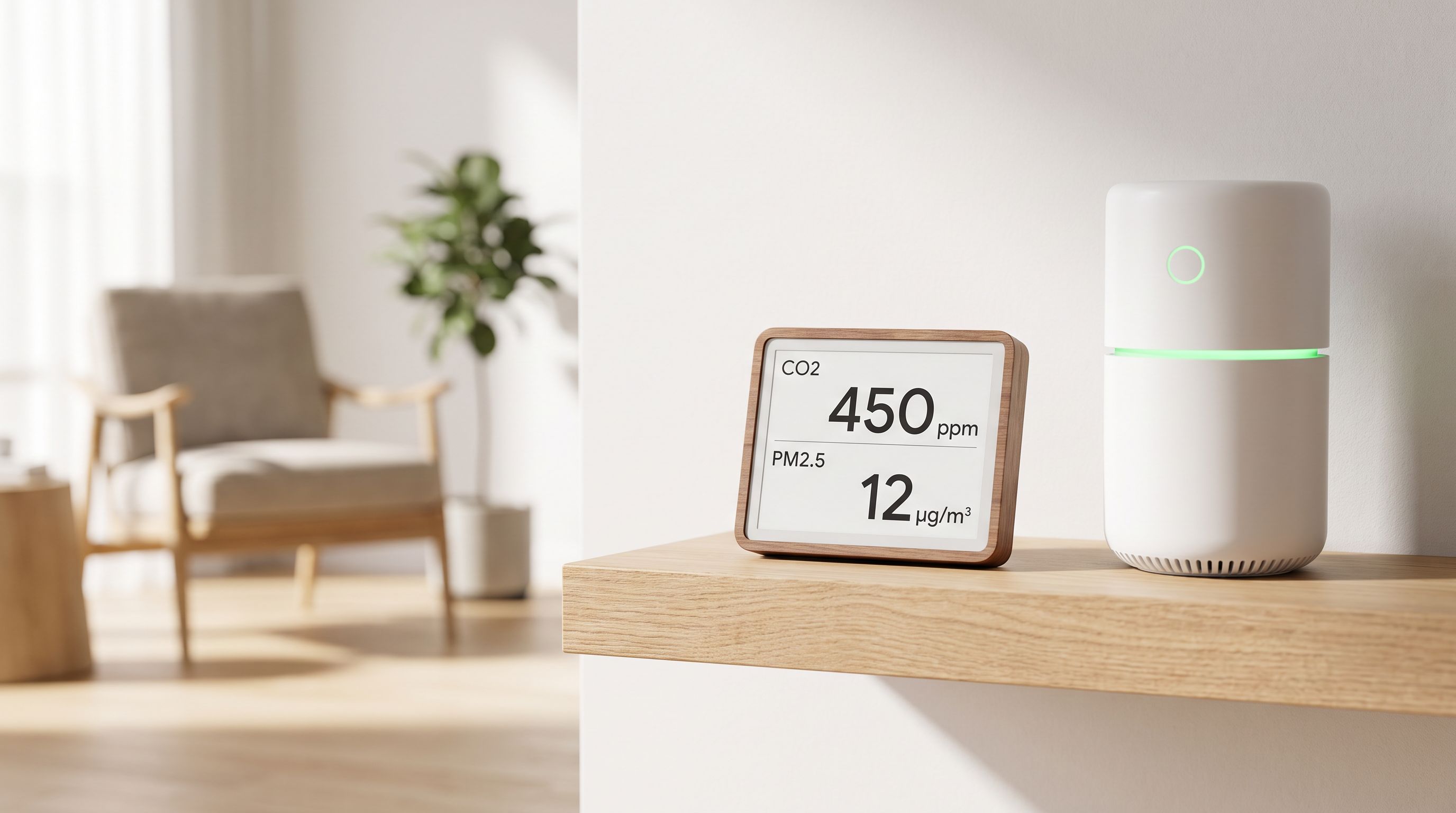
Reader-supported: we may earn a commission from links on this page, at no extra cost to you. It never affects our picks. Learn more.
If you already own an air purifier, a monitor isn't a gadget — it's the feedback loop. It tells you whether the purifier is actually keeping up, which room needs it most, when to crack a window, and whether that "auto" mode is doing anything useful. It also catches the pollutant your HEPA filter completely ignores: carbon dioxide.
We compared the leading consumer monitors on sensor hardware, what they actually measure, and how well they plug into a smart home. Here's how to choose.
The two numbers that matter most
PM2.5 is fine particulate matter — cooking smoke, wildfire haze, dust, candle soot. This is what your purifier removes. Consumer monitors measure it with a laser scattering sensor (an optical particle counter), which estimates mass concentration from how particles scatter light. These are good at showing relative change — a spike when you sear a steak, a fall after the purifier runs — but they're not calibrated reference instruments. Humidity can inflate readings, and different sensor firmware disagrees with each other by meaningful margins.
CO2 is the ventilation proxy. HEPA filters and carbon do nothing for it. It rises with occupancy and falls with fresh air, and elevated levels correlate with drowsiness and worse cognitive performance. Crucially, CO2 is where sensor type separates the honest devices from the misleading ones:
- NDIR (non-dispersive infrared) sensors genuinely measure CO2. This is what you want.
- eCO2 / "estimated CO2" is derived from a VOC sensor. It is a guess. A blast of hairspray or alcohol wipes can send it to 3,000 "ppm" with no real CO2 change.
If a cheap monitor claims CO2 but the spec sheet never says NDIR, assume eCO2 and treat the number as decorative. The Aranet4 HOME built its reputation precisely on getting this right — a true NDIR sensor, an e-ink screen, and a battery life measured in years rather than hours, so you can carry it from bedroom to office to a restaurant without thinking about charging.
 Best CO2 monitor · Aranet4 HOME — Check price on Amazon →
The secondary metrics
TVOC (total volatile organic compounds) is useful as a trend — it spikes with cleaning products, new furniture off-gassing, or paint — but the absolute number is not a health metric. Radon, formaldehyde-specific and NO2 sensors appear on some models; treat single-gas consumer sensors as directional indicators, not lab results. Temperature and humidity are simple, reliable, and genuinely actionable if you're managing mold risk or comfort.
How the top monitors compare
| Model | CO2 sensor | PM measurement | Display | Smart-home / data |
|---|---|---|---|---|
| Aranet4 HOME | NDIR | None | E-ink, always-on | Bluetooth app; third-party integrations available |
| Qingping Air Quality Monitor Gen 2 | NDIR | PM2.5 + PM10 laser | Colour touchscreen | Wi-Fi, Apple Home, Home Assistant, Mi Home |
| AirGradient ONE | NDIR | PM laser (open hardware) | LED matrix / OLED | Local API, MQTT, Home Assistant, open-source firmware |
| IQAir AirVisual Pro | NDIR | Laser PM2.5 | Large colour LCD | Wi-Fi, IQAir cloud + outdoor AQI comparison |
| SmartAir QP Pro | No | Laser particle counter | Small LCD | Standalone / handheld |
 Premium pick · IQAir AirVisual Pro — Check price on Amazon →
 Best for data nerds · AirGradient ONE — Check price on Amazon →
 Best overall · Qingping Air Quality Monitor Gen 2 — Check price on Amazon →
Feature sets change with firmware and hardware revisions — check the current listing before buying.
Our picks, and who each one is for
Best overall: Qingping Air Quality Monitor Gen 2
For most people who already own a purifier, this is the sweet spot. You get NDIR CO2 alongside PM2.5, PM10, TVOC, temperature and humidity on one legible touchscreen, and — the part that matters for automation — it exposes those readings to Apple Home and Home Assistant. That means you can trigger a smart plug to spin the purifier up when PM2.5 crosses a threshold, or fire a phone notification when CO2 passes 1,000 ppm. Independent reviewers repeatedly rank it as the best all-round consumer unit, and the reason is coverage: it's the fewest devices to buy for the most complete picture.
Best CO2 monitor: Aranet4 HOME
If you already own a purifier with a decent onboard particle sensor, the gap in your data is ventilation — and the Aranet4 fills it better than anything else at consumer scale. The e-ink display is readable at a glance without backlighting, the battery lasts long enough that you'll forget it needs any, and it's small enough to live in a bag. It's the device researchers and ventilation advocates reach for, and there's a reason it shows up at the top of nearly every 2026 round-up. The trade-off is scope: no particulate sensor at all. Pair it with your purifier's own display and you've covered both halves.
Best for data nerds: AirGradient ONE
Open-source hardware and firmware, a documented local API, and no obligation to route your data through anyone's cloud. If you run Home Assistant, InfluxDB or Grafana and want years of retained history, this is the one that won't fight you. It's also repairable and sensor-upgradeable in a way sealed consumer devices aren't. Independent reviews have made it a top pick partly on breadth of pollutants covered. Expect a slightly more hands-on setup than a plug-and-play consumer box.
Premium pick: IQAir AirVisual Pro
A big, dashboard-style colour display, laser PM2.5, NDIR CO2, and useful indoor-versus-outdoor comparison so you know whether opening a window will help or hurt. It's aimed at households in wildfire regions or dense urban areas where the outdoor baseline swings hard, and it's a top choice in several 2026 comparison guides. It's the least fiddly premium option if you want a permanent, at-a-glance display in a living room.
Budget PM2.5 pick: SmartAir QP Pro
Sometimes you don't need a permanent installation — you need to walk around and find out which room is worst, whether the bedroom purifier is undersized, or how long the kitchen takes to recover after frying. A handheld laser particle counter like the QP Pro answers those questions cheaply. No CO2, no smart-home hooks, no history worth mentioning. That's fine; it's a diagnostic tool, not a dashboard.
Buying advice: three things people get wrong
1. Placing it next to the purifier. The purifier's clean-air outlet will read beautifully and tell you nothing about the room. Put the monitor at breathing height, a couple of metres away from both the purifier and any window, vent or cooktop.
2. Expecting lab accuracy. Consumer PM sensors drift and disagree. Use them for trends and thresholds, not for absolute compliance numbers. If two monitors in the same room differ by 20–30%, that's normal, not a defect.
3. Ignoring the integration question. A monitor that can't talk to your automation platform is a monitor you'll check for two weeks and then ignore. If you want the purifier to react automatically, buy something with Home Assistant, Matter or HomeKit support — this is where Qingping and AirGradient pull ahead.
FAQ
Do I need a monitor if my purifier already has an air quality sensor? Often, yes. Built-in sensors sit inside the airflow path and are tuned to drive auto mode, not to report accurate room-wide readings — and almost none measure CO2. A separate monitor tells you whether the purifier is actually winning.
What CO2 level should I worry about? Outdoor air sits around 420 ppm. Below roughly 800 ppm indoors is well ventilated; 1,000–1,500 ppm suggests you should open a window or boost ventilation; sustained levels above that are a strong signal of poor fresh-air exchange.
Are the cheap CO2 monitors on Amazon any good? Many use eCO2 estimated from a VOC sensor rather than a real NDIR sensor. If the listing doesn't explicitly say NDIR, be sceptical — the reading can swing wildly from perfume or cleaning spray.
Can a monitor automatically control my purifier? Yes, if both sides support it. The common route is a monitor exposed to Home Assistant or Apple Home, plus a smart-plug or natively connected purifier, with a PM2.5 threshold as the trigger.
Do these sensors need calibrating? NDIR CO2 sensors typically self-calibrate by assuming the lowest reading over a period equals outdoor baseline — which requires the device to see fresh air periodically. PM sensors generally can't be user-calibrated and slowly drift over years.
Our picks
Aranet4 Indoor Air Quality Monitor, Wireless CO2 Detector for Home, Office | 4-year battery life, NDIR sensor. Tracks carbon dioxide, temperature, humidity, and pressure in real time. E-ink screen
True NDIR CO2 sensor, e-ink display and years of battery life — the reference for ventilation checks.
qingping Air Quality Monitor Gen 2, Air Quality Monitor Indoor Detects PM2.5, CO2, PM10, Noise, Temperature and Humidity, New Upgraded Alarm Clock Function, Air Quality Tester for Bedroom, Smart Home
CO2, PM2.5, PM10, TVOC and more on a bright touchscreen, with HomeKit and Home Assistant support.
Amazon Smart Air Quality Monitor, Detects temperature, humidity, carbon monoxide, PM2.5 and VOCs, Get notifications when air quality drops, Works with Alexa
Open-source, locally controllable monitor with dual PM sensors option and full API access for automations.
IQAir Air Quality Monitor Indoor, Swiss Design, Professional Grade, Detects PM2.5, CO2, AQI, Temperature, Humidity, Indoor Air Quality Real-Time Air Quality & Forecasting, Historic Data
Laser PM2.5 plus NDIR CO2 with a large display and long-term trend logging for serious households.
SmartAir QP Pro
Simple, affordable laser particle counter for spot-checking rooms and verifying purifier performance.
Get the best tech deals in your inbox
Join the BytePlaza newsletter for hand-picked gadget deals and new buying guides. No spam, unsubscribe anytime.
Related reads
Smart Blinds in 2026: Retrofit Picks That Beat Replacing
Comparing the best smart blinds 2026 options: retrofit motors like SwitchBot Blind Tilt vs made-to-measure shades, on Matter/Thread, solar charging and noise.
Smart Garage Door Openers in 2026: 4 Retrofit Picks
The best smart garage door opener controllers for 2026, compared on Matter and HomeKit support, sensor reliability, local control and whether you need a subscription.
Best Air Purifier 2026: HEPA Picks for Every Room Size
The best air purifier 2026 picks by room size — compare CADR, HEPA filter cost per year, noise and smart app control for allergy and wildfire smoke season.