USB-C DAC Dongles in 2026: When They Actually Help
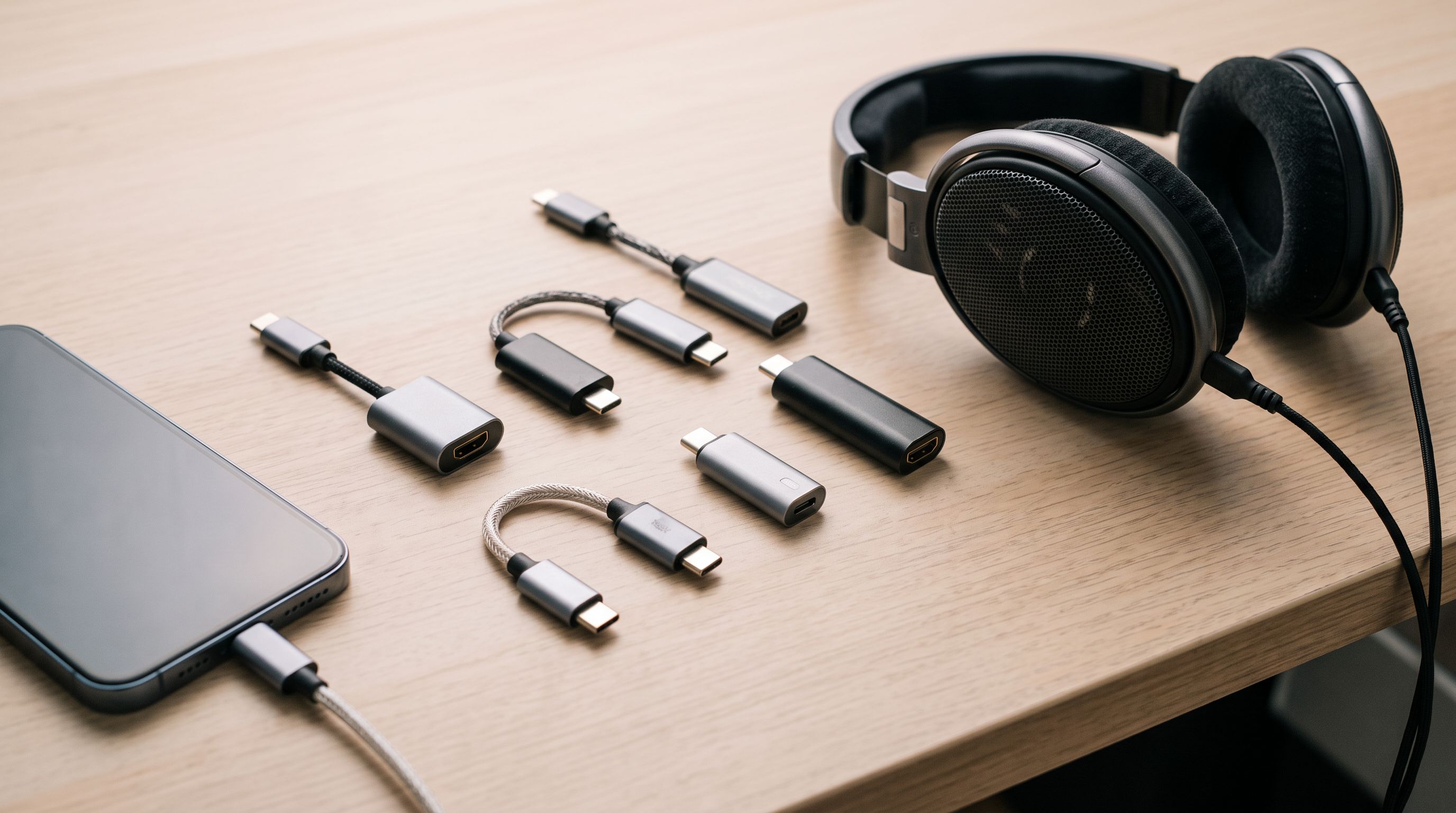
Do you really need a USB-C DAC dongle in 2026? We compare dongle DACs and portable amps by price tier, and explain when they measurably improve wired headphones.
Reader-supported: we may earn a commission from links on this page, at no extra cost to you. It never affects our picks. Learn more.
Phones stopped shipping headphone jacks years ago, and the market filled the gap with a confusing spread of USB-C dongles — from a few dollars to well over a thousand. The marketing language is nearly identical across that entire range: "hi-res," "32-bit/768kHz," "audiophile-grade." The actual audible difference between tiers is much smaller than the price gap suggests, but it is not zero, and it depends almost entirely on which headphones you plug in.
This guide sorts out when a USB-C DAC dongle or portable amp genuinely changes what you hear, and when you're buying a number on a spec sheet. Our rankings come from comparing manufacturer specs, independent measurement databases, and owner feedback — BytePlaza doesn't physically test units.
The short version
A dongle DAC does two jobs: convert digital audio to analog (the DAC part), and drive your headphones (the amp part). In 2026, the DAC half is essentially a solved problem. Even sub-$10 adapters using commodity chips measure well past the threshold of audibility for distortion and noise. The amp half is where real differences live.
So the practical question isn't "is this DAC better?" It's:
- Can it play loud enough with your headphones, without clipping or running out of volume steps?
- Is its output impedance low enough that your multi-driver IEMs don't get a tilted frequency response?
- Is its noise floor low enough that sensitive IEMs stay silent between tracks?
- Does it have the jack you need — 3.5mm single-ended, 4.4mm balanced, or both?
Everything else — the chip brand, the sample rate ceiling, the "custom firmware" — is secondary.
When a dongle measurably helps
You have full-size headphones with real power demands. Anything in the 250–600 ohm range (classic Beyerdynamic, Sennheiser HD 6-series variants) or a modern planar magnetic will sound thin, dynamically flat, and just plain quiet from a phone's built-in output or a basic adapter. This is the single most common case where an upgrade is obvious rather than subtle.
You have very sensitive IEMs and hear hiss. Some sources have a noise floor you can hear during quiet passages with efficient in-ears. A dongle with a properly low noise floor fixes it.
Your IEMs are multi-driver balanced armature or hybrid designs. These have impedance curves that swing across the frequency range. Plug them into a source with high output impedance and the frequency response shifts audibly — usually a bloated or thinned bass. The rule of thumb is that source output impedance should be under roughly 1/8th of the headphone's impedance. Dongles like the iFi GO link Max are built specifically with this in mind.
 Best for finicky IEMs · iFi GO link Max — Check price on Amazon →
Your laptop's jack is genuinely bad. Some Windows ultrabooks have audible interference — coil whine bleeding into the headphone out, or noise that changes when you scroll. A dongle bypasses the internal audio entirely.
When it mostly doesn't
If you're using efficient, easy-to-drive IEMs or consumer over-ears, and your current source plays plenty loud without hiss, an expensive dongle is unlikely to change anything you can reliably hear. The Apple USB-C to 3.5mm Headphone Jack Adapter is the honest benchmark here — it measures cleanly, has low output impedance, and costs almost nothing. It's not powerful, but for IEMs it's genuinely competent, and it's the reference point every $150 dongle needs to justify itself against.
 Budget pick · Apple USB-C to 3.5mm Headphone Jack Adapter — Check price on Amazon →
If the Apple adapter already drives your headphones to uncomfortable volume with no hiss, the upgrade you want is probably better headphones, not a better dongle.
Price tiers: what each one actually buys you
| Tier | What you get | Best for | Example |
|---|---|---|---|
| Entry (~$10) | Clean DAC, modest output, 3.5mm only, low output impedance | IEMs, earbuds, casual listening | Apple USB-C to 3.5mm Headphone Jack Adapter |
| Value (~$25–60) | Noticeably more power, better volume control, sometimes a gain switch | IEMs plus easier over-ears; phone + laptop dual use | FiiO KA11 |
| Mid (~$70–150) | Balanced 4.4mm out, lower noise floor, sturdier build, app control | Multi-driver IEMs, mid-tier planars | iFi GO link Max |
| Premium (~$200+) | Serious amplification, high/low gain, both jack types | Hard-to-drive headphones on the move | Questyle M15i |
| Portable DAC/amp (~$200+) | Battery or desktop mode, much higher output, Bluetooth, screen | 300Ω+ dynamics, demanding planars, desk + travel | FiiO BTR17 |
 Best portable DAC/amp · FiiO BTR17 — Check price on Amazon →
 Premium pick · Questyle M15i — Check price on Amazon →
 Best value upgrade · FiiO KA11 — Check price on Amazon →
Picking the right one for your headphones
For IEMs and easy headphones
Start cheap. The Apple adapter or a FiiO KA11 covers this comfortably. The KA11 is the better pick if you want a bit of headroom, a slightly more solid cable, and something that also works well plugged into a laptop or a Switch-style handheld. It's the classic "just upgrade the jack" purchase and it's the one most owners say they stopped upgrading past.
For sensitive multi-driver IEMs
Output impedance and noise floor matter more than power. The iFi GO link Max is a common recommendation here because it pairs a low-impedance output with a 4.4mm balanced jack, which is useful if your IEM cable is already terminated that way. Balanced output isn't magic — it typically just gives you more voltage swing — but on a dongle that extra headroom is real.
For planars and high-impedance over-ears
This is where you stop being able to fake it. The Questyle M15i uses current-mode amplification and offers a gain switch, which is the practical difference between "loud enough" and "loud enough with dynamics intact." If you own something like an HD 600-series or a 300+ gram planar and you're listening away from a desk, this tier is the honest minimum.
If you want more, step up to a proper portable DAC/amp. The FiiO BTR17 has a desktop mode that unlocks higher output when it's plugged into power, plus Bluetooth for when you don't want a cable at all. It's bulkier than a dongle — it's a small brick you clip to a bag or leave on a desk — but it drives headphones no dongle can.
For travel and battery life
Dongles draw power from your phone. A high-output dongle running hard on a long flight will visibly dent your battery. A battery-powered unit like the BTR17 sidesteps that entirely, at the cost of one more thing to charge.
Specs that don't deserve your attention
- 768kHz/32-bit support. No commercial music is distributed at these rates. It costs the manufacturer nothing to list.
- DAC chip name-dropping. Implementation — power supply, output stage, clocking — matters far more than the chip model.
- MQA. Largely a dead format in 2026. Don't pay a premium for it.
- THD+N figures quoted without load. A number measured into a high impedance load tells you little about how the dongle behaves with your actual headphones.
What is worth reading: rated output power at a stated impedance, output impedance, and whether there's a hardware gain switch.
A realistic upgrade path
- Buy the cheap adapter first. Live with it for two weeks.
- If you hear hiss, or run out of volume, or your bass sounds off with multi-driver IEMs — then upgrade, and target the specific problem.
- If none of those apply, spend the money on headphones or a better source file. That's where the audible gains are.
That advice is boring, but it's the pattern that shows up over and over in long-term owner reports: people who upgraded because of a specific, identifiable problem stayed happy; people who upgraded on spec-sheet faith usually kept upgrading.
FAQ
Does a dongle DAC improve Bluetooth headphones? No. Bluetooth headphones do their own conversion internally. A dongle only affects wired connections.
Is balanced 4.4mm actually better than 3.5mm? On portable gear, balanced mostly means more available voltage, which helps with power-hungry headphones. With efficient IEMs you're unlikely to hear a difference, and you'll need a cable terminated in 4.4mm.
Will a dongle drain my phone battery? Yes, somewhat — more so when driving demanding headphones loudly. Low-power dongles are negligible; high-output ones are noticeable on long sessions. Battery-powered DAC/amps avoid the issue.
Do I need an app or driver? On Android, iOS and macOS, USB audio class devices generally work plug-and-play. Windows sometimes needs a driver for the highest sample rates, and some brands offer an optional app for EQ or filters. None of it is required for basic playback.
Is an expensive dongle better than a cheap one for Spotify or YouTube? Only if it solves a power, noise or impedance problem. Lossy streaming doesn't become high-resolution because of better hardware downstream.
Our picks
USB-C to 3.5mm Audio Headphone Adapter - HiFi 2 Pack Compatible with Apple iPhone 17 16 15 Samsung Galaxy S25 S24 S23 S22 S21 Plus Pro Max Ultra Pixel iPad - Type C to Aux Cord Jack Dongle Adapter
Cheap, tiny, and measurably clean — the baseline every pricier dongle has to beat.
FiiO KA11 USB C to 3.5mm Audio Adapter 32bit/384KHz, USB Type C Dongle HiFi DAC Amplifier for Android/iOS/Windows/Mac (Silver, TC)
Adds real output power and a 3.5mm jack in a keychain-sized body, with no app fuss.
Questyle M15i Electro Purple Headphone Amplifier with DAC USB C Amps
Current-mode amplification and high/low gain for demanding planars, with 3.5mm and 4.4mm out.
iFi Audio Go Link Max - Portable Headphone Amp/DAC Dongle USB-C to 3.5/4.4mm - Plug and Play Hi-res Audio with Dynamic Range Enhancement - PCM 384kHz/DSD256
Low output impedance, balanced 4.4mm, and a sturdy cable that survives pocket life.
FiiO BTR17 Bluetooth 5.4 USB DAC AMP with LDAC, aptX Lossless. Dual ES9069Q, 10-Band PEQ, THX AAA 78+amps 3.5mm Unbalanced & 4.4mm Balanced (Blue)
Desktop-mode power, Bluetooth and USB modes, and a screen — for headphones dongles can't drive.
Get the best tech deals in your inbox
Join the BytePlaza newsletter for hand-picked gadget deals and new buying guides. No spam, unsubscribe anytime.
Related reads
Portable Bluetooth Speakers in 2026: Pocket to Party
The best portable Bluetooth speaker 2026 picks, ranked by size — from pocket-size to party-size — compared on battery life, IP rating and real-world loudness.
Mic Arms in 2026: 5 Picks That Kill Desk Thump
The best microphone boom arm stops keyboard clatter and desk thumps. We compare RØDE PSA1+, Elgato Wave Mic Arm LP, Blue Compass and more for USB and XLR mics.
Prime Big Deal Days 2026: Headphone Deals Worth Waiting For
Prime Big Deal Days 2026 runs Oct 6–7. Here's what a genuinely good headphone or earbud discount looks like, plus the AirPods, Sony, Bose and budget models to watch.